The global shrimp industry is operating in an environment that grows harder to predict. Geopolitical volatility, trade barriers, rising feed costs, climate change and restructuring across major producing countries are all bearing down on the supply chain at once.
That was the picture drawn at the opening session of the Global Shrimp Forum 2026, held in Utrecht, the Netherlands. This year's event brought together more than 550 delegates from over 40 countries. Notably, more than half of those attending had been to at least four previous editions - a sign that the Global Shrimp Forum has become an important meeting point for the world's shrimp sector.
When shrimp becomes a geopolitical game
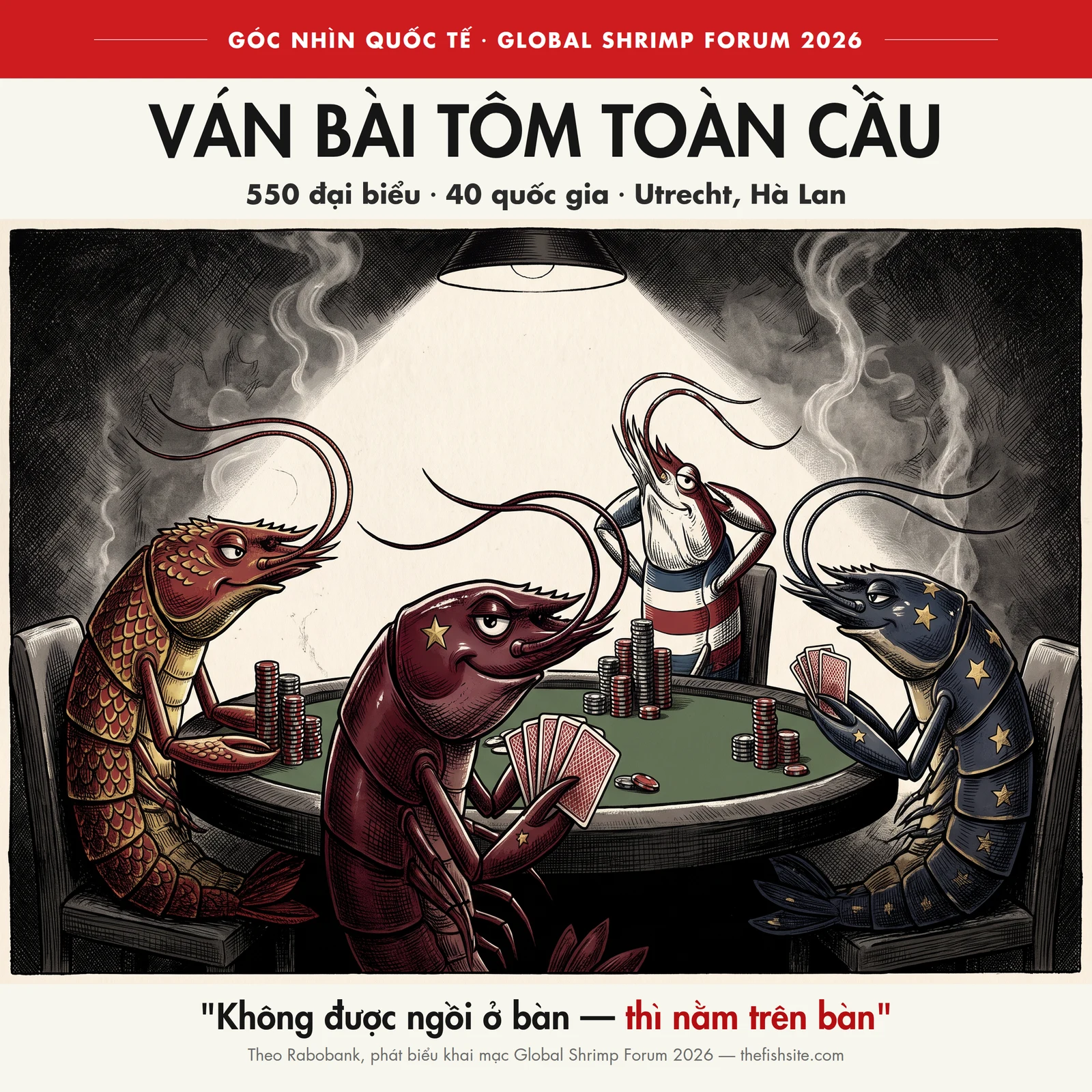
Jan Lambregts, Global Head of Economics and Markets at RaboResearch, used the image of a card game to describe today's economic order.
In this game, the United States still holds the strongest cards, thanks to the size of its consumer market and the dominant role of the US dollar. China, for its part, holds the advantage in manufacturing capacity, industrial scale and control over many critical links in the supply chain.
As competition between the world's two largest economies intensifies, businesses caught between the two poles face a more complex operating environment. Trade alliances can shift, tariffs can be imposed quickly, and supply chains risk disruption from disputes that have nothing to do with seafood.
Europe, too, faces the challenge of finding its place in a trading order increasingly shaped by the United States and China. For shrimp businesses, this means producing well is no longer enough. They must also understand trade policy, manage risk and deliberately build multiple market options.
Tariff risk from the US market
US trade policy remains one of the most closely watched issues at the forum.
Robert DeHaan, Executive Vice President and General Counsel at the National Fisheries Institute, pointed to the US Section 301 investigation into "excess production capacity". The investigation targets 16 economies, nine of which currently supply shrimp to the US market.
What worries the shrimp sector is that new tariff measures are not necessarily confined to the industries originally under investigation. Shrimp could be swept into a broader trade dispute even when the root cause lies in entirely different industries.
For countries heavily dependent on the US market, this is a clear warning: concentrating too much volume in a single market can create systemic risk.
India accelerates market diversification
India is among the countries most visibly exposed to the uncertainty of US trade policy.
Choudary Karuturi, Managing Director of Apex Frozen Foods, said tariff concerns have pushed the Indian shrimp sector to steadily reduce its reliance on the United States. Exports to Europe are rising, while new trade agreements may open opportunities in other markets.
India's strategy is not simply to find a replacement for the US market. The country needs a more balanced market structure, in which product can be directed to different regions according to size, degree of processing and standards requirements.
That shift cannot happen overnight, however. The European market has its own requirements for traceability, food safety, environmental performance and social responsibility. Companies looking to expand there must invest in certification, raw-material areas, control systems and suitable processing capability.
Market diversification, then, is not merely a change of buyer. It is an adjustment of the entire value chain.
Ecuador enters a phase of large-scale consolidation
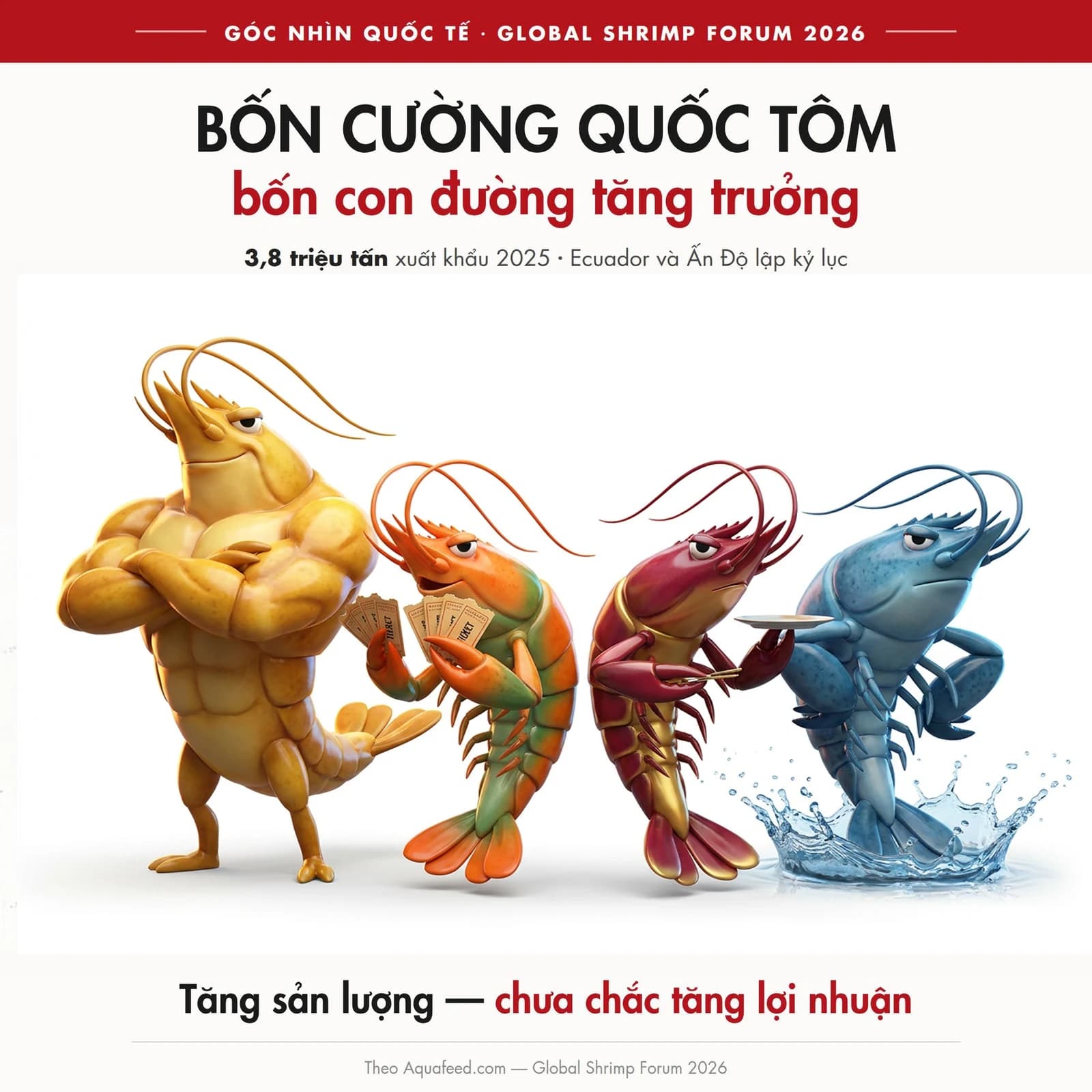
After roughly a decade of rapid growth, Ecuador's shrimp industry is moving into a new phase: greater scale, deeper integration and a focus on efficiency.
Sandro Coglitore, General Manager of Omarsa, said the company's operating area has grown from about 3,900 hectares two years ago to more than 10,000 hectares. Omarsa has also expanded production into Panama and Nicaragua while strengthening the links between farming areas, processing and distribution.
This reflects the consolidation now under way across Ecuador's shrimp sector. Large companies are not only buying more ponds but also seeking to control more stages of the value chain.
An integrated model gives a company command over raw material, quality standards, harvest scheduling, plant capacity and sales planning. When markets turn volatile, a business with a closed production chain can also react faster.
Consolidation can, however, put pressure on smaller operators. As scale, technology and capital become decisive competitive advantages, those unable to invest will have to find partners, join a linked chain, or face being pushed out of the market.
Indonesia strengthens links across the production chain
Indonesia is seeing a trend towards integration similar to Ecuador's, although its industry structure and company sizes differ considerably.
According to Liris Maduningtyas, CEO of JALA, the connections between hatcheries, farming areas and processing plants in Indonesia are becoming tighter.
This is an important shift. When the links operate in isolation, information on seed quality, disease, growth rates and market demand tends to break down along the way. Stronger integration allows companies to track the whole production process more effectively, from post-larvae to finished product.
Farm data can also be used to forecast output, optimise harvest scheduling and help processing plants plan raw-material supply more accurately. Over the longer term, these linkages could help Indonesia lift productivity and improve traceability.
El Nino has not hit directly yet, but pressure is building
Producers say they have not yet recorded a major direct impact on shrimp output. Indirect effects have begun to appear, however, particularly through tighter fishmeal supply and rising aquafeed prices.
This matters because feed typically accounts for the largest share of shrimp production costs. Rising raw-material prices can quickly erode farmer margins, especially in periods when raw shrimp prices do not rise in step.
In Indonesia, some farming areas have recorded higher salinity and growing pressure from acute hepatopancreatic necrosis disease. The scale of the impact remains limited so far, but it signals that climate change can reach the shrimp sector through several different routes.
Beyond changing water temperature, farmers also face shifts in salinity, water quality, disease, feed raw materials and energy costs. Managing climate risk therefore cannot be separated from managing nutrition, pond environment and biosecurity.
No country can sit this one out
The overarching message of the opening session was that the shrimp industry is entering a period in which every country and every business must actively choose a strategy.
India is seeking to diversify its markets to reduce dependence on the United States. Ecuador is expanding scale and deepening value-chain integration. Indonesia is strengthening the links between hatcheries, farms and processing. Meanwhile, the whole industry must prepare for fresh volatility from tariffs, geopolitics, El Nino and feed raw-material prices.
In this new game, the advantage will not belong solely to the country that produces the most shrimp or produces it most cheaply. It will belong to the businesses that can:
Spread risk across multiple markets;
Exercise tighter control over the supply chain;
Use data to improve production efficiency;
Manage disease and the environment proactively;
Build processing and distribution capability;
Adapt quickly when trade policy changes.
The world shrimp industry still has room to grow, but the road ahead will not be smooth. Companies cannot control geopolitics or the climate, but they can decide how well prepared they are, how quickly they adapt, and how they build resilience into their own production chain.
That is perhaps the most important card any business now holds.
Source: thefishsite.com - Global Shrimp Forum 2026, Utrecht, the Netherlands.