Working hours: Mon - Fri | 08:00 - 17:00HOTLINE: 0867 95 7568
📘 Official technical document

Microbiome Farm Protocol

Prevention beats treatment — by building a microbial ecosystem across the entire crop.

Version: 2026.04·For: Whiteleg shrimp (P. vannamei) + Black tiger shrimp
The full document covers:1. Challenges2. Three layers, one stable pond3. Crop map4. 5 solution pillars5. Customer success6. References
01/ 06

Challenges shrimp farmers face

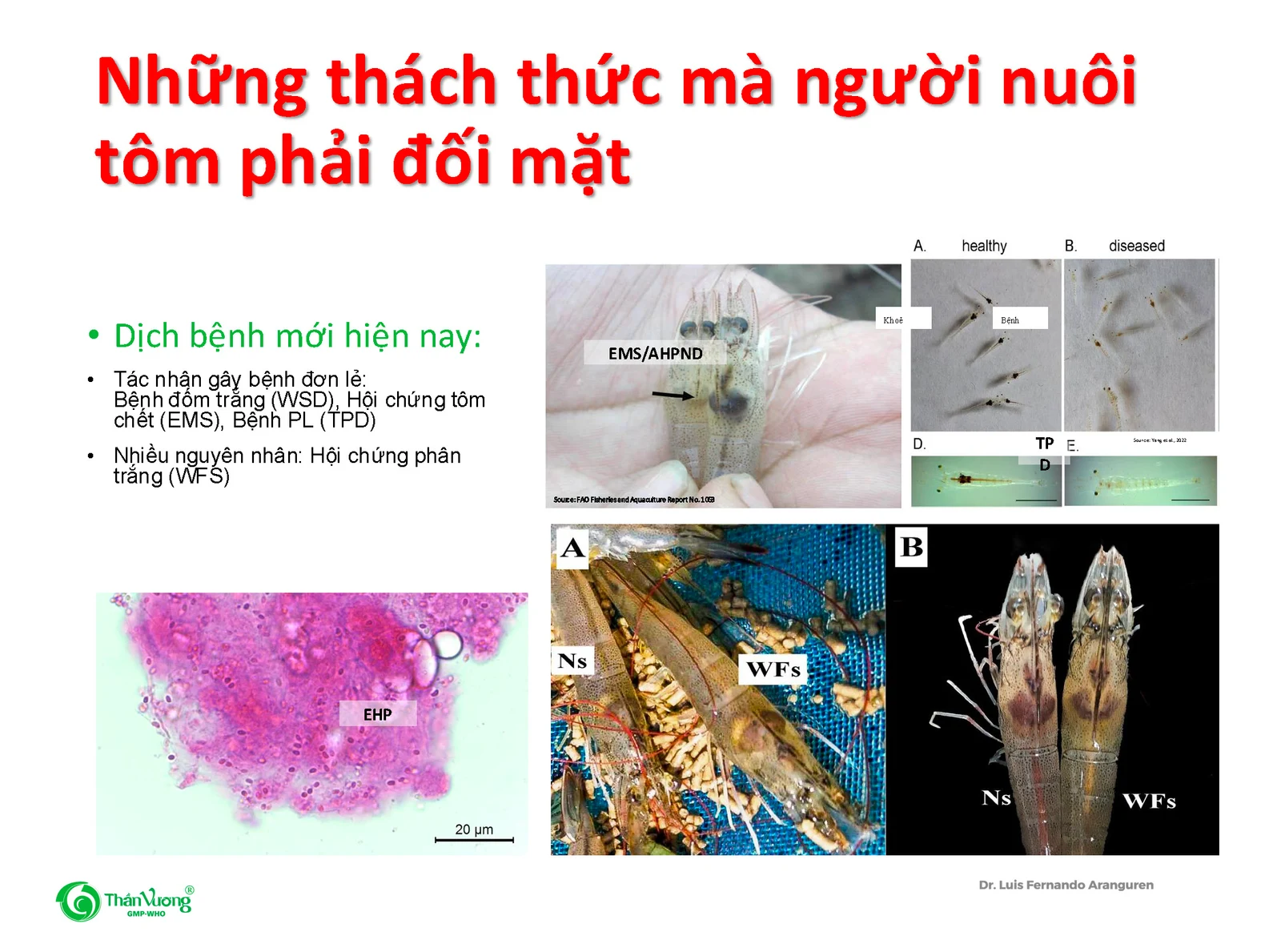
4 major diseases threaten the shrimp industry. The first 3 have single causative agents. WFS — the most common — results from MULTIPLE causes and cannot be solved with antibiotics alone.

WSD

White Spot Disease

Single agent — WSSV virus

EMS

Early Mortality Syndrome

Single agent — Vibrio parahaemolyticus / AHPND

TPD

Translucent Postlarvae Disease

Single agent — emerging Vibrio strain

WFS

White Feces Syndrome

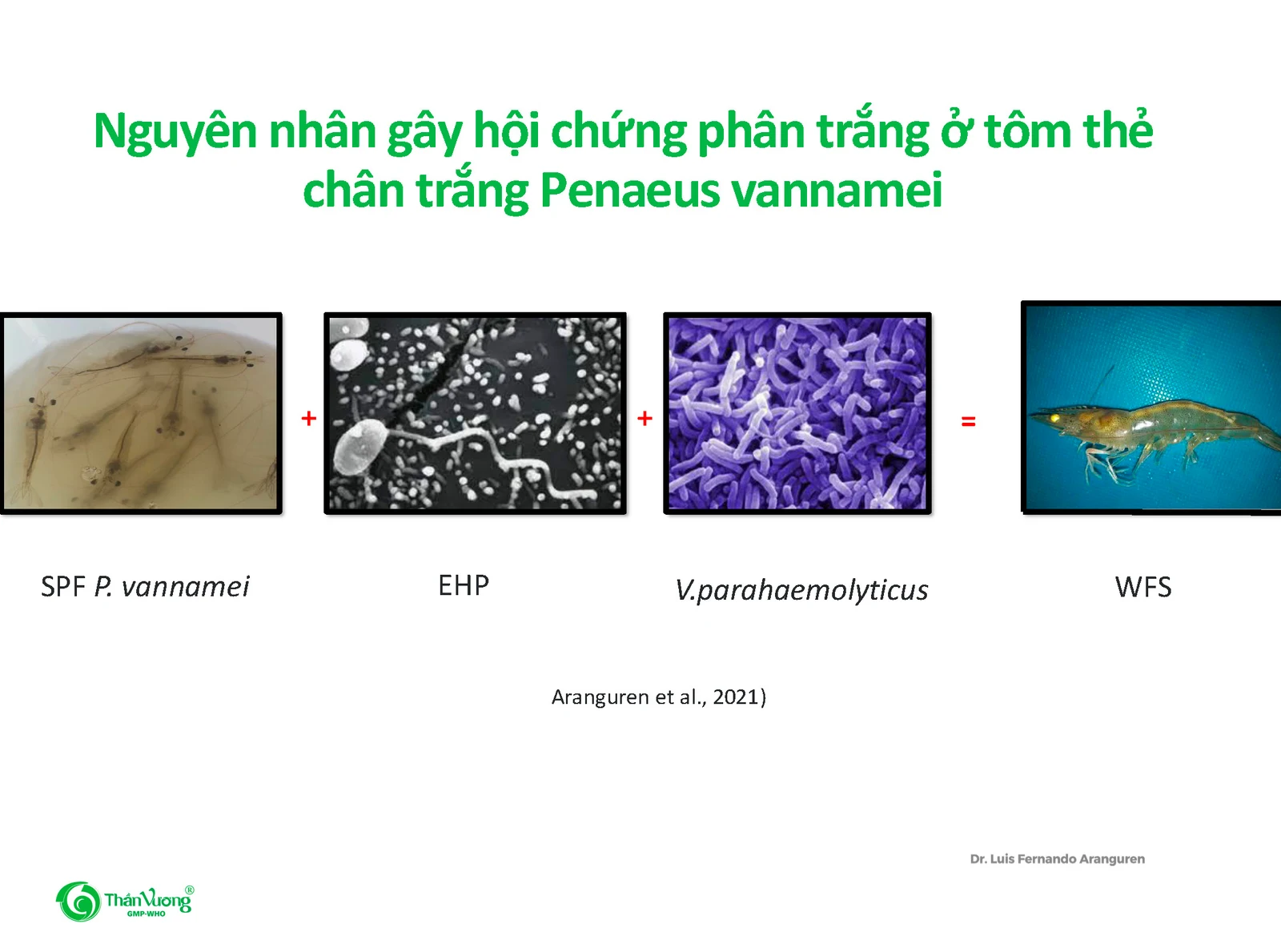
MULTI-CAUSAL — EHP + Vibrio + parasites + dysbiosis

⚠ Multi-causal
Field photos of the main diseases: EMS/AHPND-infected shrimp, translucent postlarvae (TPD), EHP spores under microscope, and WFS shrimp vs healthy.
WFS is cumulative: SPF shrimp + EHP + Vibrio parahaemolyticus → White Feces Syndrome (Aranguren et al., 2021).
Implication: No single drug solves WFS. We must build a healthy microbiome + control multi-layer agents BEFORE outbreak.
Next02 · Three layers, one stable pondThe pathogens are always there. So what decides whether they act?
02/ 06

Three layers keep the pond in the stable zone

Vibrio, EHP and parasites are almost always present — disease does not erupt because they appear, but because the pond slides out of its stable zone. Holding it there is not one product's job but three layers working at once: the pond water, the shrimp gut, and the shrimp itself. Each layer contributes different strains and functions; drop one and the other two cannot carry it.

POND

Pond bottom & water microbiome

SOILMAX New + LALSEA BIOREM + MAX 4000 + OZYME

Decompose organics, suppress Vibrio, remove NH3/NO2/H2S, stabilise nitrogen cycle

GUT

Shrimp gut microbiome

BIO MAX + PRO GUT + FLASH + CLEVER + ACTISEL

Postbiotic + probiotic + live yeast — displace pathogens, boost beneficial Bifidobacteria

HOST

Host (shrimp) support

HERB GUARD + AQUAMOS + CANFORTA + CELL CANPHOS GOLD

Protect hepatopancreas, boost immunity, supply trace minerals — strengthen immune system

  • Low riskhigh diversity — the pond recovers fast after a shock, outbreaks are rarer
  • Rising riskdiversity slipping — recovery weakens and risk creeps up
  • High risklow diversity — the pond struggles to recover and outbreaks come easily
POND WATER
2.0004.0006.0000102030Days since the first samplingBacterial diversity indexT5 · day 0T5 · day 11T5 · day 18T5 · day 25T5 · day 31T6 · day 0T6 · day 7T6 · day 13
  • T5
  • T6
SHRIMP GUT
2.0004.0006.0000102030Days since the first samplingBacterial diversity indexGIT5 · day 0GIT5 · day 7GIT5 · day 14GIT5 · day 20GIT6 · day 0GIT6 · day 6
  • GIT5
  • GIT6

The horizontal axis counts days from the FIRST SAMPLING, not from stocking. Monitoring data from ponds running the protocol: both the pond water and the shrimp gut hold their diversity index in the low-risk zone throughout. Values digitised from the original monitoring chart.
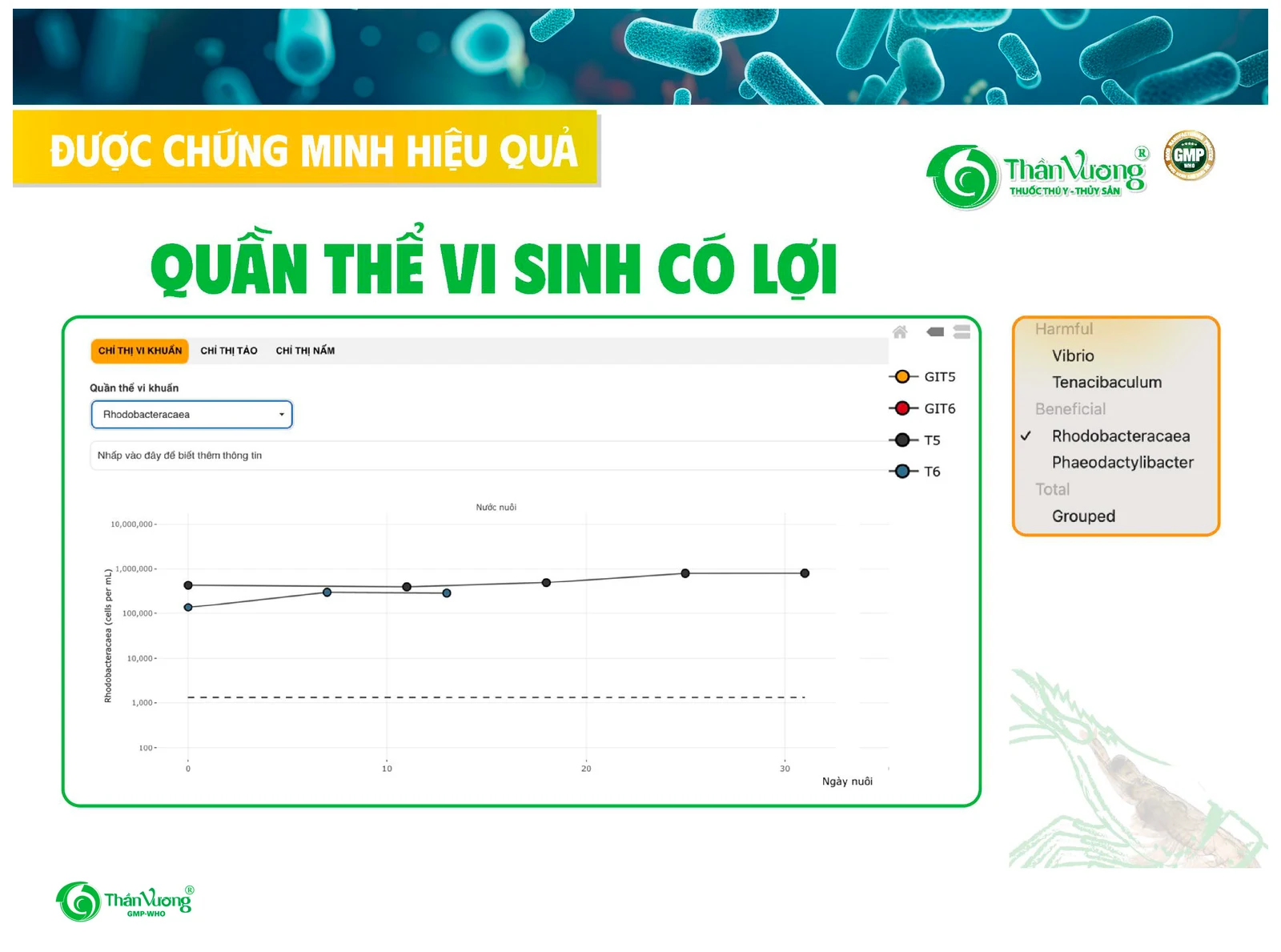
Beneficial microbial population (Rhodobacteraceae) sustained and rising across days of culture — proven by field monitoring.
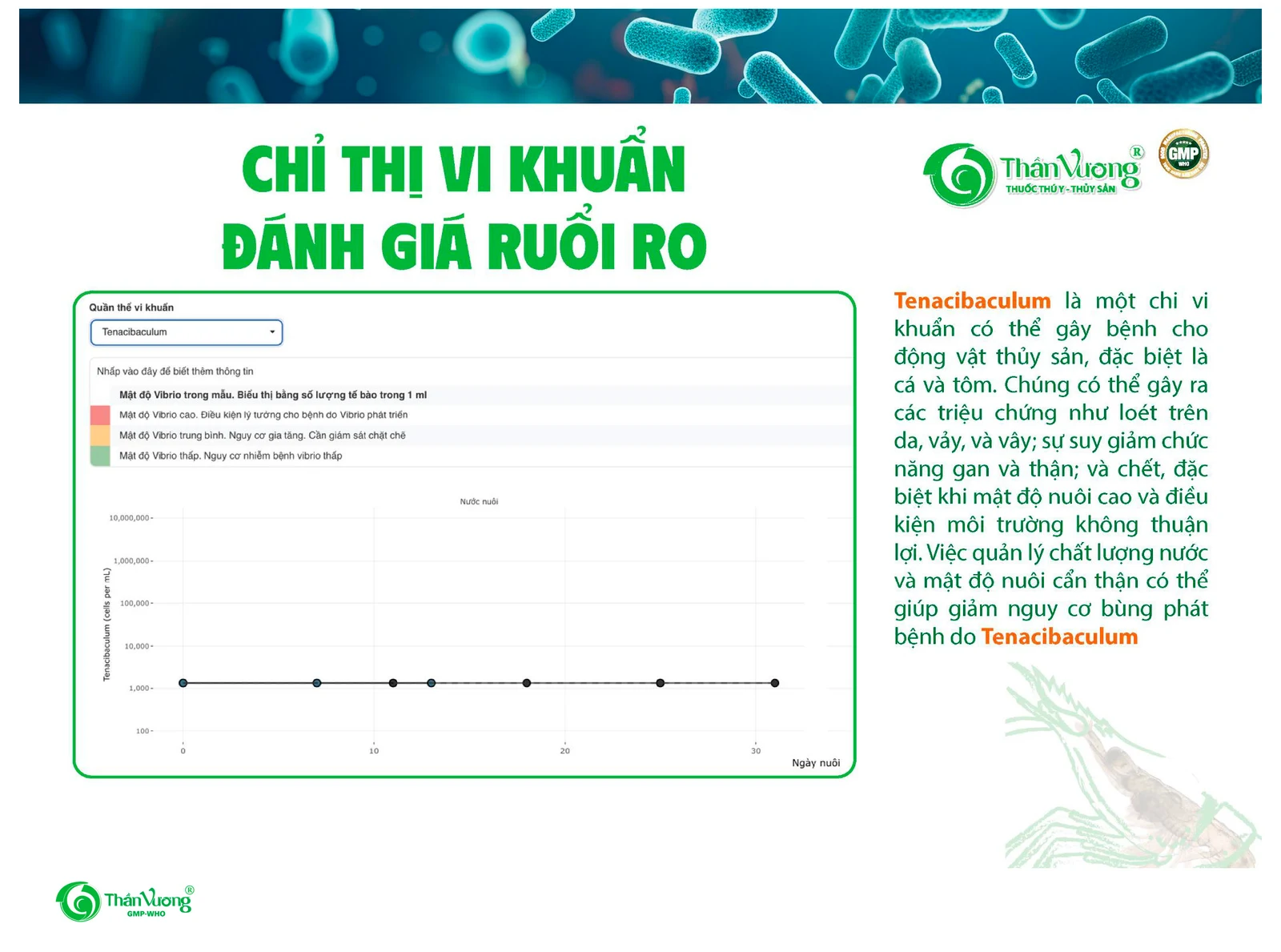
Bacterial risk indicator: Tenacibaculum density — causing ulcers and hepatorenal decline — held low and stable all crop.
Synthesis: The three layers run in parallel, not as substitutes. Clean water with a dysbiotic gut still fails; a good gut with weak host immunity still breaks under a shock. A farm using a single product line is standing on one leg.

A closer look at the GUT layer

This is the layer we can measure most clearly. Metagenomics classifies shrimp gut bacteria into 3 groups — beneficial, opportunistic, pathogenic — and the ratio among them decides whether the shrimp thrives or collapses.
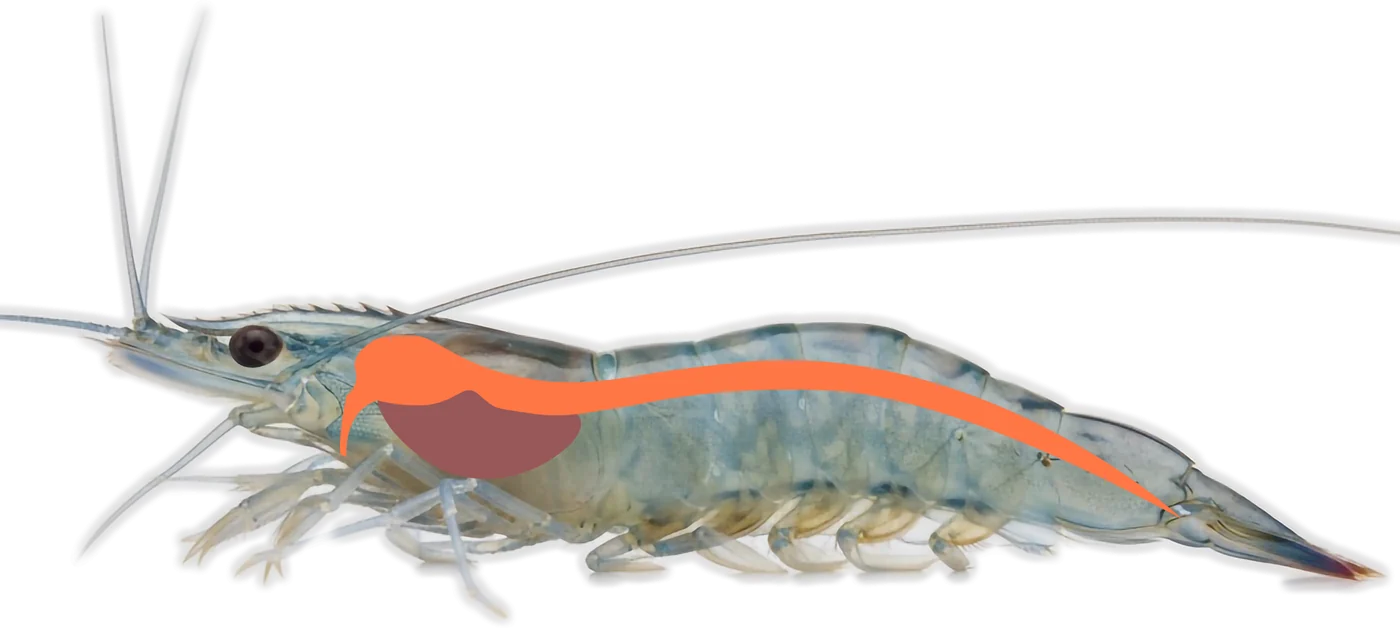
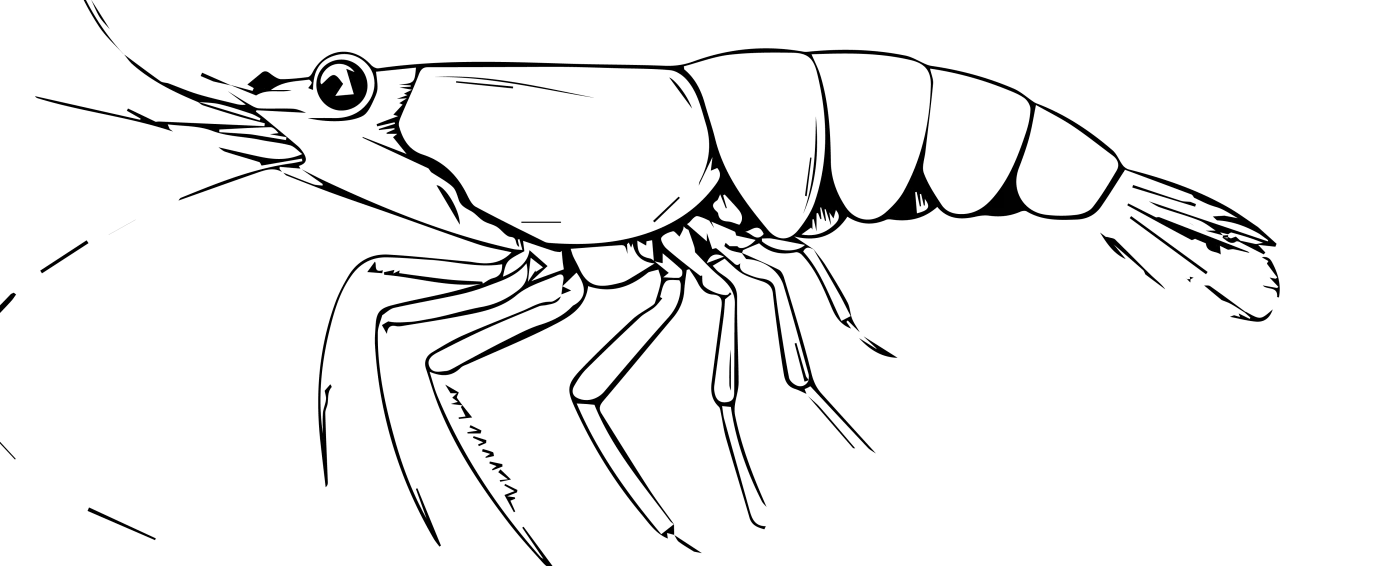
Side view of a whiteleg shrimp with the gut highlighted in orange along the back and the hepatopancreas behind the head in dark red.HEPATOPANCREASreserves, detox, immunityGUTwhere the microbiome lives
The two places that decide shrimp health sit next to each other: the gut running along the back and the hepatopancreas just behind the head.
The shrimp gut holds
  • Yeasts
  • Protozoa
  • Viruses
  • Bacteria

All four are present. But the group that decides whether the pond holds or collapses is BACTERIA — and it is also the only one a farmer can steer, through feed and probiotics.

The bacteria in that gut fall into three groups — and it is the ratio between them that decides, not the mere presence of any one group.

Beneficial

  • Bacillus
  • Lactococcus
  • Lactobacillus
  • Pediococcus
  • Bifidobacterium
  • Rhodopseudomonas

Opportunistic

  • Pseudomonas
  • Flavobacterium

Pathogenic

  • Vibrio parahaemolyticus
  • Vibrio harveyi
  • EHP

Reference: Cornejo-Granados et al., 2017 — Scientific Reports

🔒

4 more sections in the in-depth edition

Free to read — just enter the phone number you use on Zalo to receive an OTP.

  • Balance the three and the pond holdsDynamic diagram: the pond's stable basin vs. its wobble ridge.
  • Crop mapOne picture: which job sits in which layer, when, and the goal of each stage.
  • 5 solution pillarsPond colour, postbiotic, hepatopancreas, trace minerals and growth.
  • Customer successReal pond results from farmers already running it.
  • ReferencesThe studies behind the protocol, with lookup-able DOIs.
Unlock the in-depth edition →

Ask Than Vuong

Aquaculture technical assistant

Hello there 👋

Describe your pond issue or pick a question below.