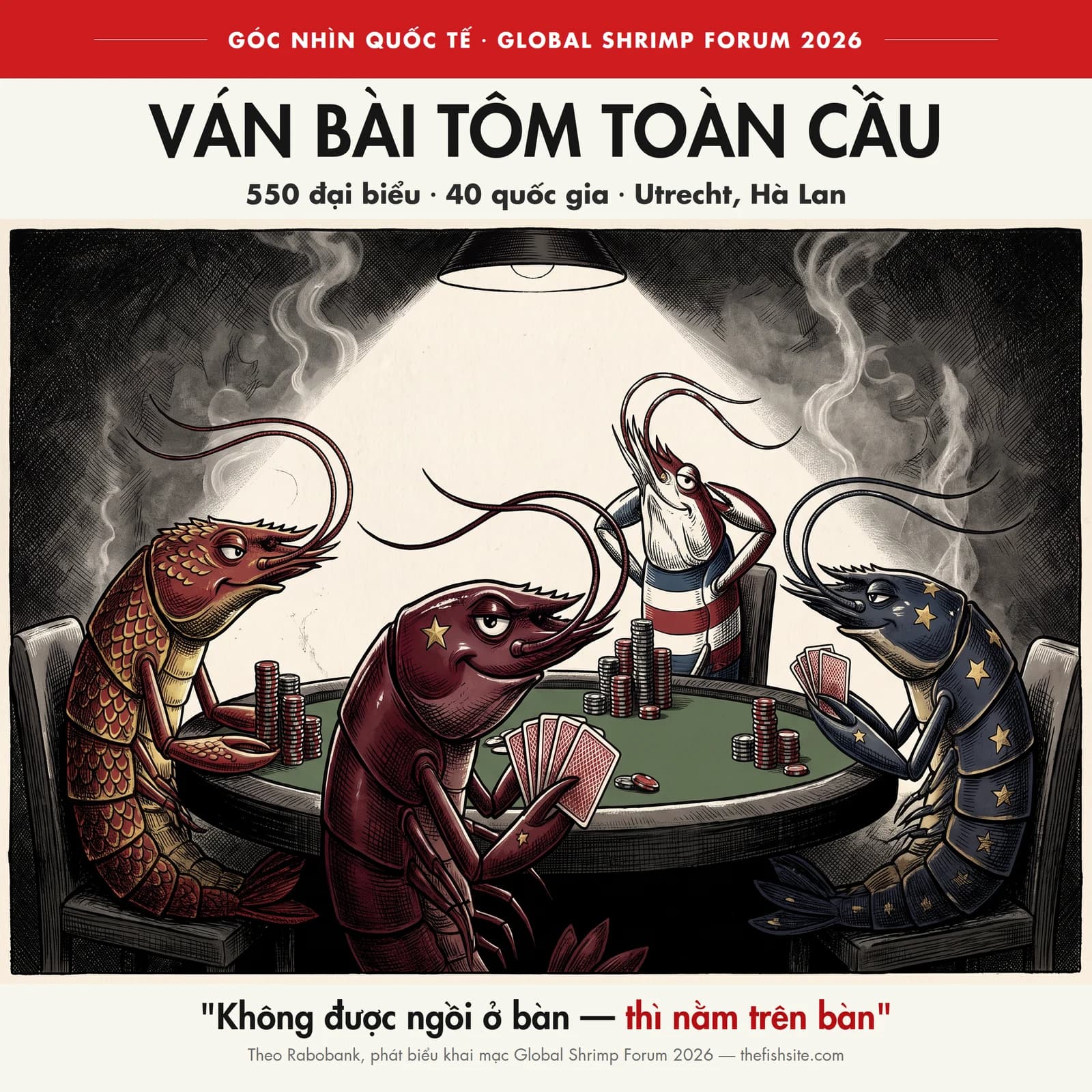
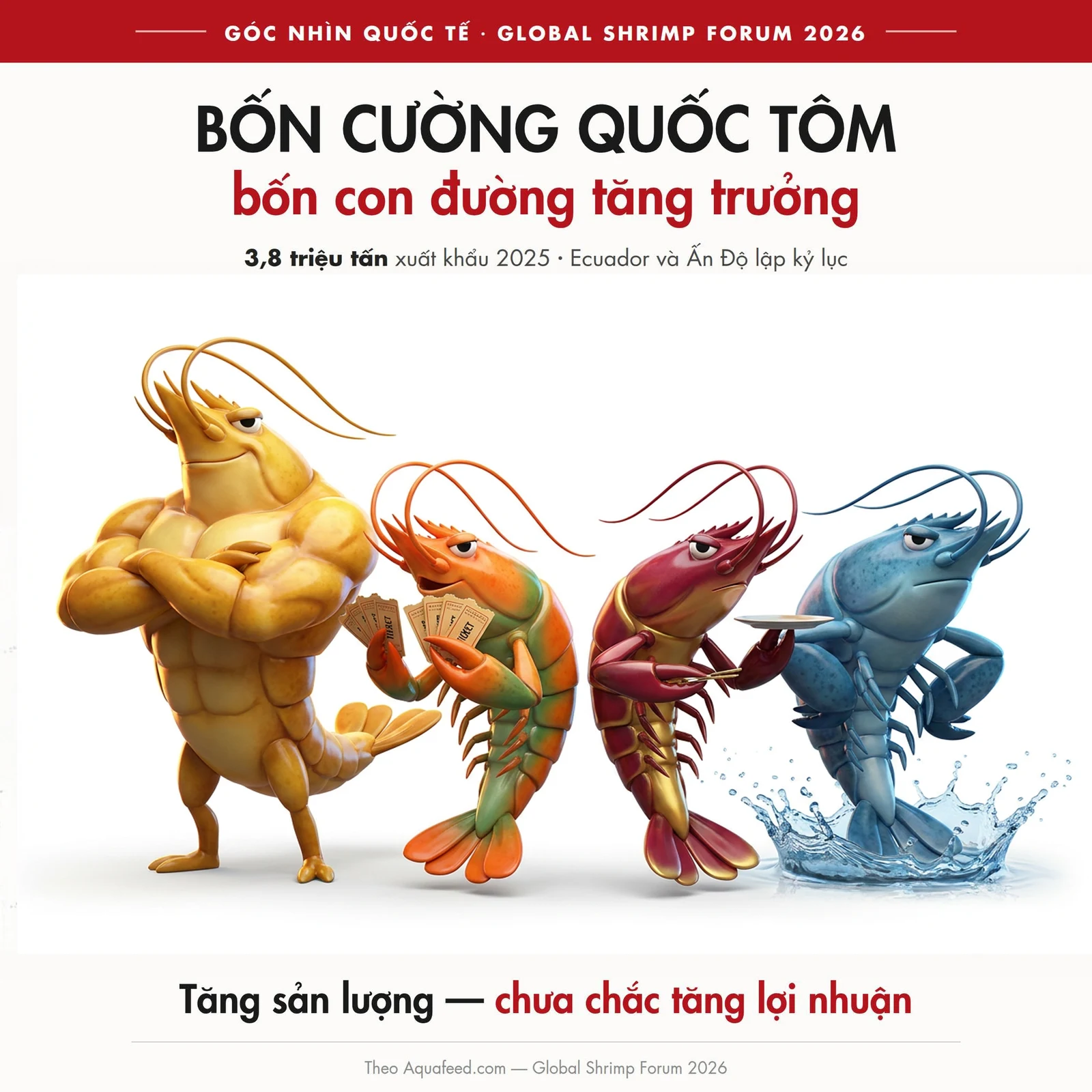
2025 marked a new milestone for the world shrimp industry: total export volume from the major producing countries rose to around 3.8 million tonnes. Both Ecuador and India set new export records.
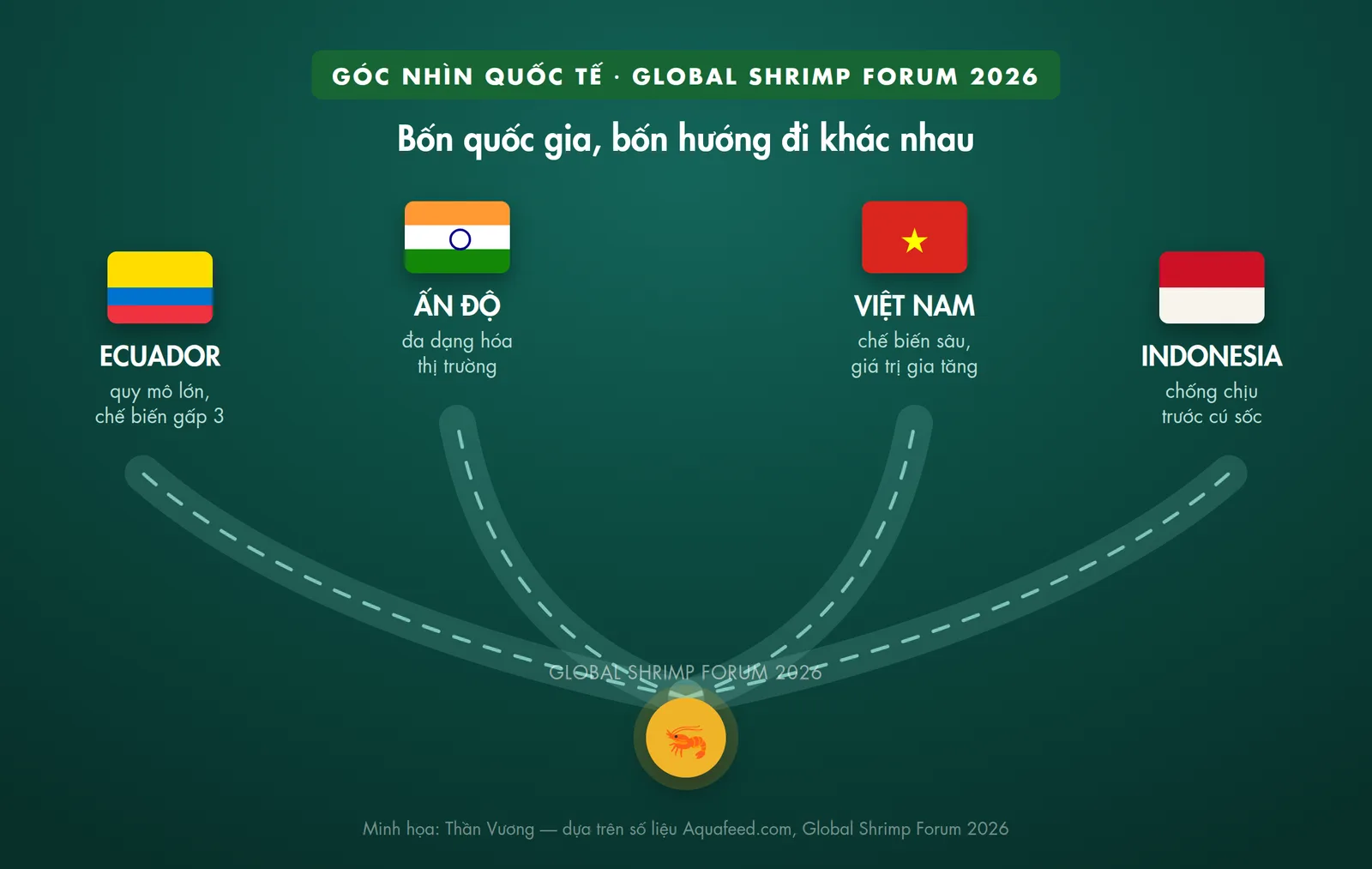
Yet the figures presented at the Global Shrimp Forum 2026 also showed that the industry is not growing to a single formula. Ecuador, India, Vietnam and Indonesia are pursuing four different paths, shaped by their own production conditions, market structures and competitive strengths.
🇪🇨 Ecuador: More scale, more processing capacity
Ecuador remains the single largest driver of growth in global shrimp supply.
Its advantages come from a large farming area, relatively low stocking densities, a long-running genetics programme and the ability to apply technology at industrial scale. Many farms now operate as open-air production complexes, with automated feeding systems and increasingly precise biomass control.
After the COVID-19 shock disrupted exports to China, Ecuador recognised the risk of depending too heavily on head-on shell-on shrimp and on one large consumer market.
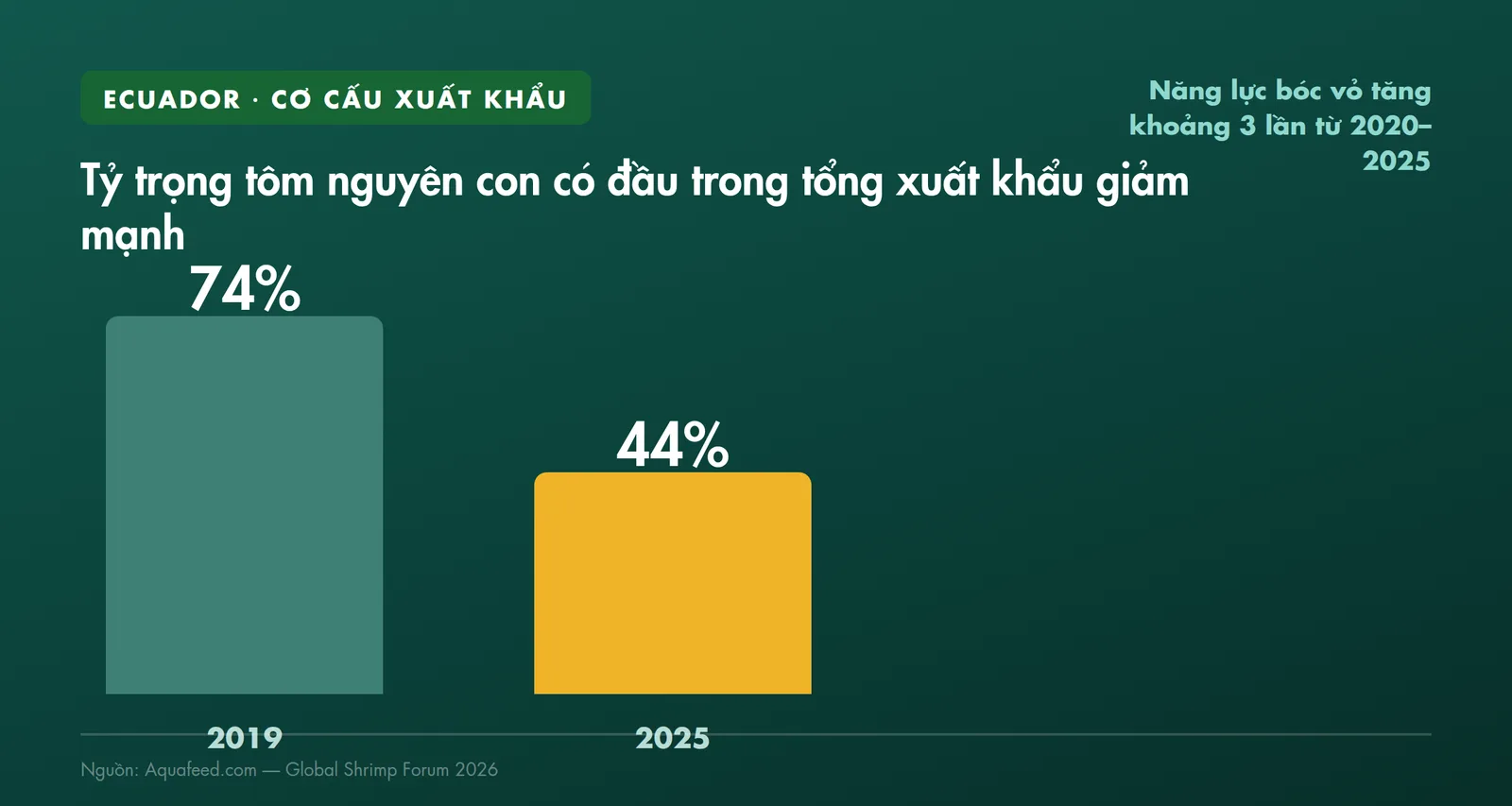
Between 2020 and 2025, Ecuador's peeling capacity roughly tripled. The share of head-on shell-on shrimp in total exports fell from 74% in 2019 to around 44%. That shift has given Ecuadorian companies better access to the US and European markets, where demand is stronger for peeled, deveined and convenience products.
Ecuador's biggest challenge today may no longer be production capability, but whether global demand will grow fast enough to absorb the additional volume. If supply expands too quickly, that very production strength could put downward pressure on prices.
🇮🇳 India: Diversifying to reduce US dependence
India also reached record export volumes in 2025, but faces heavy pressure from tariff policy and its reliance on the US market.
That uncertainty has forced Indian companies to accelerate diversification. Exports to Europe, China, Vietnam and several newer markets have risen, while trade agreements are opening further opportunities with buyers outside the United States.
Changing markets, however, is not simply a matter of shipping shrimp from one country to another. Each market has its own requirements for size, processing specification, certification, traceability and social responsibility.
India's path will therefore have to combine three elements: widening its export markets, raising processing capacity and developing domestic consumption. With a large population and a growing middle class, the home market could become an important safety valve when exports turn volatile.
🇻🇳 Vietnam: Competing on value, not just volume
Vietnam cannot compete head-on with Ecuador on scale and cost, but it holds a distinct advantage in deep processing, value-added products and the ability to handle complex orders.
Rather than selling raw material alone, Vietnamese companies can create higher value through ready-to-cook shrimp, convenience products, premium lines and items designed to the specific requirements of individual retail chains.
Vietnam's development path therefore does not have to follow a race for volume at any cost. The greater opportunity may lie in raising the value of every kilogram of shrimp, building brands, improving traceability and reaching segments where buyers will pay more for quality, convenience and sustainability.
To go down this road, Vietnam's shrimp chain needs tighter linkage from post-larvae, feed and farming areas through to processing plants and markets. Added value is only sustainable when the quality of the incoming raw material is consistent.
🇮🇩 Indonesia: Building resilience to shocks
Indonesia shows clearly what is at risk when an export industry depends too heavily on one market.
The United States typically accounts for around 65-70% of Indonesia's shrimp exports. So when an incident involving caesium-137 led to tighter import controls in late 2025, the entire sector felt the impact.
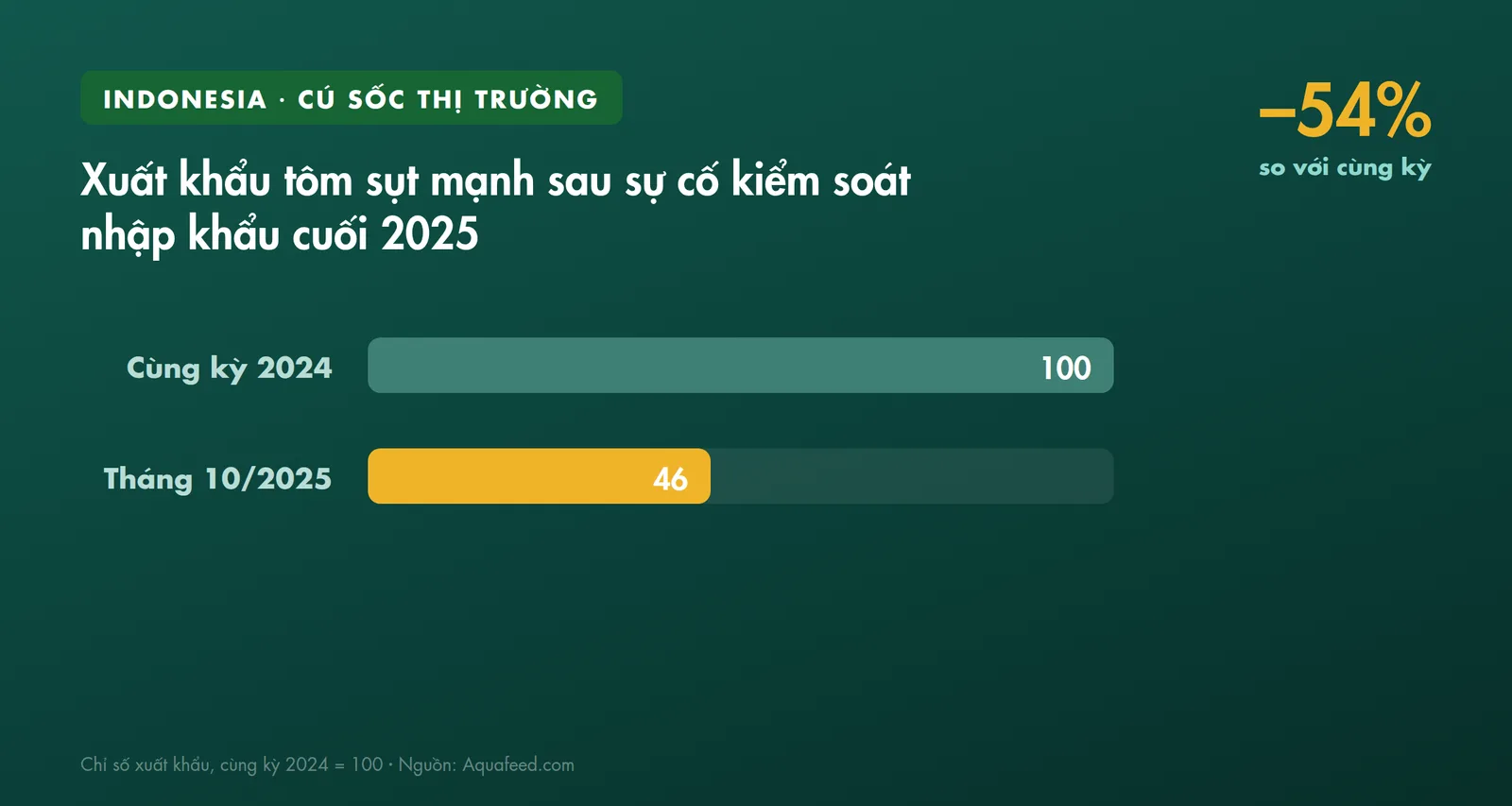
In October 2025, Indonesian shrimp exports fell 54% year on year. Companies moved quickly to redirect volume to Europe and China, but the depth of the dependence meant recovery could not be immediate.
The episode showed that growth is not measured by volume alone. A healthy shrimp industry also needs multiple markets, a transparent supply chain, fast traceability and an effective response mechanism when something goes wrong.
Indonesia is strengthening the links between hatcheries, farming areas and processing plants. Using data to manage farms, forecast output and control quality will also play an increasingly important role.
🔎 Lessons for the shrimp industry
Four countries are travelling four different roads:
Ecuador is building on scale, technology and expanded processing.
India is pushing market diversification.
Vietnam is concentrating on deep processing and added value.
Indonesia is prioritising resilience to trade shocks.
No model can be copied wholesale into another country. Ecuador's advantage is tied to abundant land and low-density farming systems. Asian producers have a smallholder structure, different costs and very different market conditions.
The most important message from the Global Shrimp Forum 2026 is this: producing more does not necessarily mean earning more.
In a period of low shrimp prices and unpredictable markets, the winners will not simply be those who produce the most. They will be the businesses that control costs well, diversify their outlets, raise product value and stay flexible enough to adapt to volatility.
Source: Aquafeed.com - "Four shrimp producers, four different paths to growth".