

Science & Technology | Well Informed — The Economist
7 August 2026, updated 13 August 2026
Yes. But it's probably best not to overthink it.
Trillions of microbes live in the human gut, breaking down complex carbohydrates into fatty acids and supplying roughly 10% of the calories a person uses.
They synthesise vitamins, notably vitamin K — which regulates blood clotting — and several B vitamins. They help regulate the immune system, keep disease-causing agents in check, and modulate the production of signalling molecules such as serotonin, which carries information from gut to brain.
So keeping the gut microbiome in good shape makes sense. Maintaining a diverse bacterial population is generally thought to be an effective way to do that. And since each species of bacteria has different "tastes", a varied diet makes sense too.
In 2018, a citizen-science project in America found that people who ate 30 different plant types a week had significantly more diverse gut microbiomes than those eating fewer than ten.
A Stanford University study published in 2021 also confirmed that fermented foods such as kimchi and sauerkraut can increase microbiome diversity.
Some people argue, however, that such general advice isn't enough. They want a solution personalised to them.
Personal microbiome testing
If willing to spend a fairly hefty sum, they can get one.
Direct-to-consumer (D2C) companies analyse a stool sample and compile a list of the microbes it contains based on the DNA and RNA they detect.
These firms can also offer personalised dietary recommendations, live bacterial strains and supplements said to benefit the microbiome — all meant to "fill" the microbial gaps their test claims exist.
The problem with this approach is:
There is no single "correct" microbiome to use as a benchmark.
In reality, microbiomes can differ considerably from person to person while still performing perfectly well the functions the host body needs.
One of the clearest warning signs of poor gut health is simply low biodiversity — precisely the problem a varied diet, including some fermented foods, can improve.
By contrast, the idea that adjusting the presence or absence of one specific microbe will markedly improve health still has very little published scientific evidence to support it.
What's more, many D2C companies are reluctant to disclose the proprietary data underlying their claims.
There are exceptions
There are, of course, exceptions.
In Britain, Tim Spector has operated in parallel in both worlds: academia — he holds a position at King's College London — and commerce, as a co-founder of the D2C company Zoe.
So far, he has managed to keep the two in balance.
With customers' consent, results from Zoe users feed into serious, peer-reviewed scientific research.
Findings so far suggest personalised diets don't move the needle dramatically, but may offer some benefit.
But is the testing even accurate?
Even if the personalised approach genuinely has value, that value must rest on one precondition:
The microbiome composition reported by D2C companies has to be accurate.
To test this, researchers at America's National Institute of Standards and Technology (NIST) prepared 21 homogenised stool samples — essentially identical in composition.
They then sent three samples to each of seven D2C companies.
When the results came back — the study was published in February — the scientists found striking discrepancies.
Not only did results differ between companies, but in one case even results analysed by the same company differed from each other.
Personalised microbiome medicine is still a long way off
Jonathan Eisen, an evolutionary microbiologist at the University of California, Davis, notes that variation in people's microbiomes doesn't mean an era of personalised microbiome medicine is around the corner.
He put it even more bluntly:
"Most of the claims in this field are unfounded."
So perhaps it's best to keep your money and buy a jar of kimchi instead.
The article's main takeaway
The gut microbiome matters a great deal, but there isn't yet enough scientific grounding to believe we can precisely "optimise" it by testing stool and then supplementing specific bacterial strains.
The sturdier point today is fairly simple: eat a varied diet, increase the diversity of plants in your meals, and use fermented foods sensibly to maintain a diverse microbiome.
What about microbiome in shrimp?
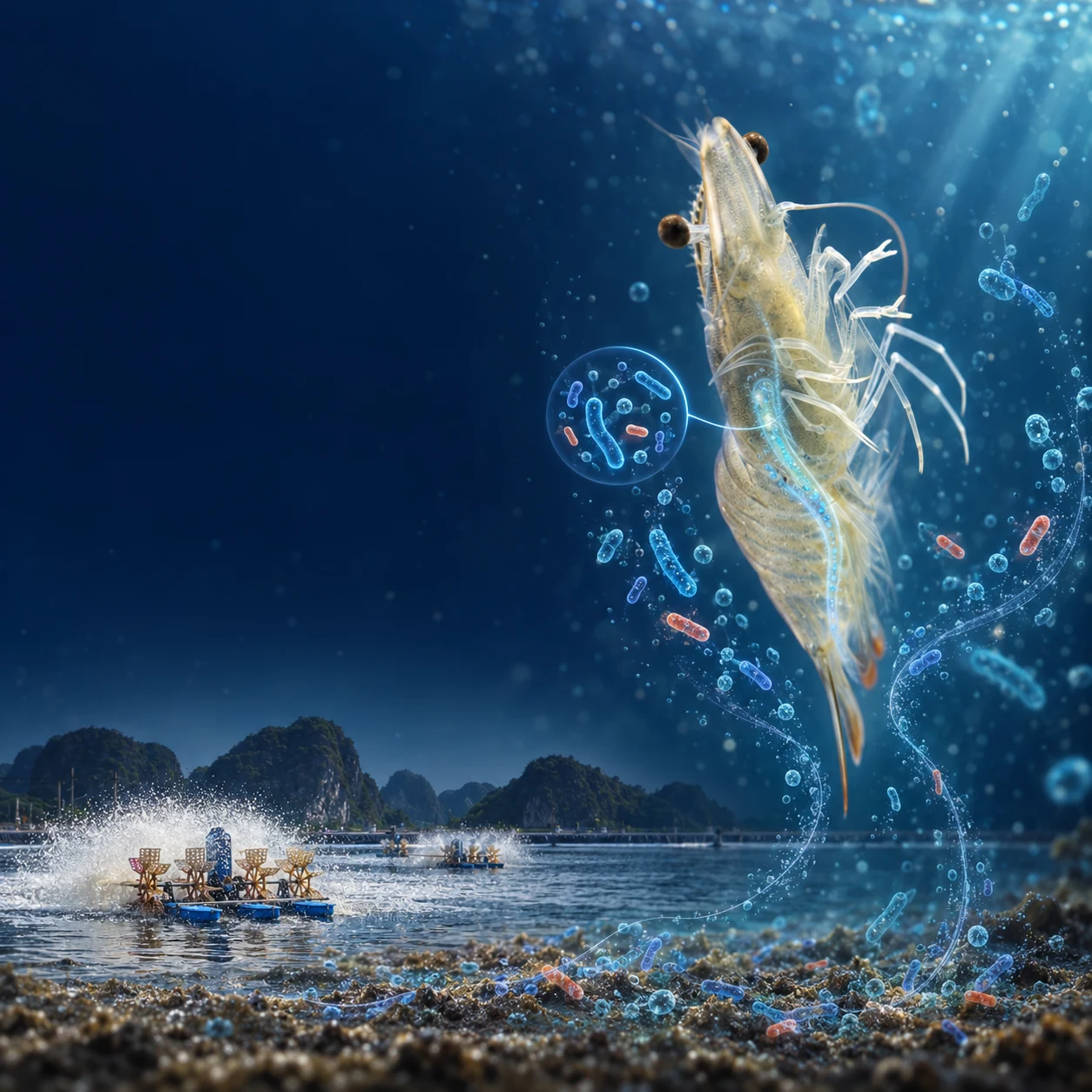
The human-microbiome story raises a question well worth paying attention to in shrimp farming too.
Shrimp are never isolated from microbes. Complex microbial communities exist in the gut, gills, body surface, pond water and pond bottom at all times. They break down organic matter, cycle nutrients, interact with the shrimp's immune system, and compete ecologically with potentially pathogenic microbes.
But just as with humans, we should be cautious about the idea that a "perfect microbiome" exists for shrimp — one that can be found by testing for a handful of species and simply supplementing exactly those to guarantee a healthy pond.
The reality is far more complex.
Shrimp microbiome is shaped simultaneously by post-larvae quality, feed, water source, salinity, temperature, pH, alkalinity, dissolved oxygen, organic load, stocking density, pond bottom, water exchange, and the drugs and chemicals used during the crop. The gut microbiome is also in constant interaction with the microbiome of the pond environment itself.
So the sensible goal is probably not to draw up a fixed list of "good" bacteria to add while eliminating all "bad" bacteria.
What matters more is building a microbial community that is stable, functional, and resilient to imbalance.
Vibrio being present doesn't automatically mean disease
This is an especially important point in shrimp farming.
Many species within the Vibrio group can be present in water and gut without necessarily causing disease right away. Problems typically arise when environmental conditions change, organic matter accumulates, shrimp become stressed, or the microbial community structure becomes unbalanced — giving certain pathogenic populations room to surge.
Managing the microbiome, then, shouldn't simply be understood as:
"Kill Vibrio, then add probiotics."
It should be viewed more broadly:
Manage the environment → manage organic load → manage water and bottom microbiota → manage gut microbiome → sustain animal health.
Probiotics aren't "the more, the better" either
Probiotic and prebiotic products, enzymes, or functional feed components can be used to influence the microbiome.
But their effectiveness still depends on the strain, dosage, feed, environment, timing of use, and each pond's specific conditions.
A bacterial strain that is beneficial under one condition may not produce the same effect under another.
So just as the article warns about human microbiome hype, the shrimp industry also needs to avoid reducing microbiome management to an overly simple idea:
"Missing a bacterium? Add it."
A bigger goal: "microbiome resilience"
In shrimp farming, a more worthwhile approach is the resilience and stability of the microbial community — microbiome resilience.
A good pond isn't necessarily one free of disease-causing bacteria.
It may instead be an ecosystem where the microbial community is stable enough that no single group gets the chance to bloom and dominate when the environment fluctuates.
And that brings the microbiome story back to some very basic principles of the farming trade:
- Good post-larvae quality.
- Appropriate feed.
- Stable dissolved oxygen.
- Controlled organic load.
- Stable pH and alkalinity.
- A well-managed pond bottom.
- Maintained biosecurity.
Probiotics and related products are then tools for tuning the ecosystem — not something that can replace overall pond management.
Don't try to control every single bacterium. Build an ecosystem that gives the beneficial microbial community the edge to keep itself in balance.
This is also why, in modern shrimp farming, we should start shifting from a "kill the bacteria" mindset toward "managing the microbiome" — grounded in data and ecology, not just piling on more probiotics.
Source: The Economist, Science & Technology, "Can you hack your gut microbiome?", 7 August 2026, updated 13 August 2026.