Every time you want to know the shrimp's size or growth rate, you have to lift them up, weigh and measure, then release them back. Not only is this laborious, but it also stresses the shrimp, and you can only assess a small portion of the pond. A Portuguese research group has tried a different approach: attaching a small camera above the feeder, letting AI software observe and calculate automatically. The initial results are quite surprising.
Why is this worth paying attention to?
Feed accounts for 40% to 65% of total production costs in shrimp farming. However, determining the right amount of feed, whether shrimp are feeding properly, and their current size mostly rely on experience-based observations of the feeder and periodic lifting of shrimp.
The manual method has three well-known weaknesses among farmers: it's time-consuming, only a tiny fraction of the pond can be sampled, and each lifting causes stress to the shrimp. Moreover, underfeeding or during molting, shrimp may cannibalize each other — often detected too late.
Equipment Used by the Research Group
In the experimental model of the article, the research group used the following configuration. This is research equipment, not a configuration proposed by Thần Vương for commercial deployment in shrimp ponds:
- A mini computer Raspberry Pi (palm-sized, priced around a few million VND)
- A wide-angle Raspberry Pi Camera Module 3 WIDE
- Camera placed 94.5 cm above the feeder, with feeder dimensions 32 × 25.9 cm
- A button to capture images at feeding time
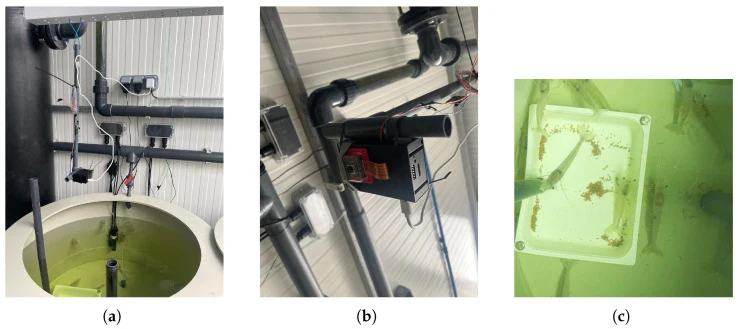
Notable point: the team attempted to place a camera in a mica box to counteract water reflection, but the mica surface caused the camera to lose focus, resulting in blurry images. Ultimately, they discarded the mica box and instead adjusted the position of the feeding tray to minimize reflections. This is a practical lesson for anyone looking to set up a similar system.
Teaching AI to "see" shrimp in murky water
The team captured 1,144 images on multiple days, at various times, under natural light, with two different types of feed. They then manually labeled each shrimp in the images to train the YOLOv8 model — a popular object detection AI currently.
- "Shrimp Morphology" Model — selecting only shrimp lying straight, suitable for accurate size measurement (excluding those that were bent)
- "Pond Activity" Model — identifying all shrimp to count quantity, regardless of posture
Prior to this, the team had attempted traditional image processing techniques (Canny Edge, K-means, Watershed) but failed when shrimp overlapped — a common scenario on actual feeding trays.
Measuring Shrimp Length: Which Method is Most Accurate?
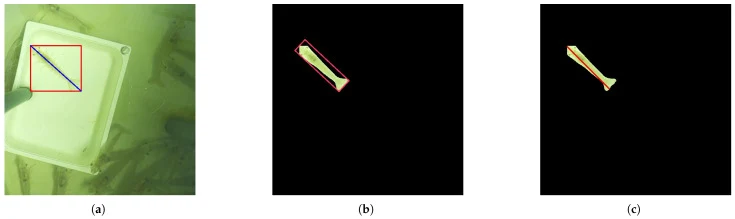
The team compared three measurement methods against 60 manually measured shrimp:
| Measurement Method | Average Error (MAPE) | Absolute Deviation |
|---|---|---|
| Minimum Bounding Box (MBBox) — tightly around head and tail | 1.56% | 0.23 cm |
| Hough Line — detecting straight line along body | 2.95% | 0.44 cm |
| Diagonal of Bounding Rectangle | 10.87% | 1.58 cm |
The Minimum Bounding Box (MBBox) method was clearly superior: with an error rate of only 1.56%, averaging a deviation of about 2 mm per shrimp. The diagonal measurement method yielded the poorest results due to its dependence on the shrimp's orientation within the frame.
Inferring Weight Without Scales
This is the most useful part for farmers. After measuring the length, the system measures the body width of the shrimp at a point approximately 31% of the body length from the head tip — specifically the thoracic region, characterized by the distinctive dark patch of whiteleg shrimp.
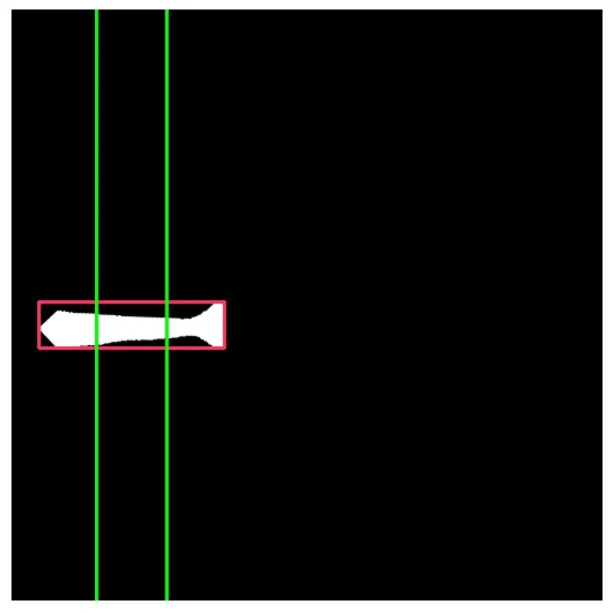
The error margin for width measurement is 4.19% (deviation of 0.15 cm). From real measurements of 186 shrimp, the team developed a regression formula linking length + width to weight.
Practical Implications
- Estimate shrimp size without netting or lifting them out of the pond
- No stress for shrimp, no disruption of feeding rhythm
- Continuous daily weight gain monitoring instead of periodic checks per cycle
- Replaces traditional methods requiring sampling up to 30% of the population
Counting Shrimp on Feeders: Error Less Than 1 Shrimp
With a confidence threshold of 0.60, the shrimp identification model achieves 94.3% accuracy and 93.5% coverage. The count error averages 0.97 shrimp compared to manual counting — typically less than one shrimp. The average percentage error is 7.17%.
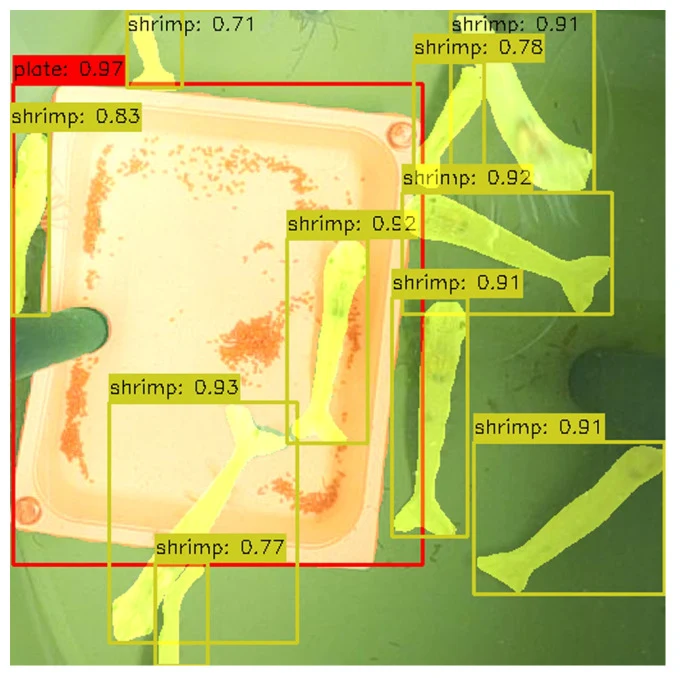
The research team openly discusses limitations: in cases with turbid water or poor lighting, errors jump to 9.23%. Additionally, shrimp often overlap or hide under the feeder's edge, complicating counts. Importantly, cameras currently only cover areas around feeders, not the entire pond.
Measuring "Feed Attractiveness" — The Most Interesting Part
The team experimented with two feed types: Type 1 using fishmeal (theoretically more attractive) and Type 2 using plant protein. They evaluated attractiveness in two ways:
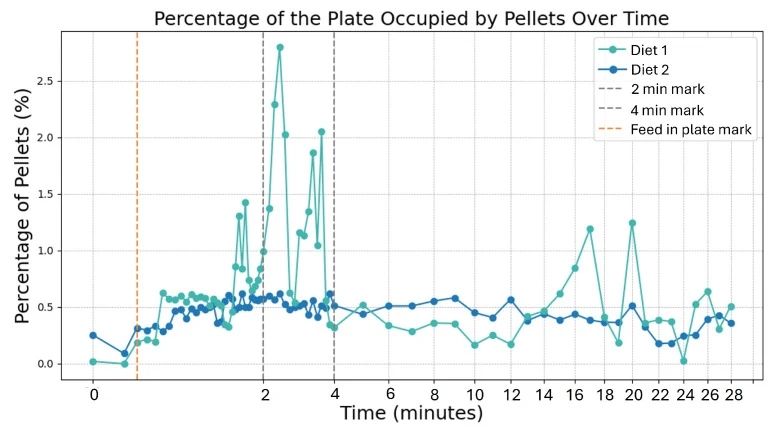
Method 1: Monitoring Remaining Feed Pellets on the Feeder
The software measures the feeder area covered by feed pellets over time. Rapid area reduction = strong shrimp feeding. Actual observation confirms that fishmeal feed was almost entirely consumed, while plant protein feed still had leftover pellets on the feeder.
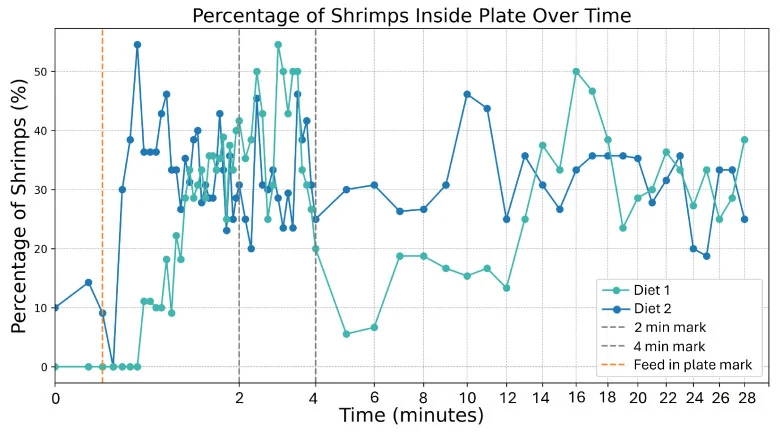
Method 2: Monitoring Shrimp Congregation Around the Feeder
With fishmeal feed, shrimp numbers around the feeder decreased by approximately 40% after about 5 minutes — indicating shrimp finished eating and left, a normal behavior. With plant protein feed, shrimp remained near the feeder but more feed was left — meaning shrimp approached but did not finish eating.
Current Capabilities of Nuoi Lời
On Thần Vương's nuoiloi.vn aquaculture diary software, the currently operational feature is shrimp counting via video snippets. Farmers lift and briefly record a clip; the software counts shrimp across multiple frames, suggests a number with confidence level, and alerts if frames significantly diverge. Pond owners review, correct if necessary, before logging — the system does not auto-log.
The system can also connect to underwater observation cameras placed at feeders, replacing manual video recording during each feeding session.
To clarify and avoid misunderstanding: the indices such as shrimp size, growth rate, or feeding time are what the study has proven cameras can do — not features currently provided by Nuôi Lời. The existing feature is counting shrimp in the trough, with the number displayed in the diary alongside feed quantity, environmental indicators, and the pond's disease history.
View at nuoiloi.vn, or discuss further with Thần Vương’s technical team — 0867 957 568.
What remains unaccomplished?
This is not a fully commercialized product. The authors list clear limitations and areas for improvement:
- Cameras placed on the water surface suffer from reflections; submerging them in waterproof boxes improves image quality
- Identifying feed pellets by color (HSV) is highly sensitive to lighting changes — deep learning models are needed instead
- More image data, especially of shrimp lying straight, is required for a more accurate model
- Human verification of measurement images is necessary to eliminate cases where rippling water distorts shapes
- Commercial ponds often have stable artificial lighting — which would mitigate most errors due to lighting variability encountered in the study
Conclusion of the field survey: What can Thần Vương accomplish?
Brief Conclusion: AI camera technology on feed sifters can be deployed in Vietnam, but it must be viewed as a controlled sampling system — not a camera that can see through murky water or count all shrimp in the pond. The camera only counts and measures shrimp clearly visible within its observation area; from this sample, the software tracks trends in shrimp size, concentration around the sifter, and feeding time.
The 1.56% error rate in the study is a result of a controlled experimental setup, not a default accuracy level for all commercial ponds. More recent field research also shows that underwater length measurement can achieve an MAPE of approximately 3.16% and weight prediction around 10.58%, but this requires image distortion correction, size markers, and a mechanism to exclude murky frames. Therefore, all Thần Vương’s indices must be re-verified on actual Vietnamese pond conditions before using them to adjust feed rations.
Minimum Conditions for Stable System Operation
- Fixed camera at correct height/angle, waterproof housing suitable and with a size reference plate on the same plane as the shrimp.
- Stable diffused lighting; minimizing fan shadows, water surface reflections, air bubbles, and lens fouling.
- Contrasting sieve background, standard size, and moderate observed shrimp number to reduce overlap.
- Software for automatic image quality scoring; discarding blurry, shaky, overexposed frames or heavily overlapped shrimp instead of forcing a count.
- AI data must be periodically cross-verified by manual sampling, weighing, and measuring. Farmers or technicians approve before logging the data.
Deployable Roadmap for Thần Vương
- Phase 1 — Pilot with Smartphone/Short Clips: Test at 2–4 ponds for 6–8 weeks, capturing images of various shrimp sizes, water colors, times, and sieve types; concurrent manual counting/measuring to create a Vietnamese baseline dataset.
- Phase 2 — Fixed Camera at Sieve: Add waterproof camera, stable lighting, calibration plate, and on-farm processing unit; automatic result submission to Nuôi Lời with user confirmation required.
- Phase 3 — Feeding Decision Support: Combine sieve shrimp count, size distribution, leftover feed, DO, temperature, weather, and feeding history to suggest feed adjustment. The system proposes but does not auto-control feeders without safety layers and approved personnel.
Criteria for Commercialization Decision
Thần Vương should pre-announce go/no-go pilot criteria: usable frame rate of 80% or higher; MAPE counting error not exceeding 10% in non-heavily overlapped samples; MAPE length error not over 5%; and system must flag “insufficient quality to measure” instead of providing false numbers. These are proposed acceptance goals, not yet achieved at ponds.
Why can Thần Vương succeed? Core components are already viable: appropriately priced cameras and edge computers, verified recognition/segmentation models in research, and Nuôi Lời’s existing clip logging and pond journaling. Further investment is not for “reinventing AI” but for designing Vietnam-pond-suited camera clusters, collecting field datasets, calibrating per sieve, and organizing independent verification.
Therefore, the commitment at this stage is: Thần Vương can manufacture prototypes, deploy pilots, and integrate results into Nuôi Lời. After achieving KPIs across multiple ponds, water colors, and shrimp sizes, the system will have a solid foundation to become a commercial product supporting reduced labor for sampling, growth monitoring, and feed cost control.
Farms interested in participating in the pilot can register with Thần Vương's technical team. Each test site needs to provide pond type, area, depth, water color, sieve type, expected shrimp size, and sampling schedule to build a baseline dataset.
Additional reference materials: Model for estimating live shrimp weight on automatic sieves in earthen ponds; Underwater camera system for real-time measurement of shrimp size and weight (2026).
Do you need technical consulting for your aquaculture pond?
24/7 AI Consulting — ask technical questions, schemes, and products anytime at:
thanvuong.vn/vi/products
Hotline: 0867 957 568 | thanvuong.vn
Source: Correia, B.; Pacheco, O.; Rocha, R.J.M.; Correia, P.L. Image-Based Shrimp Aquaculture Monitoring. Sensors 2025, 25(1), 248. https://doi.org/10.3390/s25010248 — Read the full text on PubMed Central
The original article was published under a Creative Commons Attribution 4.0 (CC BY 4.0) license, allowing translation and republication with proper attribution. The Vietnamese version is adapted and compiled by Thần Vương for shrimp farmers; all data remains unchanged from the original.
All illustrative images in this article are originals from the authors' group (Figures 3, 7, 8, 10, 12, 13 in the original), reused under CC BY 4.0 with attribution. Image captions in Vietnamese were compiled by Thần Vương.
The ShrimpFarming image dataset is made freely available by the authors for research purposes at img.lx.it.pt/ShrimpFarming.