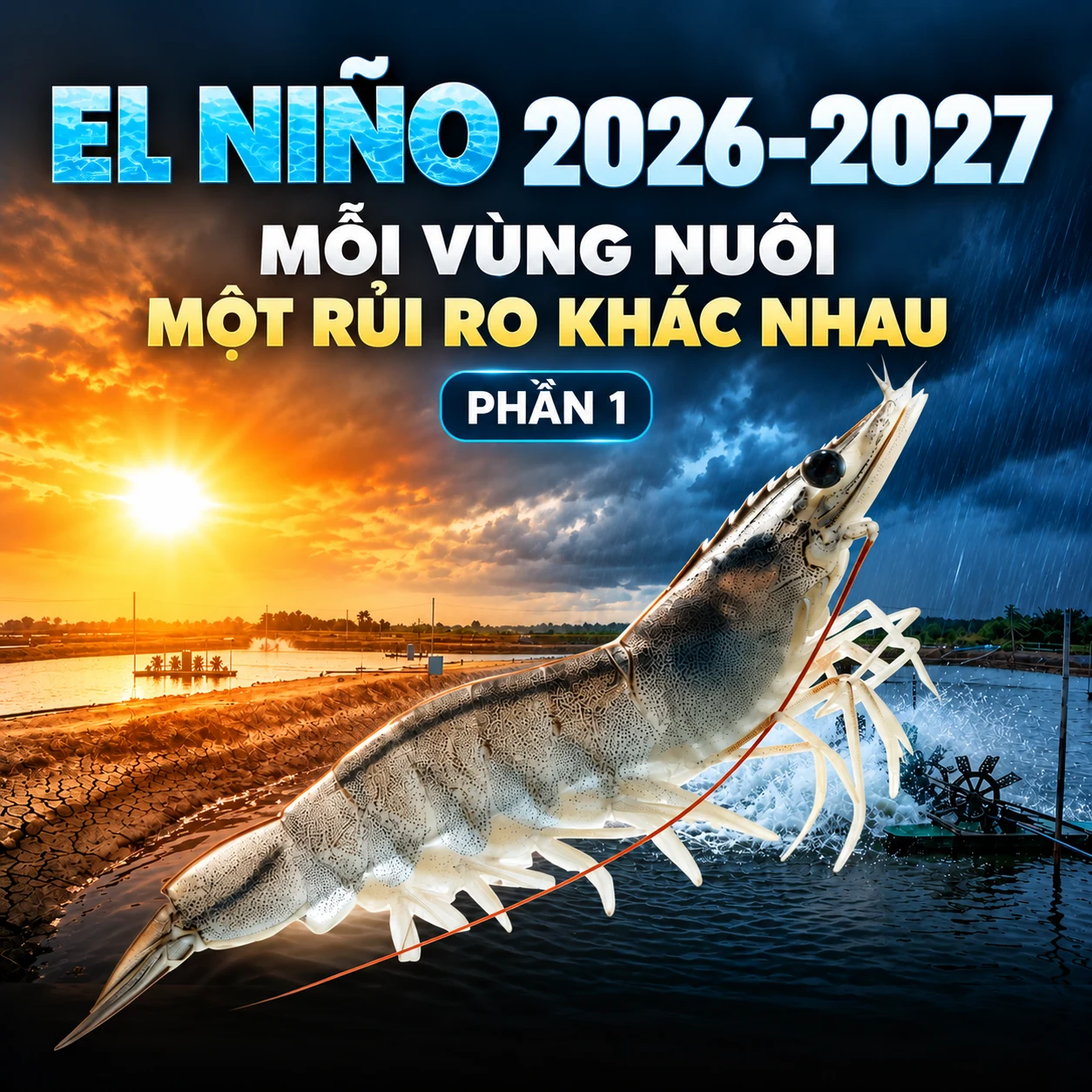
PART 1: THE SAME EL NIÑO – BUT EACH SHRIMP FARMING REGION FACES A DIFFERENT RISK
When people hear about El Niño, most immediately think of heat, drought, and water shortages.
But for shrimp farming, the story is far more complex.
An article by The Fish Site, published on September 9, 2026, based on content presented at the Global Shrimp Forum 2026, shows that El Niño 2026–2027 could bring very different impacts across the world's shrimp farming regions.
Some places will see warmer water.
Some places will see heavier rain.
Some places will face prolonged drought.
Some places will see salinity drop quickly.
And some places will see salinity rise instead.
A key point stands out:
Shrimp are not only affected by how high or low a single environmental parameter is, but are especially sensitive when conditions change too quickly.
How does El Niño happen?
Under normal conditions, trade winds across the Pacific push warm surface water westward, toward Indonesia and Australia.
When El Niño occurs, these winds weaken.
The warm water mass begins to shift back eastward across the tropical Pacific.
This shift in warm water doesn't just change ocean temperature — it also affects atmospheric circulation, which in turn alters:
temperature;
rainfall;
monsoon seasons;
drought;
and weather patterns across many regions.
According to content presented at the Global Shrimp Forum 2026, the current El Niño could persist into early 2027.
Warmer water isn't simply "faster shrimp growth"
Higher water temperature can speed up shrimp metabolism.
Within a suitable range, this can support growth.
But there's a critical problem:
The hotter the water, the less dissolved oxygen it can hold.
Meanwhile:
Rising temperature → higher shrimp metabolism → higher shrimp oxygen demand.
In other words:
Oxygen in the water tends to drop right when shrimp need more of it.
For high-density ponds, this is a pressure worth paying close attention to.
Ecuador and Peru: warmer water may help at first, but heavy rain is a different risk
Along the Pacific coast of South America, especially Ecuador and Peru, El Niño can warm the seawater.
In the early stage, warmer water can create favorable conditions for shrimp growth.
But a strong El Niño can also bring very heavy rainfall.
When rainfall surges:
Freshwater inflow → salinity drops quickly → ponds risk flooding → water quality shifts.
And this is one of the most important points in the article:
Shrimp can adapt to a given condition, but struggle far more when that condition changes too fast.
So sometimes the real concern isn't just low or high salinity.
The real concern is:
How much salinity differs from today to tomorrow.
Mexico, Guatemala and Venezuela: the opposite scenario from Ecuador
While Ecuador may face heavy rain and falling salinity, other parts of Latin America could face:
Hotter + drier + less water.
This puts direct pressure on managing water supply for ponds.
So under the same El Niño, shrimp farmers in two different regions may need to prepare for two completely opposite situations:
one dealing with too much water;
another dealing with not enough water.
India: the main concern is the monsoon
For India, El Niño's key impact relates to the monsoon season.
Strong El Niño events can come with risks of:
lower rainfall;
an irregular monsoon onset;
or abnormal rainfall distribution.
For shrimp farming, this can directly affect water supply and the ability to maintain a stable pond environment.
What about Vietnam?
This is a particularly notable section.
According to the article, Vietnam could face drier conditions, along with a rising risk of saltwater intrusion in the Mekong Delta.
The mechanism is fairly straightforward:
Drought → lower Mekong flow → weaker freshwater push toward the sea → saltwater can intrude further inland.
For shrimp farmers, this could create a difficult combination:
Temperature ↑
Salinity ↑
Freshwater supply ↓
And all three factors could happen at the same time.
At that point, the question is no longer simply:
"What salinity level is ideal?"
But rather:
Can farmers keep the pond environment stable enough?
Indonesia – Thailand – Philippines
Some areas in Indonesia, Thailand, and the Philippines could also experience:
Warmer and drier conditions.
This could increase pressure on:
water supply;
pond temperature;
dissolved oxygen;
and the ability to maintain stable environmental parameters.
China: no single scenario
In China, El Niño's impact can vary sharply by region.
Some areas may see:
Hotter and drier conditions.
While other areas may see:
More rainfall.
This again shows:
El Niño cannot be viewed through one single formula for every shrimp farming region.
The most important lesson
El Niño isn't simply:
"Getting hotter."
Nor can it be concluded that:
"El Niño is good or bad for shrimp."
What matters more is that El Niño can make:
temperature – rainfall – salinity – oxygen – water supply
fluctuate more sharply and become harder to control.
For shrimp, an imperfect but stable environment can sometimes be easier to adapt to than an environment that's great today but changes too fast tomorrow.
So the question farmers should ask isn't just:
"How much will El Niño raise the temperature?"
But rather:
"If weather changes quickly, does my pond have enough capacity to keep the environment stable?"
Part 2: What should shrimp farmers prepare before ponds get stressed?
We'll dive into more practical issues:
DO – pH – alkalinity – salinity – Ca/Mg/K – algae – bottom organic matter – feed – backup water sources.
The key isn't to wait until shrimp are stressed before trying to "fight stress."
The key is preparing a stable enough environment so shrimp face less stress from the start.
Source: The Fish Site – El Niño raises contrasting risks for shrimp farmers – 09/09/2026. Based on discussions at Global Shrimp Forum 2026.
#ElNino #ShrimpFarming #Aquaculture #PondManagement #WhitelegShrimp