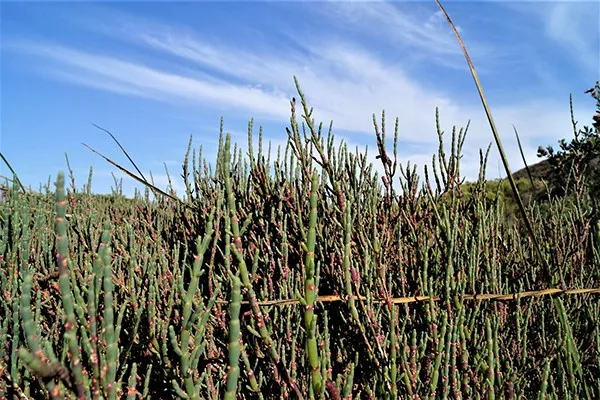
 This study evaluates the potential of *Salicornia neei*, a halophyte native to South America, for treating saline wastewater with simulated concentrations of ammonium and nitrate nitrogen equivalent to those found in land-based marine aquaculture wastewater. Photo by Pato Novoa via Wikimedia Commons.
The development of recirculating aquaculture systems (RAS) is limited by the ability to effectively treat saline wastewater, which accumulates large amounts of nitrogen compounds originating from the metabolism of cultured organisms. In RAS, the removal of nitrogen compounds, primarily ammonium and ammonia, is prioritized because they rapidly degrade water quality and have negative impacts on the cultured animals. Biofilters that promote the conversion of ionized and unionized ammonium to nitrate are commonly used for this purpose. Nitrate is not highly toxic to most cultured organisms, with acceptable accumulated concentrations ranging from 120 to 150 mg per liter.
The recent development of integrated systems allows for the use of RAS waste as nutrients, connecting different water circuits to the main shrimp or fish production water system. To utilize these wastes, such as nitrogen compounds accumulated in marine RAS models, the use of constructed wetlands with halophytic plants has been proposed. Halophytes are capable of absorbing various forms of nitrogen, depending on different environmental factors.
Salicornia neei is a halophytic plant that thrives in saline environments, native to South America and widely distributed along the South Pacific coast, where the majority of marine aquaculture production in South America is concentrated. S. neei is used as human food and is an emerging crop in coastal Chile. This plant is described as containing abundant nutrients and important functional metabolites.
Study Setup
The research team collected 100 *Salicornia neei* plants with fully developed roots and shoots from a wetland in the Valparaíso Region, Chile, and transported them to the study area. The plants were transplanted into sand beds and irrigated for 10 weeks, after which they were transferred to the experimental unit.
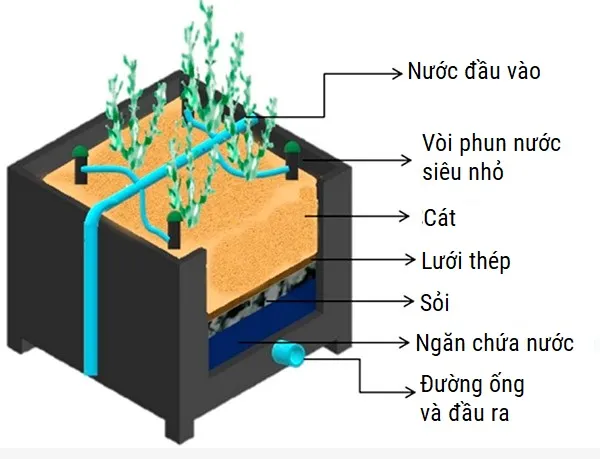 Figure 1: Diagram showing the design of a mesocosm, illustrating the overall construction, water inlets and outlets, substrate (sand and gravel separated by mesh), and micro-irrigation nozzles.
The experimental unit consisted of three separate RAS systems, each RAS comprising three recirculating mesocosms (replicates). Each mesocosm was placed in a polyethylene container measuring 0.5 × 0.6 × 0.6 meters (length × width × depth) with a surface area of 0.3 square meters and a total area per RAS of 0.9 square meters. Four *S. neei* plants were transplanted and grown in each mesocosm until a biomass of approximately 1 kg per mesocosm or 3 kg per square meter was achieved. Effluent water (wastewater) was returned to the respective collection tanks of each system to close the water recirculation loop.
Plants were cultivated for 74 days in water settlement tanks under three fertilized seawater treatments: (1) Nit + Amm, (2) Nit, or (3) unfertilized (Control). Physicochemical parameters of water quality were recorded directly from the effluent water during the first eight consecutive days after nutrient addition.
Results and Discussion
The integration of halophytes as biofilters in recirculating systems in marine aquaculture has been proposed as a suitable alternative for water decontamination due to increasing nitrogen compounds. This study evaluated whether *S. neei* constructed wetlands could be used to treat saline aquaculture wastewater. *S. neei* was primarily chosen due to its natural occurrence along most of the South Pacific coast of South America, which would allow for its rapid adoption in the growing South American aquaculture industry. The nitrate-nitrogen removal rates and removal efficiency recorded in this study were higher than or similar to those reported for other halophyte species at high salinities. Therefore, *S. neei* constructed wetlands could be a suitable alternative for treating high-concentration wastewater discharged from marine RAS operations.
Physicochemical parameters of wastewater, such as temperature and pH, are particularly important in the treatment of saline wastewater as they can affect the decisive processes in the removal of nitrogen compounds. In our study, temperature and pH were maintained within optimal ranges (20–21 degrees C and 7.8–8.2, respectively) and therefore did not affect the nutrient removal process. This finding is consistent with studies by other researchers, where for denitrification in wetland systems, the optimal temperature ranges from 20 to 40 degrees C and the optimal pH is around 8.0.
Another important parameter we evaluated in our study was the high effluent salinity, reaching concentrations of up to 50 grams/liter NaCl. This increase was primarily due to the known environmental factor of evapotranspiration.
The total amount of nitrogen fixed in the shoots of *S. neei* corresponded to 1.76 ± 0.08 grams per 100 grams fresh weight. Other researchers in India also obtained similar results for *Salicornia Brachiata*. Therefore, it is estimated that the total concentration of fixed nitrogen nutrients in *S. neei* at the end of the experiment would be from 46 to 103.9 grams for the Nit treatment, while for Nit + Amm, the fixation would be from 57.8 to 130.1 grams N for the total biomass formed by this treatment, indicating that *S. neei* can assimilate most of the available nitrogen in this experiment.
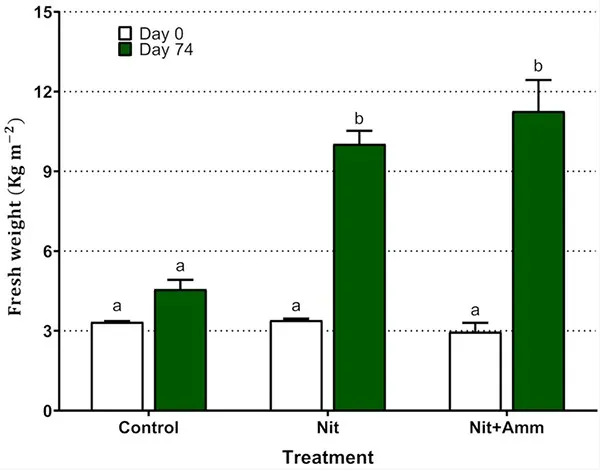 Figure 2: Biomass production of *Salicornia neei* by treatment, expressed as fresh weight yield per unit area (kg per square meter). Nit + Amm: corresponds to treatment irrigated with nitrate-nitrogen and ammonium-nitrogen, Nit: irrigated with nitrate-nitrogen, Control: treatment irrigated with seawater only.
 The results showed that nitrogen removal was proportional to biomass. The biomass formation of *S. neei* during the evaluation period reached a total net weight of 7 to 8 kg per square meter over 11 weeks in the Nitrogen and Nit + Amm irrigated treatments, respectively. The *S. neei* plants remained vigorous throughout the evaluation period, even at high salinity concentrations of nearly 50 grams / liter NaCl.
This inherent characteristic of halophytes highlights the robust response mechanisms to abiotic stress exhibited by *S. neei*, reinforcing the feasibility of incorporating this plant into aquaculture wastewater treatment. Regarding the removal of the two nitrogen compound sources, there was a positive interaction between the supplied ammonium/nitrate and the biomass formation of *S. neei*.
Perspective
The results demonstrate that the integration of *S. neei* into constructed wetlands with recirculating aquaculture wastewater would be a viable alternative for nutrient removal in saline wastewater and has potential for marine RAS systems in South America.
Authors: Mónica R. Diaz Javier Araneda Andrea Osses Jaime Orellana Dr. José A. Gallardo