Broodstock maturation farming technique is one of the first important steps in the seed production process; good quality broodstock will yield high survival rates and fast growth. The average size of imported shrimp ranges from 38-73g/individual for males and 40-79g/individual for females.
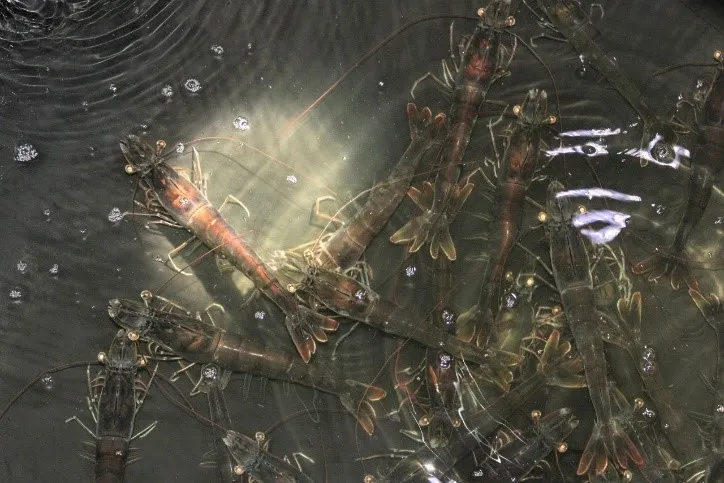
Eyestalk-intact female shrimp
- Broodstock Maturation Pond Preparation.
• Maturation ponds are usually large, round or square, with a capacity of 10 - 20 m3. Ponds should be smooth and dark-colored. The water supply pipe should be Ø 60 – 90, so that when changing water, it helps create a central vortex to carry out dirt and feces, cleaning the water. The drainage pipe should be Ø 90 - 114. Ponds are thoroughly cleaned, disinfected with Chlorine at a concentration of 40 ppm, then rinsed with fresh water before filling with clean seawater.
• Female (broodstock) and male (broodstock) shrimp rearing tanks should be close to each other, and spawning tanks should be close to female (broodstock) tanks for easier operation.
Spawning tanks typically have a volume of 5 – 12 m3. Spawning tanks need to be prepared with tarpaulins for covering.
• Lighting for Pacific white shrimp broodstock: lighting for broodstock should follow a natural cycle, i.e., 12 hours light and 12 hours dark. Too much or too little light will reduce the shrimp's reproductive capacity. The appropriate light intensity for broodstock is 500 - 1,000 lux. Light intensity can be measured with a light meter or by observing the shadow of the farmer's hand when placed in the rearing tank. If the hand shadow is clear, the light intensity is sufficient; if the hand shadow is faint, the light intensity is weak, and additional lighting is needed.
• Seawater is treated and filtered through mechanical and biological filtration systems to remove suspended solids and pathogens. Water entering the tank must meet environmental parameters: NH3 < 0.1 mg/l; NO2 < 0.05 mg/l; pH 7.5 - 8.2. Rearing water temperature 28 – 290 C, salinity > 28 - 32‰. Water depth 0.5 - 0.7 m. Rearing tanks are aerated 24/24, with 6 - 8 air stones placed in the center of the rearing tank.
- Broodstock Source:
• Domestic shrimp source: Shrimp are acclimatized, carefully selected, and then introduced for spawning.
• Imported shrimp source: There are Pacific white shrimp broodstock lines such as: Specific Pathogen Free (SPF) lines, disease-resistant lines, low-salinity tolerant (SPR) lines.
Currently, SIS (Shrimp Improvement Systems) provides Vietnam with 3 different broodstock lines to suit the conditions and needs of hatcheries and farmers:
+ SIS Superior: Fast growth.
+ SIS Hardy: Moderate growth, high tolerance.
+ SIS Regulargrowwth: Balance between growth and tolerance.
C.P Group produces Pacific white shrimp broodstock with two main lines: CPF-Turbo and CPF-Kong.
• Select clean, healthy, disease-free shrimp broodstock. Male shrimp should be 35 g or larger, and female shrimp 40 g or larger. The male/female ratio is: 3/2.
+ Currently, the average size of imported shrimp ranges from 38-73g/individual for males and 40-79g/individual for females.
+ Select shrimp with intact reproductive organs. Males have swollen, milky-white spermatophores. Females have eggs from stage 1 to stage 3.
- Shrimp Acclimatization.
• For imported shrimp:
+ Fill the rearing tank with clean water, add ice to the tank (it's better if the ice is wrapped in clean nylon bags).
+ Adjust the water temperature in the tank to match the water temperature in the broodstock bags (or containers) upon arrival.
+ Place the shrimp bags into the tank, continue to acclimatize salinity, then slowly release the shrimp.
Note: Female and male shrimp should be stocked in separate tanks, not mixed.
• For domestic shrimp: do similarly.
• Broodstock stocking density: 7 - 10 individuals/m2.
• After acclimatizing broodstock for about 1 – 2 weeks when shrimp are healthy, proceed with unilateral eyestalk ablation for females. Use heated forceps to clip one eyestalk.
• Spawning can be initiated 3 – 5 days after eyestalk ablation.
(Eyestalk ablation may not be performed depending on the farming process).
• Daily feed broodstock with polychaetes, squid, oysters, earthworms, blood cockles, etc., supplemented with vitamins and minerals.
• Broodstock diet: 40% polychaetes + 30% fresh squid, 30% oysters, mixed with vitamins, intestinal probiotics.
• Feed shrimp 3 - 4 times/day, with a total feed amount equal to 30 - 40% of body weight/day. Check 2 hours after feeding; if there is leftover feed in the tank, it must be removed to ensure a clean rearing environment.
• Clean and change water daily every morning. Scrub the tank walls, bottom, air lines, rinse the tank with fresh water. When about 60% of the water has been drained, open the bottom water supply valve to create a central vortex. Once all feces and old water are removed, close the drain and proceed to fill the tank with sufficient water. Carefully observe the shrimp for color, appendages, reflexes, etc., each time water is changed, to address issues promptly. Periodically, every 7 – 10 days, use formalin at a concentration of 25 ppm. In cases where the tank is very slimy, or shrimp gills and appendages show signs of disease, before changing water, bathe the shrimp with: BKC Gold or Aqua Dine or VibrioClear at a concentration of 1 ppm for 2 hours, then proceed with water change.
• Disease prevention for broodstock:
This is a crucial step, determining the success of the production cycle as well as the quality of larvae.
To achieve success, a strong and appropriate solution must be chosen for disease prevention in shrimp, helping shrimp stay healthy, ensuring even egg development, continuous egg production, and good eggs for healthy nauplii (for females) and abundant, vigorous sperm (for males), in order to cope with the current disease situation. Especially, Glass Post-larvae Disease (GPD), also known as Translucent Post-larvae Disease (TPD).
Implemented solutions:
+ Shrimp gut health solution:
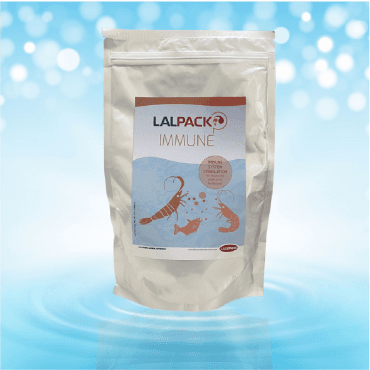
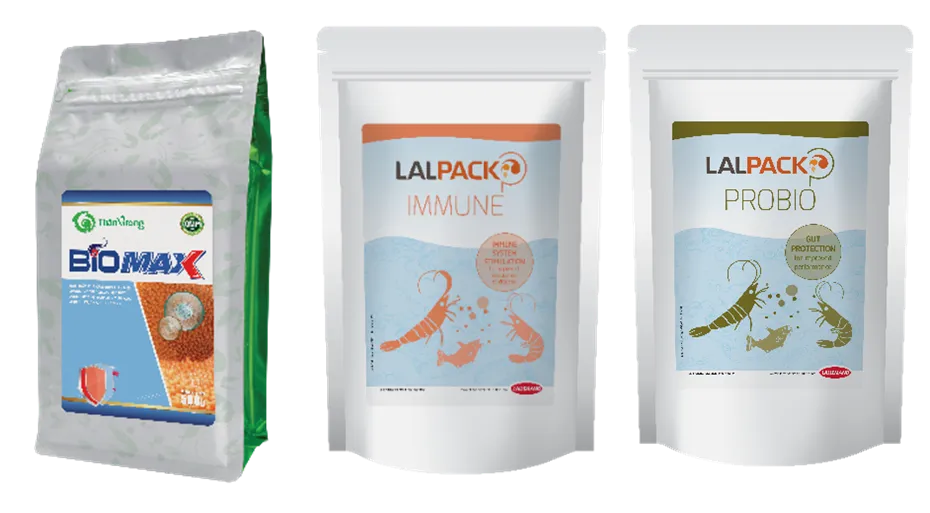
Mix premium intestinal probiotics: Bio Max 15g/kg alternately with the duo Lalpack Probio 20g/kg + Lalpack Immune 20g/kg feed. Feed throughout the rearing process to help protect shrimp gut and ovaries.
+ Shrimp liver health solution:
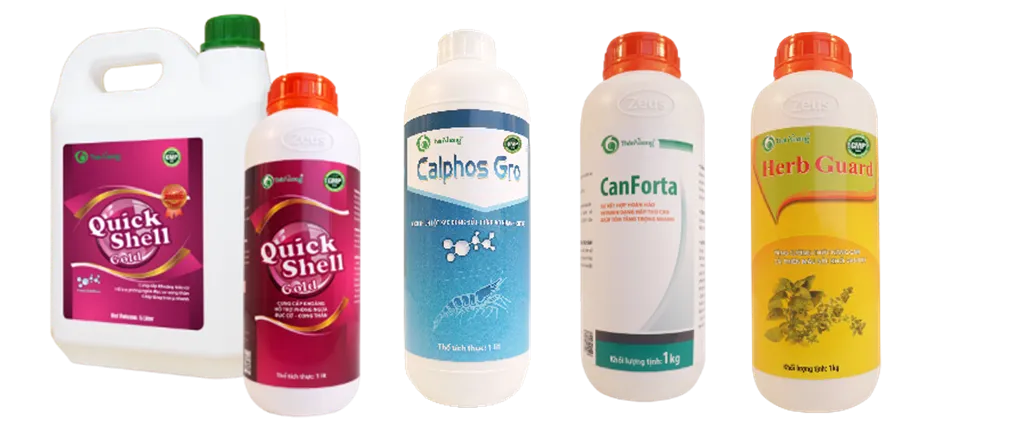
Mix Herbguard (liver detoxifier and liver function enhancer) 20ml/kg + Bio Max 15g/kg.
+ Nutritional solution:
Mix Canforta (concentrated vitamin) 20ml/kg + QuickshellGold (easily absorbed organic trace minerals) 25ml/kg. Additionally, broadcast Calphos Gro 2ml/m3 of water, which helps shrimp directly absorb minerals and creates a better mating environment for shrimp.
♦ Some other important notes:
+ For polychaete feed:
- Clean, ensure continuous water flow, ensuring polychaetes are clean and healthy.
- Feed polychaetes with N0 feed mixed with the duo Lalpack Probio, Lalpack Immune, at a ratio of 1:1:1. Dosage: 10g of mixture (feed, Lalpack Probio, Lalpack Immune)/kg polychaetes, for one feeding; feed twice/day. This helps keep polychaetes healthy and clean. It eliminates harmful vibrios and parasites, preventing the risk of disease transmission such as: (Early Mortality Syndrome EMS, EHP disease, Translucent Post-larvae Disease TPD, etc.).
+ For squid feed:
Thoroughly peel the skin, rinse with salt water or Iodine, then chop into small pieces and mix with the aforementioned substances.
+ For oyster feed:
- Select fresh, new oysters.
- Wash thoroughly, remove broken shells before mixing with the aforementioned substances.
- Regularly clean refrigerators, freezers, squid cutting machines, and tools to prevent bacterial contamination.
Additionally, some other feeds also require similar cleaning.
- Preparation for Spawning.
• After 2 - 3 weeks of maturation, when over 20% of female shrimp have developed eggs, inspect and select shrimp for spawning.
• Spawning tanks are treated with EDTA 10ppm and aerated 24/24. Adjust aeration to be gentle and moderate.
• Select female shrimp with well-developed eggs (stage IV eggs) and transfer them to male shrimp tanks or separate mating tanks. This is usually done between 15:00 – 16:00. Turn off all lights.
+ Average fecundity of female shrimp: If the female shrimp weighs 30 - 45g, the egg count ranges from 100,000 - 250,000 eggs.
+ Spawning density is about 3 – 5 individuals/m2. Egg density is about 1,000,000 eggs/m3.
+ The interval between two spawning events is about 2 – 3 days.
• After about 2 – 3 hours, use a flashlight to check (check once every 2 hours at 18:00, 20:00, 22:00), transfer fertilized female shrimp to the spawning tank, and cover the spawning tank with a tarpaulin.
After spawning, remove the shrimp and place them in the female shrimp tank.
• Egg quality assessment:
+ Good egg laying: The tank has a slight fishy odor, small and few bubbles, and detached eggs. Microscopic examination shows a fertilization membrane, and cell division occurs 30 minutes after spawning.
+ Poor egg laying: The tank has a fishy odor, many slimy bubbles, and clumped eggs. Microscopic examination shows few fertilization membranes, most eggs do not undergo cell division 30 minutes after spawning, and many eggs are broken.
• Proceed with egg stirring (stir once every 1 hour) to ensure even hatching.
• Eggs hatch approximately 13 – 14 hours after spawning (in winter, lower temperatures result in slower hatching). After all eggs have hatched, proceed with Nauplius collection.
- Nauplius Collection Methods:
Method 1: Turn off aeration, use a light to concentrate nauplii, and collect them with a net.
Method 2: Use a nauplius collection net (the net frame should be wide enough not to compress nauplii), gently pump water into the net frame, and use a net to transfer nauplii from the net frame to a 120 - 150 liter collection tank.
After collecting nauplii, proceed with nauplius quantification. Transfer nauplii to the larval rearing tank.
TECHNICAL DEPARTMENT THAN VUONG COMPANY