Due to its strong antiviral properties, polysaccharide is highly effective in controlling White Spot Disease in shrimp. This effect has been tested in Thailand. Thai authors suggest that polysaccharide is effective in controlling White Spot Disease in Penaeus monodon shrimp caused by White Spot Syndrome virus (WSSV). Experimental results showed that polysaccharide was incorporated into the feed of two shrimp species weighing 5 – 8g and 12 – 15g before and after infection. After 10 days of viral infection, the survival rates of these two shrimp species were 46% and 93%.
In Japan, crude polysaccharide extracted from the brown seaweed “Okinawa-mozuku”, Cladosiphon okamuram, is also used to control White Spot Disease in kuruma shrimp (Penaeus japonicus). Polysaccharide was mixed into shrimp feed at dosages of 60 and 100mg PPF/kg/day, and shrimp were fed this diet for 15 days. In the first 4 days, the results of the crude polysaccharide-mixed feed were not significant. After 10 days, the shrimp survival rates were 77% in the group fed with 60 mg mixed feed and 76.2% in the group fed with 100mg crude polysaccharide mixed feed. These rates were significantly higher than the control group without polysaccharide supplementation (P<0.01). It is clear that experiments with different shrimp sizes yield different results; larger shrimp tend to have higher survival rates. However, in both sizes, the use of crude polysaccharide-mixed feed resulted in high survival rates.
Another experiment was conducted to evaluate the effectiveness of a polysaccharide mixture extracted from brown seaweed (Sargassum microcytum) on the growth and survival rate of black tiger shrimp (Penaeus monodon). The experiment included 4 treatments corresponding to different polysaccharide levels: 0%, 0.5%, 1%, and 2%. Each treatment was replicated 3 times, and the experiment was conducted in composite tanks with a stocking density of 100 shrimp/tank. The experiment lasted for 60 days. After 60 days, the treatment group fed with 0.5% polysaccharide mixture had the highest average survival rate of 96.67%±2.89, while the 2% treatment group had the lowest average survival rate of 52.0%±6.24. The survival rate of shrimp between the 1% treatment and the control showed no statistically significant difference (p>0.05). The highest growth indices, SGR and DWG, were observed in the 2% treatment group, averaging 7.25±0.61%/day and 0.008±0.0032 g/day, respectively, followed by the 1% treatment group. The above research results confirm that feeding with a polysaccharide mixture extracted from S. microcystum seaweed helps improve shrimp survival rates during farming.
Experimental results show that polysaccharide mixture can be used in shrimp feed. Growth rate tended to increase with the supplementation level, reaching its highest at 2% supplementation.
According to research by Briggs et al., (1996), when Gracilaria sp. seaweed was supplemented into black tiger shrimp feed at levels of 0%, 5%, 10%, 15%, and 30% of the feed weight. The highest relative growth rate was observed in the 10% treatment (8.03%/day) and the lowest in the 30% treatment (7.33%/day). The reason is attributed to high ash content, low protein content, or the presence of high soluble fiber in the experimental feed with high seaweed supplementation levels. Polysaccharide mixture supplemented into feed affects shrimp growth but is only suitable at certain concentrations. At each concentration, the polysaccharide mixture exhibits different antioxidant activities.
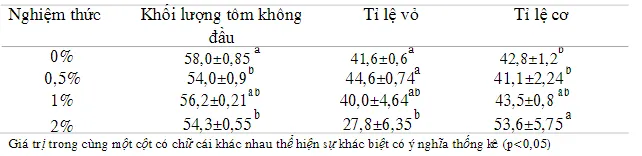
At the end of the experiment, shrimp sample analysis showed differences in headless shrimp ratio, meat yield, and shell ratio between the control and supplemented treatments. Treatment 4 (2%) yielded the highest meat ratio, reaching 53.6%. Among the remaining treatments, there was no significant difference, only fluctuating from 41.1 – 43.5%.
Table 1. Shell ratio and muscle ratio of P. monodon black tiger shrimp when fed polysaccharide mixture at different concentrations (%)
The moisture content in the experimental shrimp meat gradually increased with the supplementation level of the polysaccharide mixture (66.5 – 72%). The moisture content for treatments 1, 2, 3, and 4 were 66.5%, 66.7%, 70.9%, and 72%, respectively. Regarding shrimp size, larger shrimp have higher metabolic demands to support growth. The muscle protein content (% CP) of shrimp ranged from 29.6 – 34.2%. At 1% supplementation (NT3), the highest protein content was 34.2% (p<0.05). Treatments 0% (NT1) and 0.5% (NT2) had protein contents of 31.8% and 32.2%, respectively. However, the 2% treatment had the lowest protein content of 26.1% with the highest polysaccharide mixture supplementation level. This could be due to the high biological activity of the polysaccharide mixture at 2% supplementation exceeding the cellular capacity, thereby limiting protein accumulation in the muscle. According to research by Augusto et al., (2014), supplementing black tiger shrimp with a polysaccharide mixture extracted from Enteromorpha intestinalis at 1g – 1.5g/kg significantly increased protein production.
Through these studies, it is shown that the benefits of supplementing with seaweed-extracted polysaccharide are advantageous for farmed shrimp. It helps improve survival rates for normal shrimp and even when shrimp are infected with WSSV. Furthermore, after harvest, commercial shrimp achieve high protein content, yielding clean and safe products.
Source: Internet Compilation