Test results show bacterial composition varies significantly depending on water salinity
Whiteleg shrimp is the most farmed shrimp species worldwide. Their native habitat is the eastern Pacific coast of South America with an average water temperature above 20°C and salinity of 34–37‰. In aquaculture, this species is commonly produced in ponds at water temperatures of 26–32°C, primarily in South America and Asia. With the development of land-based recirculating aquaculture systems (RAS), whiteleg shrimp production has also become feasible in Northern European and North American countries in inland farms independent of natural seawater.
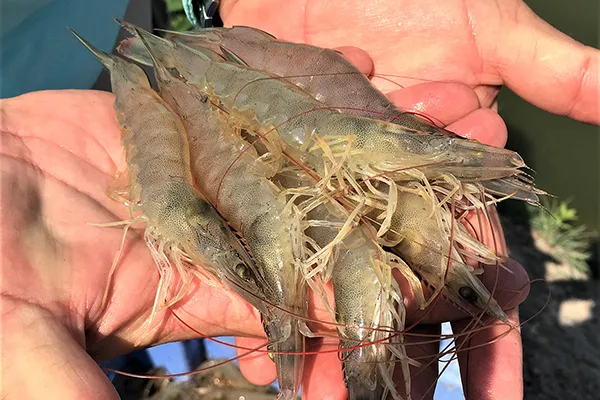
The main challenge of RAS shrimp farming is maintaining high water temperature and appropriate salinity. By utilizing waste heat from biogas plants, RAS water heating can be achieved sustainably. Since whiteleg shrimp tolerate low to medium salinity, RAS for growing shrimp after the post-larval stage is often operated at 10–15‰ salinity to reduce costs for artificial sea salt and the volume of saline wastewater. This further contributes to the sustainability of local shrimp production. However, even if shrimp tolerate brackish water, their natural immunity can be suppressed when water salinity decreases, especially when the ionic composition is suboptimal.
These are common bacteria in seawater and brackish water, accounting for up to 40%. Some Vibrio spp. form part of the natural microbiota of fish and shellfish, but some species can also act as opportunistic pathogens for shrimp or finfish. Specifically, V. alginolyticus, V. campbellii, V. harveyi, V. owensii, and V. parahaemolyticus are potential pathogens for shrimp. Some Vibrio species are also known to be pathogenic to humans, especially V. cholerae, V. parahaemolyticus, and V. vulnificus.
Study Setup
The analyzed water samples originated from 6 different RAS systems stocked with whiteleg shrimp of varying ages and production conditions. Three RAS systems were maintained at approximately 30‰ salinity, and three RAS systems were maintained at approximately 15‰ salinity. RAS 1, 3, 5, and 6 were located at different research facilities. RAS 1 and RAS 3 comprised three 100-liter tanks. RAS 5 and RAS 6 comprised three 70-liter tanks.
All RAS in the research facilities were stocked with specific pathogen-free (SPF) shrimp. Samples from RAS 2 and RAS 4 originated from commercial production facilities in Northern Europe. RAS 2 comprised two 7,000-liter tanks, and RAS 4 comprised four 88,000-liter tanks. Water samples from each tank of both RAS were analyzed.
Results and Discussion
Maintaining optimal chemical and microbial water quality is crucial for shrimp health in RAS, especially when only a low volume of water is exchanged during cultivation. Water temperature and water quality issues, such as increased ammonia and nitrite concentrations and suboptimal pH levels, can lead to higher susceptibility of animals to bacterial infections, such as those caused by V. alginolyticus.
Changes in water salinity are also very important for shrimp health, ideally at 24‰, but they can tolerate a wide range of salinities, up to 45‰. This is found in RAS systems, where salinity is often reduced to 10–15‰ after the post-larval stage to reduce costs for artificial sea salt and also to reduce the salt content in wastewater. When farming whiteleg shrimp at higher salinities from 25-45‰, the animals maintain good growth, but keeping them at low salinity requires maintaining potassium (K+) and magnesium (Mg2+) concentrations in artificial seawater to achieve optimal growth. Furthermore, the Na:K and Mg:Ca ratios must also be considered as potential confounding factors and should be kept within optimal ranges. If these ions are not adjusted during shrimp farming, low salinity can lead to higher susceptibility to bacterial pathogens such as V. alginolyticus.
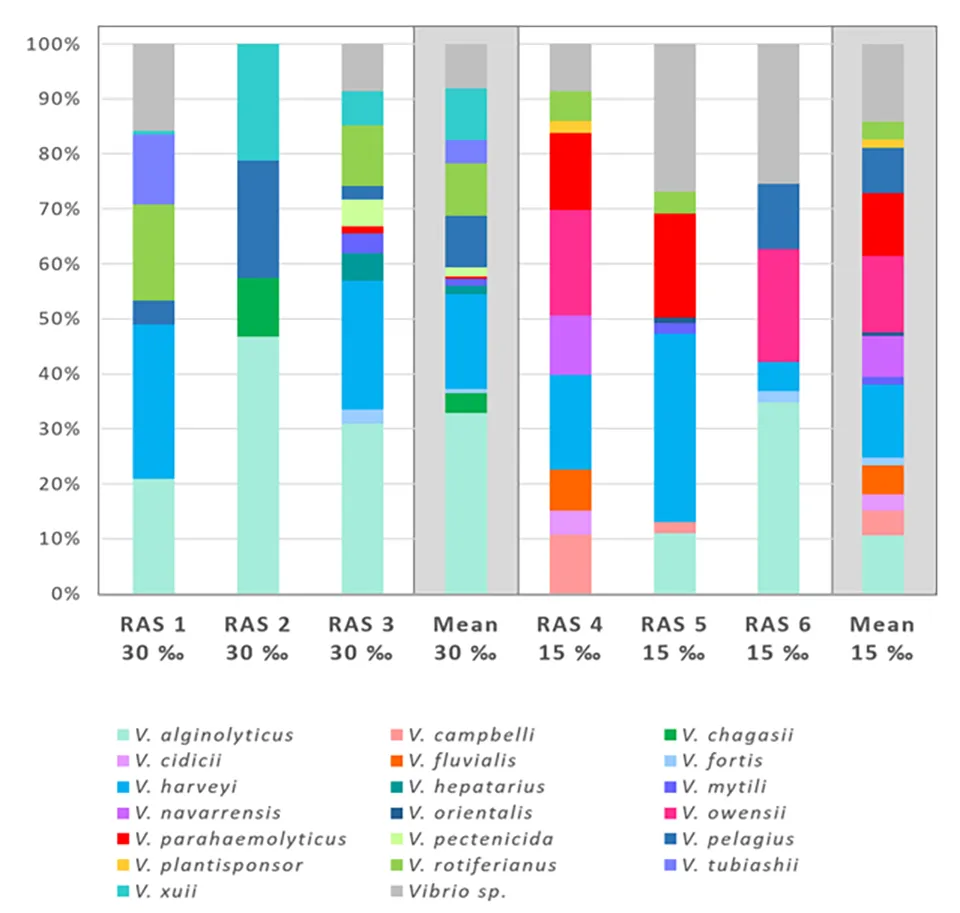
Figure 1. Composition of Vibrio species communities in the water of 6 RAS tanks and average composition
V. alginolyticus was detected at various salinities, but more frequently in RAS at 30‰ salinity. V. alginolyticus is often used in infection experiments as a secondary pathogen to investigate the effects of different water conditions on shrimp. This bacterium can cause clinical signs of disease and reduce natural immunity in shrimp, but the chemical and physical parameters of the water are reported to be decisive for disease severity.
Vibrio harveyi was present in all RAS, except RAS 2, and only a few analyzed isolates tested positive for virulence factors. Other Vibrio bacteria such as V. parahaemolyticus, V. owensii, and V. campbellii were found in higher numbers in water from RAS at 15‰ salinity. V. owensii was only detected in RAS 4. V. parahaemolyticus is known as a pathogen commonly found in seawater and brackish water, causing significant mortality (Acute Hepatopancreatic Necrosis Disease, AHPND) in farmed shrimp since approximately 2009.
All V. owensii isolates tested in this study were negative for AHPND toxin genes, and only a few isolates tested positive for other virulence factors. However, since V. owensii can also carry AHPND toxins and was only detected in one of the RAS at 15‰ salinity, reduced salinity appears to be a risk factor for V. owensii infection in shrimp.
All V. campbellii isolates tested were negative for AHPND toxin genes and all other analyzed virulence factors. V. campbellii was only detected in RAS at 15‰, so it could be a potential threat to shrimp in lower salinity systems.
Perspective
Our results show that the Vibrio population in shrimp water within RAS systems varies depending on water salinity. In RAS at 15‰ salinity, higher numbers of potential pathogenic species V. parahaemolyticus, V. owensii, and V. campbellii were detected, all of which can produce toxins causing Acute Hepatopancreatic Necrosis Disease (AHPND) in shrimp. In high salinity water at 30‰, these species were almost absent.
It can be concluded that reduced salinity may lead to a shift in the Vibrio population towards pathogenic species, thereby increasing the risk of disease outbreaks in shrimp within RAS systems. When considering salinity reduction in RAS systems, not only the negative impacts on shrimp's natural immunity but also the shift in Vibrio species composition need to be considered.
Source: https://www.globalseafood.org/
Translated by: Trần Thị Thúy Quyên