
New research shows that shrimp point-of-care (POC) tests only detect high levels of White Spot Syndrome Virus (WSSV) infection, indicating that shrimp farmers need a better solution.
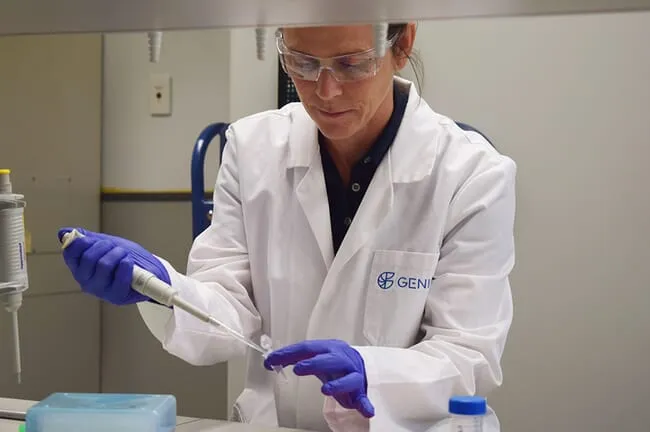
Dr. Melony Sellars working in the Genics laboratory
Beginning in 2019, Australia's Commonwealth Scientific and Industrial Research Organisation (CSIRO) partnered with the country's shrimp industry stakeholders in a comprehensive study of WSSV testing methods. The newly published research report - An Evaluation of Point-of-Care (POC) Tests for White Spot Syndrome Virus (WSSV) - compared existing commercial tests designed to detect WSSV on commercial shrimp farms with laboratory PCR tests.
“At the time of the study, point-of-care tests had become a commonly used disease detection method for shrimp farmers, a situation that persists to this day. However, with the publication of CSIRO's findings, it is time for an urgent re-evaluation of testing methods,” said Dr. Melony Sellars, shrimp disease expert and CEO of Genics, regarding the new findings.
“CSIRO's study compared and evaluated five WSSV tests, including three rapid antigen-type tests and two PCR-based tests. The study clearly showed that the evaluated POC test kits yielded poorer limits of detection (also known as sensitivity) when compared to laboratory PCR tests,” she added.
Among the issues with POC kits, CSIRO highlighted the gap between user expectations and the actual sensitivity of field test kits.
“The lack of sensitivity of these POC testing systems actually creates a false sense of security for shrimp farmers. The findings of the CSIRO study have significant implications for the global aquaculture industry because the current expectation of shrimp farmers is that POC tests can detect WSSV in the early stages of infection, providing early warning of the disease. However, the CSIRO study identified significant problems with the evaluated POC test kits, meaning that in reality, they are not a solution for early warning and prevention of WSSV,” Dr. Sellars argued.
The need for a strategic change
“For shrimp farmers, the conclusion from the CSIRO study is clear: to avoid devastating WSSV outbreaks, the shrimp industry urgently needs to switch to using laboratory PCR tests for routine screening instead of relying on POC kits and testing systems. Notably, such laboratory PCR tests must also be validated by laboratory personnel, as all tests vary in performance based on equipment, chemistry, personnel, and operating conditions,” Dr. Sellars concluded.
Source: thefishsite
Translated by: PKT THẦN VƯƠNG CO.