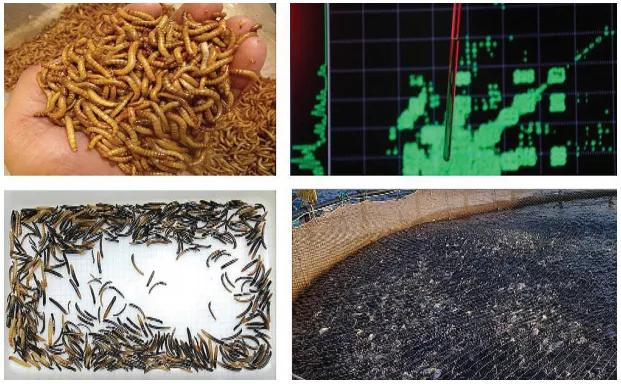
The urgent demand for protein supply is increasing globally. Forecasts indicate an increase to 30 million tons in the next decade, which means 45 million tons of raw materials will be needed for aquaculture. To meet these requirements, protein sources from fishmeal, fish oil, and plants need to be replaced. However, replacing a large amount of protein from fishmeal with plant-based ingredients will reduce palatability and lack essential nutritional components required for aquatic animals. But since 2017, the EU has allowed the use of processed animal protein for farmed fish. In this context, the emergence of insect meals can be exploited as a novel feed ingredient. Yellow mealworm (Tenebrio molitor L.) is attracting significant interest due to its high protein and fat content (protein content up to 35% on a dry basis) and its ability to provide amino acids, fiber, vitamins, and minerals that can meet the requirements for both humans and animals.
Another interesting aspect of mealworm farming is its high sustainability, as they are raised on by-products from the agri-food industry. This adds several benefits, including the elimination or significant reduction of some issues associated with traditional livestock production, such as higher environmental impact and lower feed conversion efficiency compared to insect production. However, the variation in the nutritional composition of mealworms for feed processing is very broad and closely related to differences in rearing conditions, as well as in feed substrates and post-harvest processing methods.
Metabolomics in Aquaculture
Recognizing this opportunity, Porto Conte Ricerche (PCR), a member of the Science and Technology Park of Sardinia (Italy), in collaboration with a research group from the Institute for BioEconomy (IBE), has conducted a three-year research project on the use of insect meal processed from yellow mealworms, focusing these studies on aquaculture feed applications. Here, scientists also focused on optimizing mealworm farming in a sustainable and profitable way. Scientists have shown that when this insect meal is incorporated into fish feed, it leads to better growth performance.
Results
By employing a metabolic approach, scientists have discovered differences related to one of the most important activities in insect meal production, namely the choice of post-harvest processing methods (Melis et al ., 2018). However, generally, two methods, freezing and high-temperature short-time drying, are almost optimal as they minimally affect the quality of this insect meal. More importantly, in this study, scientists found the best mealworm rearing practices. The study indicates that when using two types of feed for mealworms: BSG (by-product from beer production) and WB (wheat bran), mealworms fed with BSG showed higher protein content, higher fat content with PUFA components (Omega 3 and Omega 6), and rearing mealworms with BSG feed resulted in a low feed conversion ratio (FCR) and easier absorption for the larvae.
Conclusion
- Rearing insects as high-value feed will rapidly emerge.
- The technology required for efficient insect rearing and processing is still in its early stages and demands dedicated scientific research to improve quality and production efficiency.
- Metabolomic analysis tools have shown the ability to detect physiological responses most relevant to mealworms for alternative feed and achieve high-quality insect meal.
- Further studies are being conducted at Porto Conte Ricerche and the CNR Institute of BioEconomy on the selection and testing of different rearing substrates and the characteristics of yellow mealworm-fed aquaculture on carnivorous marine fish.
Source: AQUAFEED - (Riccardo Melis and Roberto Anedda, Porto Conte Ricerche and Giuseppe Serra, CNR Institute of BioEconomy)