
Industry stakeholders must prepare for the future of sustainable shrimp farming. Regis F. Bador, development strategy consultant, New Caledonia, moderated the workshop on "Future-proofing Asian shrimp farming" and explained: "The concept of future-proofing is the process of anticipating the future and developing methods to mitigate the impact of shocks and stresses from future events". The challenge for the five speakers was to focus on strategies to future-proof shrimp farming in Asia. These included farming practices, production costs, product quality for the market, disease control, smart feeding technology, and life cycle assessment (LCA).
Market Trends and Challenges
"Industrial shrimp farming saw strong growth from 2021 to 2022; farmed shrimp production increased by 11% while market demand was +13%", said Herve Lucien-Brun, Aquaculture Consultant, Jefo Nutrition, as he provided an overview of the headwinds the industry faced in 2023. "As supply increased, various factors are causing disruptions in key markets, especially in China, the EU, the US, and Southeast Asia". "Demand has been impacted by inflation, consumer confidence, and economic crises, affecting market stability and farm-gate prices," Lucien-Brun added. "While global supply increased, market demand struggled to keep pace, leading to price reductions and reduced profitability for shrimp farmers. In this competitive environment, while larger enterprises benefit from economies of scale and market expertise, independent, small-scale producers face significant challenges.
Rising Energy and Feed Input Costs
Energy and fuel costs, as well as feed costs, continue to rise. In 2023, energy and fuel costs accounted for 7%, 20%, and 13% of the cost of production (COP) in Ecuador, Thailand, and Indonesia, respectively. "Intensifying production, which often involves increased aeration to maintain dissolved oxygen levels, poses a critical challenge: Will increased production offset the additional energy costs?", Lucien-Brun questioned. In Vietnam, the impact of falling shrimp prices is severe. Wei Che Wen, Uni-President Vietnam, noted that in 2023, the average cost of production in Vietnam was US$3.5 ~ 4.5/kg (50/kg) while farm-gate prices were US$4.0 - 5.0/kg.
Feed accounts for over 50% of COP, such as 53% in Ecuador, 42% in Thailand, and 56% in Vietnam. Shrimp feed prices have escalated in parallel with rising prices of key ingredients. However, the suggestion from Dominique Bureau's presentation is that more can be achieved through smart feed management. "Productivity and profitability are often negatively impacted by poor feed management."
Health Monitoring and Microbiome
"What we don't see with standard farming practices is related to the microbiome and therefore impacts our inability to make preventative decisions around shrimp farm management," said Alex Farthing, Co-founder and Chief Scientific Officer at Indonesia-based Delos Aqua. The company focuses on enterprise farm management.
In his presentation, he touched on several aspects of preventative workflow and explored techniques and technologies to unlock the story of the shrimp gut microbiome and provide health insights. "Microbiome management has emerged as a developing aspect of shrimp farming, aiming to enhance health, productivity, and sustainability in aquaculture systems," Farthing stated.
Challenges in Microbiome Monitoring
Conventional methods such as plate counts and flow cytometry face limitations in accurately capturing microorganisms.

Alex Farthing said: "The establishment of a beneficial microbiome, ideally starting in broodstock and maintained throughout hatchery and grow-out phases, is essential for effective microbiome management."
Diversity and dynamics in shrimp farms. Metagenomic analysis is a promising tool, providing deeper insights into microbial shifts and disease correlations to facilitate early intervention and disease management. Farthing stated: "Significant mortality from EHP infection can correlate with high Vibrio loads. Understanding the presence and structure at this level of detail can indicate when we can predict mortality and how it will impact feed and how to change feed management practices."
Microbiome Presence
In cases of co-infections such as AHPND-IMNV-EHP, gut dysbiosis correlates with shrimp mortality.
Microbiome presence indicates the quantity of microbiome in the gut and hepatopancreas relative to the microbial community in the water and sediment (Figure 1). Organelle damage occurs when the microbiome in the gut and hepatopancreas is equal to that in the water and sediment. Therefore, understanding these dynamics is key to adjusting treatment strategies and enhancing microbial balance to improve shrimp health and survival rates.
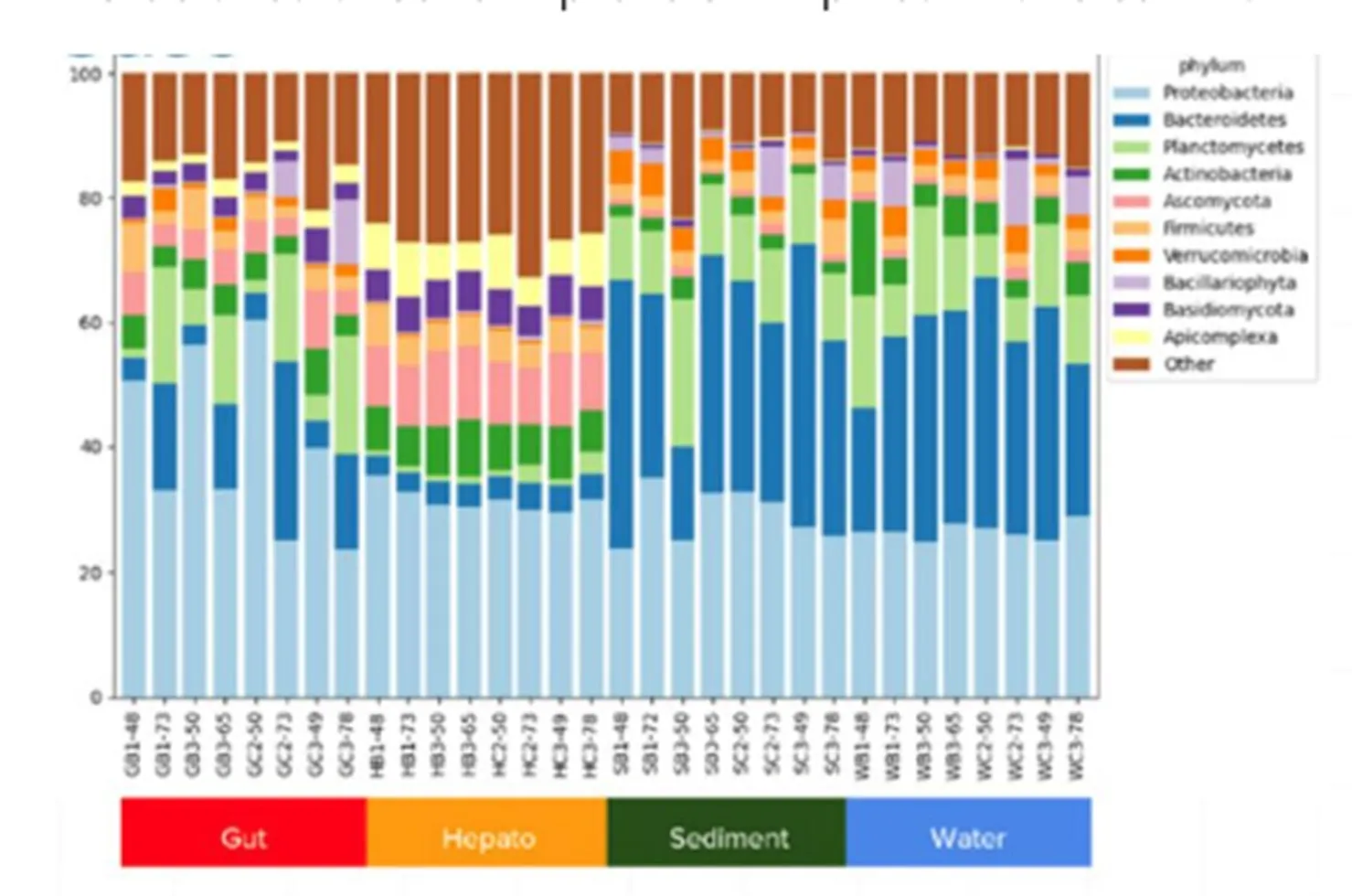
Figure 1. Microbiome in shrimp with co-infections (AHPND-IMNV-EHP) showing the microbial community in the gut and hepatopancreas compared to the microbial community in sediment and water. Source:
Alex Farthing, 2023. Health Monitoring and Microbiome for Preventative Shrimp Farm Management presented at TARS 2023.
Promising Tools in Microbiome Management
These include probiotics and prebiotics, offering preventative and therapeutic interventions in shrimp farming. Delos has dedicated significant time and effort to demonstrating their efficacy and application. "Probiotics, which comprise a significant portion of chemical and additive costs, are challenging to validate for effectiveness, but we can see the effect over a long period," Farthing said.
Metagenomic analysis indicates that despite regular Bacillus-based probiotic supplementation, bacterial composition often remains stagnant or declines over time. Evaluating probiotic efficacy requires considering environmental factors and delivery methods to optimize dosage and application. In the case of prebiotics, the challenge lies in delivery. Supplementation methods, whether through diet or on-farm application, play a role in prebiotic effectiveness," he added.
Microbiome Management: Causes and Recovery
The presence of a beneficial microbiome, ideally starting in broodstock and maintained throughout the nursery and grow-out phases, is essential for effective microbiome management. Early intervention ensures the establishment of a healthy microbiome, which enhances shrimp health and disease resistance.
While a resilient microbiome can naturally recover to a healthy state, the effectiveness of treatments for large-scale dysbiosis remains limited. Even if the gut microbiome recovers, tissue regeneration is slow, leaving the microbiome vulnerable to subsequent changes.
Aligning Products with Specific Market Needs: Cost and Quality
"Survival strategies for farmers include: controlling production costs, adjusting production to demand, optimizing product quality, and considering market-appropriate certifications to enhance product value," Lucien-Brun said.
Soybean meal, wheat flour, and fishmeal are key feed ingredients. Decreased supply and increased prices mean that alternative protein sources need to be utilized, despite challenges in nutritional consistency and environmental impact. Therefore, proteases in the diet play a role in enhancing protein digestibility and amino acid availability, thereby improving growth performance and profitability in shrimp farming. Experimental studies demonstrate the effectiveness of incorporating proteases into shrimp diets, offering a sustainable solution to reduce feed costs and environmental impact. Undigested protein is not metabolized and waste feed pollutes the environment."

Optimizing Product Quality
The shrimp market is diverse and complex. Product differentiation based on presentation, origin, and quality is crucial to meet consumer expectations and navigate price fluctuations effectively. Maintaining product quality from farm to market is paramount, as quality degradation occurs rapidly post-harvest. Farmers play a vital role in preserving quality, which is incentivized by price differentials based on product quality, as seen in Ecuador. Direct communication between farms and packing plants helps improve quality assurance and enhance consumer satisfaction. Understanding cultural and consumer preferences is essential for exporters to offer products appealing to the end consumer.
Market-Appropriate Certifications
Certifications such as ASC, BAP, and Global_GAP build consumer trust and facilitate market access. These certifications validate responsible farming practices, ensuring product safety and quality throughout the supply chain. Choosing the right certification while considering regional priorities, Regio warenesses a certification ID requirement. Adherence to industry standards is essential for market competitiveness and consumer confidence.
Balancing Farm Management and Production Capacity for Small-Scale Farmers in Vietnam
Tóm tắt nội dung chính: Sự nóng lên toàn cầu làm thay đổi hệ vi sinh vật đường ruột của tôm thẻ chân trắng Thái Bình Dương bằng cách[...] Tổng hợp thị trường tôm thế giới 2025: Ecuador dẫn đầu xuất khẩu (1.39M tấn, +15%), EU tăng nhập khẩu mạnh nhất (+21%), Mỹ biến động[...] As the aquaculture industry increasingly develops strategies for animal health protection, functional nutrition has become a key fac[...]Products linked to this topic
Related technical articles

CHANGES IN GUT MICROBIOTA DUE TO GLOBAL WARMING. REGULATING HOST HEALTH AND DISEASE STATUS IN POIKILOTHERMIC ANIMALS

Global Shrimp Market 2025 Overview — Shrimp Insights Bulletin February 2026

SALMON UNDER STRESS CONDITIONS: REINFORCING THE FIRST LINE OF DEFENSE

Technical Advisor
Aquaculture Q&A
Help us serve you better
Share your name + phone so we remember your pond next time — no repeating yourself.
- 🔒 Tech team only — never shared with third parties
- 📨 No spam, no promotional SMS
- 💾 History saved on your device — clear anytime