Shrimp farming is one of the most profitable and fastest-growing sectors in aquaculture. However, the increasing issue of intensive farming has greatly affected disease incidence and caused economic losses.
EMS is a disease causing severe damage in aquaculture with mortality rates up to 90%. Early Mortality Syndrome or Acute Hepatopancreatic Necrosis Disease (AHPND) is caused by the bacterium Vibrio parahaemolyticus. The disease affects both whiteleg shrimp and black tiger shrimp, leading to high mortality rates of 90%. The disease has spread across many countries including China, Vietnam, Malaysia, Thailand, and Mexico.
Probiotics are live microbial nutritional supplements beneficial to the host. Probiotics exert their beneficial effects through various mechanisms, not only on the farmed animals but also on the surrounding environment.
Characteristics for selecting suitable bacteria: origin; resistance; ability to colonize and adhere to the intestinal epithelium; viability under normal storage conditions and suitability for intended use.
Characteristics of the Bacillus amyloliquefaciens CECT 5940 strain: Meets EU safety standards; high compatibility with organic acids, AGP; Stable at temperatures up to 1150C, tolerant to pH 2-3; rapid growth rate; Inhibits many pathogens such as Vibrio spp strains; Aeromonas; streptococci…
Mechanism of action of B.amyloliquefaciens CECT 5940: Inhibits pathogenic bacteria affecting shrimp through high lactic acid secretion; prevents communication between pathogenic bacteria; modulates innate immune system; secretes a range of antimicrobial substances (secondary metabolites).
Produces lactic acid beneficial for pathogen control and pH reduction in the gut
Lactic acid plays an important role in shrimp farming by helping to reduce pH in the gut; reduce pathogen load in the gut and stimulate the growth of Lactobacillus and other beneficial lactic acid bacteria.
Prevents communication between pathogenic bacteria (quorum quenching)
Bacteria communicate with each other through the production of various specific molecules; this communication is called quorum sensing (QS). The molecule responsible for communication is N-acyl-homoserine Lactone (AHL). AHL helps bacteria communicate, receive, and transmit information to produce more virulence factors.
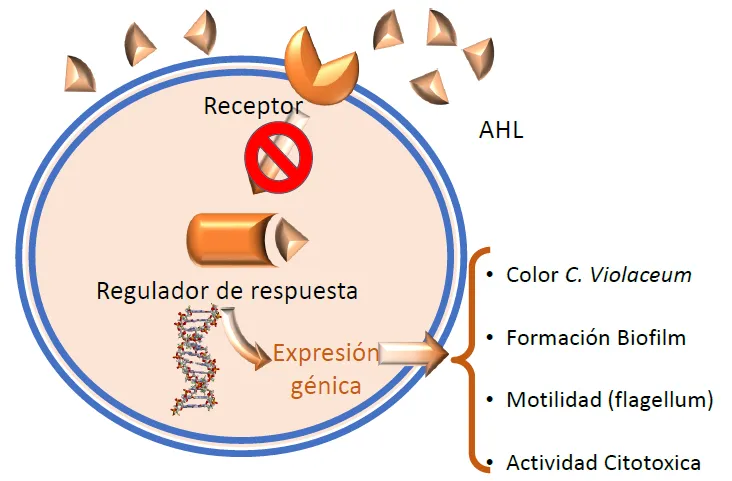
The action of preventing communication between bacteria is called Quorum Quenching
Blocking AHL will prevent communication between pathogenic bacteria, achieving quorum quenching (QQ).
Quorum quenching is a combined approach to pathogen control without the need for treatment. Interfering with the quorum sensing system is a potential strategy for antibiotic replacement. It does not aim to kill pathogens or restrict cell growth but rather to neutralize the expression of pathogenic genes. Therefore, it does not create selective pressure on organisms and does not promote the emergence of resistance.
B.amyloliquefaciens modulates the shrimp immune system
The shrimp immune system is much more complex than that of vertebrates, making vaccines ineffective. The shrimp's innate defense system comprises cellular and humoral components that work in coordination to detect and eliminate pathogens. It modulates the immune system by increasing pathogen detection capabilities.
Total plasma protein (TPC) is the mechanism by which the immune system identifies shrimp pathogens, regulating the binding of pathogens to blood cells, thereby controlling their phagocytic ability. Therefore, higher TPC is associated with better pathogen detection and control capabilities.
Higher hemocyte granularity (HG) also indicates better pathogen elimination (phagocytosis and prophenoloxidase activity).
B.amyloliquefaciens CECT5940 inhibits V.parahaemolyticus
B.amyloliquefaciens reduces mortality and increases biomass when challenged with 106 cfu/ml V.parahaemolyticus.
B.amyloliquefaciens can improve chemical oxygen demand (COD) in water
Chemical Oxygen Demand (COD) testing is commonly used to measure the amount of organic compounds in water. COD determines the amount of organic pollutants found in water.
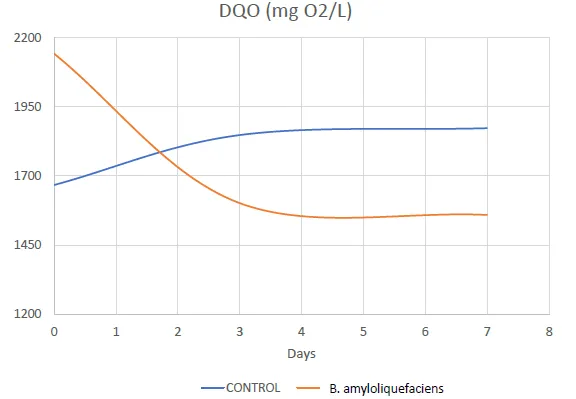
B.amyloliquefaciens consistently improves water quality
Studies show that supplementing with B.amyloliquefaciens reduces oxygen demand, leading to cleaner and better water quality.
B.amyloliquefaciens improves water quality by reducing total NH3, NO2, P, suspended solids, etc.
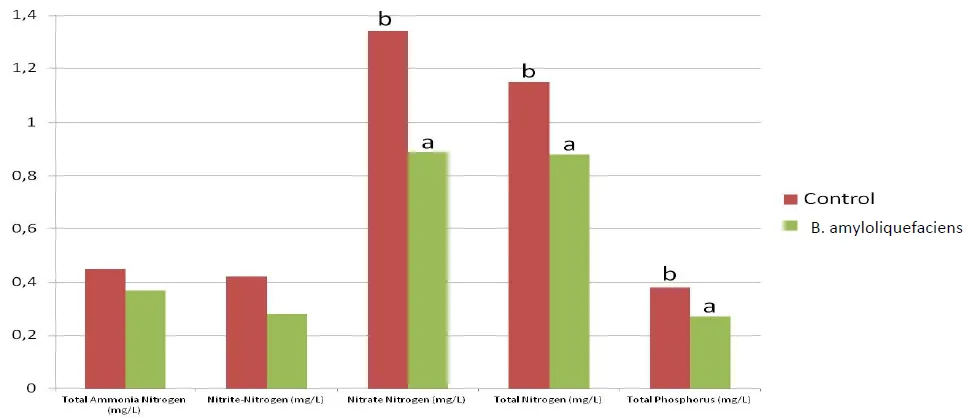
B.amyloliquefaciens CECT 5940 reduces the pathogenic microbial load in ponds, helping to improve water quality. It converts organic matter into CO2 and assimilated products (AA, oligosaccharides).
Bacillus amyloliquefaciens CECT 5940 is a sustainable solution for the prevention and control of emerging diseases. It prevents communication between bacteria (quorum quenching) and is beneficial in improving water quality and gut health.
Source: Mario Garcia Bustillos