Inland shrimp farmers in Alabama, USA, supplement Mg2+ at the beginning of each production cycle to achieve concentrations >20 mg/L at salinities of 1 to 11 g/L. However, this concentration may not be high enough for larger shrimp in later stages of the production cycle. Therefore, two field trials were conducted at a commercial shrimp farm in western Alabama to evaluate the effects of Mg2+ concentrations in low-salinity water on the growth, survival, and physiology of Pacific white shrimp, Litopenaeus vannamei.
Due to the superior ability of Pacific white shrimp (Litopenaeus vannamei) to tolerate various salinities, it has become the species of choice for cultivation in low-salinity water in various production systems located far from the coast.
Inland shrimp production using low-salinity groundwater (LSW) is a common practice in many countries worldwide, including China, Thailand, Vietnam, Ecuador, Brazil, Mexico, the United States, Israel, Australia, and many others.
In US farms in Florida, Alabama, and Texas, well water with salinities ranging from 1–15 g/L is currently used for shrimp farming, and some of these farms have been operating for over 20 years (Roy et al., 2010).
Due to consistently low survival rates and production in recent years among commercial shrimp producers in Alabama, and uncertainties regarding the optimal concentrations of Mg2+ and the Mg:Ca ratio, farmers are curious to know if Mg2+ supplementation in commercial ponds can improve the growth, survival, and production of shrimp cultured in low-salinity water while reducing late-cycle mortality.
The current study evaluated the effectiveness of Mg2+ supplementation on the productivity of L. vannamei shrimp cultured in earthen ponds with LSW.
Materials and Methods
This study was conducted at a privately owned commercial shrimp farm (Greene Prairie Aquafarm; Boligee, Alabama, USA) as two separate trials during the 2021 shrimp production season. The first was a commercial-scale pond trial, while the second was a tank study, both conducted on the same farm. The farm has 23 commercial shrimp ponds of various sizes. Eight ponds were used for the study, ranging in size from 1.09 to 1.90 ha.
Results
Pond Trial
To double the Mg2+ concentration in the water of high-Mg2+ ponds (n = 4; total area = 5.02 ha) compared to the amount typically used by commercial producers, an additional Mg2+ concentration of 55.05 ± 10.85 ppm was required. As a result, the total amount of technical grade MgCl2 used for this purpose was 15,429 kg (617 bags × 25 kg/bag; 3,075 kg/ha) at a total cost of 10,545 US Dollars (USD; 0.68 USD/kg; 2,101 USD/ha).
Production and growth parameters: Pond groups showed no significant differences in area, stocking density, post-larval weight, or culture duration. No significant differences were found in growth parameters between pond groups.
The Johnson-Neyman procedure showed no significant differences in mean body weight during weeks 1 to 14 between pond groups. However, shrimp in high-Mg2+ ponds were significantly heavier than those in low-Mg2+ ponds during culture weeks 15 to 21 (Figure 1).
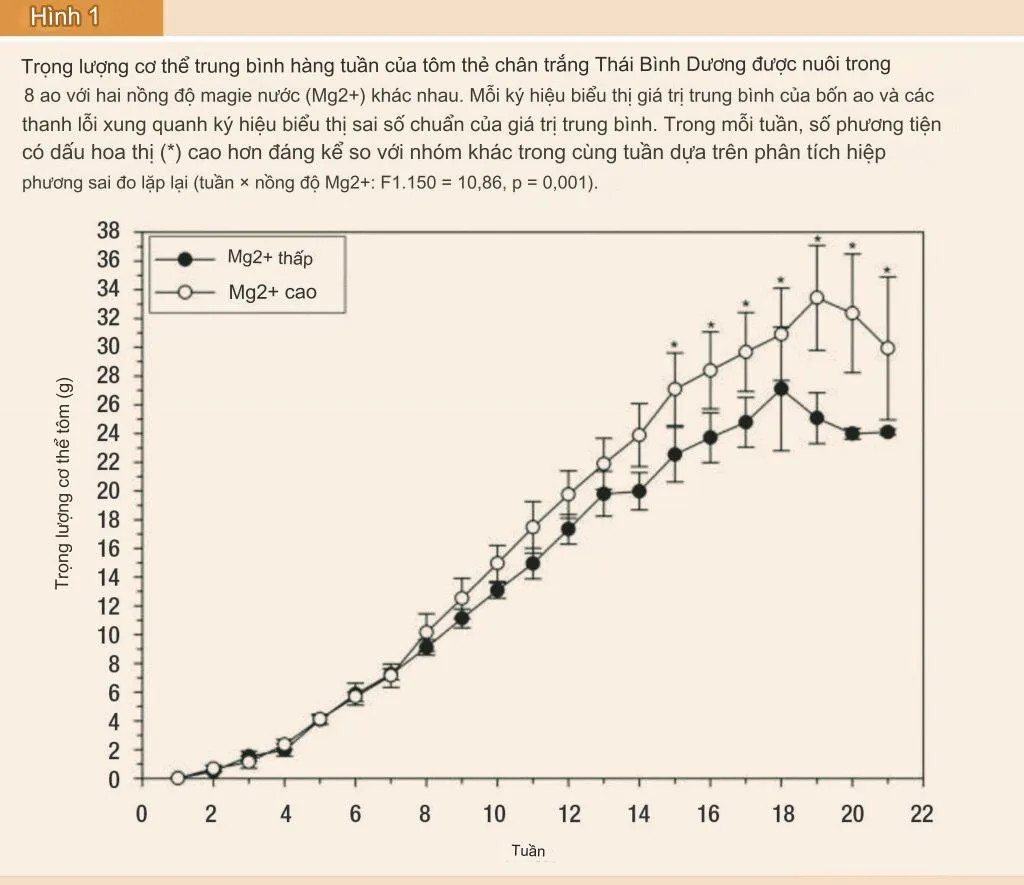
Although shrimp harvested from high-Mg2+ ponds had numerically higher final body weights (32.13 ± 5.39 g) compared to shrimp harvested from low-Mg2+ ponds (26.13 ± 1.79 g), they were not statistically different (p = 0.079). This could be due to pond-to-pond variability and the small sample size (4 ponds/group).
Based on sample size calculations, the difference in final body weight between pond groups would have been statistically significant if the sample size was 9 ponds per group (effect size = 1.49, power = 0.84).
“Whole-body and hemolymph Mg2+ ion concentrations: In each month of the trial, whole-body Mg2+ concentrations of shrimp in high-Mg2+ ponds were significantly higher than those in low-Mg2+ ponds”.
Ponds with high Mg2+ concentrations had significantly higher whole-body Mg2+ concentrations than ponds with low Mg2+ concentrations. There was a significant difference (t(30) = 166.29, p < 0.0001) in the ratio between whole-body shrimp Mg2+ concentration and culture water Mg2+ concentration between high-Mg2+ ponds (mean ± SD: 52.67 ± 13.90; range: 33.98 to 86.37) and low-Mg2+ ponds (129.02 ± 19.98; 95.88 to 164.57).
There were significant differences between pond groups for other whole-body ion concentrations and hemolymph ion concentrations.
Growth Trial
Production and growth parameters: Initial body weight of shrimp in high-Mg2+ tanks was significantly greater than in low-Mg2+ tanks. Therefore, the effect of initial body weight on all other parameters was statistically evaluated and accounted for, whenever significant, by adding it as a covariate to the statistical model.
The six Mg2+ concentration stocking density tank groups did not show that Mg2+ concentration or stocking density affected final body weight, survival rate, feed conversion ratio (FCR), weekly weight gain, or percentage weight gain.
“Shrimp in low-Mg2+ tanks stocked at 20 shrimp/tank had significantly higher thermal growth coefficient (TGC) than shrimp in high-Mg2+ tanks stocked at 25 shrimp/tank, while all other tank groups were not different”.
Additionally, the final biomass of shrimp in high-Mg2+ tanks stocked at 30 shrimp/tank was significantly higher than all other tank groups, and in low-Mg2+ tanks, the final biomass of shrimp in tanks stocked at 30 shrimp/tank was higher than in tanks stocked at 20 shrimp/tank.
Regardless of stocking density, shrimp cultured in high-Mg2+ tanks had significantly lower TGC (Figure 2-C) and higher final biomass (Figure 2-E) compared to shrimp cultured in high-Mg2+ tanks.
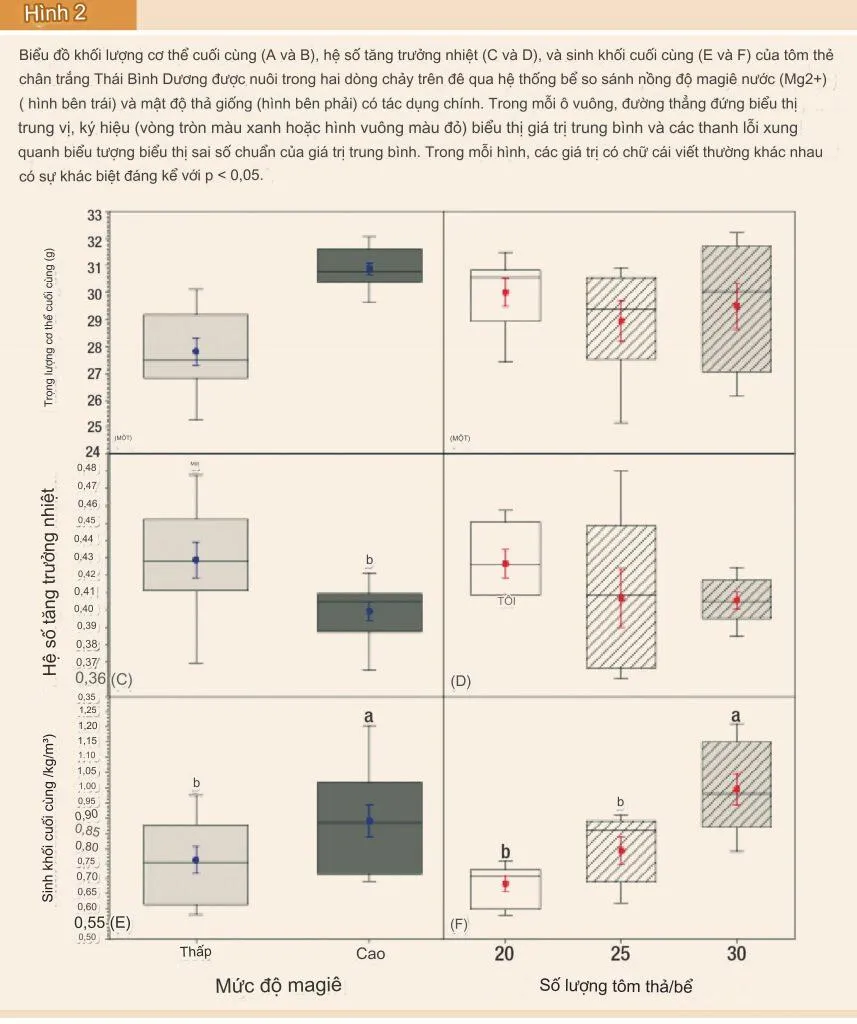
Regardless of Mg2+ concentration, tanks stocked with 30 shrimp/tank had significantly higher final biomass than those stocked with 20 or 25 shrimp/tank (Figure 2-F).
Whole-body and Hemolymph Mg2+ Ion Concentrations
Whole-body Mg2+ concentrations of shrimp in all high-Mg2+ tanks were higher than in low-Mg2+ tanks. Higher whole-body Mg:Ca ratios were found in shrimp cultured in high-Mg2+ tanks with 25 shrimp/tank compared to shrimp cultured in low-Mg2+ tanks stocked at 20 shrimp/tank.
Shrimp stocked in 25 or 30 shrimp/tank in the low-Mg2+ system had significantly higher Na:K ratios than shrimp in the high-Mg2+ system.
Hemolymph from shrimp in high-Mg2+ tanks stocked at 25 or 30 shrimp/tank had significantly higher Mg2+ concentrations and Mg:Ca ratios than hemolymph from shrimp in low-Mg2+ tanks stocked at 20 shrimp/tank.
Discussion
Inland low-salinity aquifers supplying water for Pacific white shrimp in earthen ponds in western Alabama have variable Mg2+ concentrations, and most farms are extremely deficient.
Therefore, farmers need to supplement with magnesium salts (typically K-Mag®, a commercial potassium magnesium sulfate) to increase Mg2+ concentrations in pond water. However, specific Mg2+ requirements have not been clearly established. Therefore, concentrations in seawater diluted to a given salinity are considered the safest reference values for achieving optimal growth and survival of L. vannamei (Boyd, 2018).
During the study, no differences were found in performance parameters or physiological variables of shrimp between the control treatment (Mg2+ = 12.9 ± 4.0 mg/L) and the Mg2+ treatment (Mg2+ = 28.1 ± 22.8 mg/L), except for significantly higher whole-body Mg2+ concentrations in shrimp cultured at elevated Mg2+ concentrations.
“The reference Mg2+ concentration in seawater at the tested salinity (2.1 g/L) was 82.2 mg/L.”
Therefore, the Mg2+ concentrations achieved in both the control and treated culture water in this trial were suboptimal, less than 50% of what the Mg2+ concentration should have been at the salinity where the experiment was conducted.
The shrimp growth performance observed in the current study is consistent with the observations of Galkanda-Arachchige et al. (2021), which indicated that elevated Mg2+ concentrations in ponds were not high enough to result in significantly higher growth rates in shrimp compared to the control because the Mg2+ concentrations were below the optimal range.
In parallel, non-significant differences in the final weight of Pacific white shrimp cultured in low-salinity water (4 g/L) containing different Mg2+ concentrations were reported by Zacarias et al. (2019). This was attributed to the absence of Mg2+ deficiency in the experimental treatments (167 to 205 mg/L) compared to the Mg2+ concentration in diluted seawater (~156 mg/L) at the respective salinities.
Findings from the 8-week levee tank experiment confirmed that there were no significant main effects or interactions of Mg2+ concentrations (12 and 37 mg/L) or stocking densities (24, 29, and 35 shrimp/m2) on shrimp growth performance, survival, FCR, hemolymph osmolality, and osmoregulatory capacity.
Although not statistically significant, there was numerically lower growth in shrimp in the control group with lower Mg2+ concentrations. This could be due to the additional energy expenditure required to maintain osmoregulation or a size-dependent deficiency in Mg2+ bioavailability to support the molting mechanism of adult shrimp in low-salinity water.
“In summary, the stocking densities we tested did not negatively impact the growth performance of shrimp cultured at suboptimal Mg2+ concentrations. Furthermore, the benefits of Mg2+ supplementation in low-salinity shrimp farming systems with suboptimal Mg2+ concentrations were confirmed.”
Taken together, this suggests that commercial shrimp producers in western Alabama using inland low-salinity water may continue to face challenges at the end of the production cycle due to low Mg2+ concentrations in production ponds and should closely monitor water Mg2+, especially towards the end of the production cycle.
This is a summarized version developed by the Aquaculture Magazine editorial team based on the review article titled “EVALUATION OF WATER MAGNESIUM CONCENTRATIONS ON THE PERFORMANCE OF PACIFIC WHITE SHRIMP (LITOPENAEUS VANNAMEI) CULTURED IN LOW-SALINITY WATER IN WESTERN ALABAMA, USA” developed by: Hernandez, D. – Alabama Fish Farming Center and Auburn University, Abdelrahman, H. – Cairo University, Alabama Fish Farming Center, Galkanda, H. -Arachchige – Wayamba University of Sri Lanka, Kelly, A. – Alabama Fish Farming Center, Butts, I. – Auburn University, Davis, D. -Auburn University, Beck, B. – US Department of Agriculture, Roy, L. – Alabama Fish Farming Center and Auburn University.
The original article, including tables and figures, was published in DECEMBER 2022, through AQUACULTURE.
The full version can be accessed online via this link: https://doi.org/10.1016/j.aquaculture.2022.739133.
Source: Aquaculture