In whiteleg shrimp hatchery production, broodstock maturation is a crucial step that determines the reproductive performance of the broodstock (Vũ Văn In et al., 2012). The age and size of shrimp significantly affect the reproductive capacity of penaeid shrimp species (Motoh, 1981; Primavera, 1985; Menasveta et al., 1994; Cavalli et al., 1997; Crocos and Coman, 1997). Wild whiteleg shrimp and those cultured in brackish water reach maturity at 6-7 months of age with a mature size of >20 g/male shrimp and >28 g/female shrimp (FAO, 2006; Parnes et al., 2004). Shrimp weighing 30-45g can be used for artificial reproduction (FAO, 2001; Han-Jin et al., 2011). However, the standards for broodstock weight provided in technical guidelines vary greatly, such as: 35 g/male shrimp and 40 g/female shrimp (Ministry of Fisheries, 2006); 40 g/male shrimp and 45 g/female shrimp (Wyban and Sweeney, 1991); 45 g/male shrimp and 50 g/female shrimp (Vũ Văn In et al., 2012). Therefore, research on the effect of age and size on the reproductive performance of Specific Pathogen-Free (SPF) whiteleg shrimp broodstock will provide a scientific basis for determining the appropriate age and size of broodstock for maturation and spawning in whiteleg shrimp hatchery production.
Experiment:
Experiment 1 evaluated the effect of size in different weight groups: 35-39g; 40-44g; 45-49g; 50-55g and 60g and above. Experiment 2 evaluated the effect of different ages: 7; 8; 9; 10 and 11 months old on the reproductive performance of Specific Pathogen-Free (SPF) whiteleg shrimp (Litopenaeus vannamei) broodstock. The experiments were conducted indoors in 14m2 fiberglass tanks (for maturation) and 1m3 tanks (for spawning and larval rearing) under biosecure conditions, with temperature: 28-30oC, and salinity: 28-30‰. Shrimp were fed 4 times/day with a diet of 50% polychaetes and 50% fresh squid. 100% water exchange was performed daily. After 30 days of maturation, eyestalk ablation was performed for spawning.
Monitoring of environmental parameters:
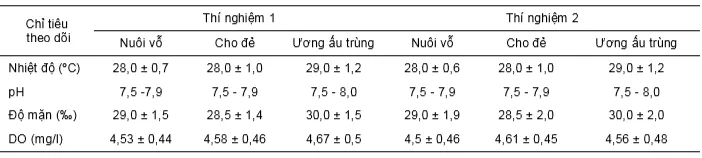
Temperature, pH, and DO were measured twice daily at 6:00 AM and 2:00 PM, while salinity was measured weekly in the maturation, spawning, and larval rearing tanks.
Table 1. Fluctuation of some environmental parameters in the experimental tanks
Note: Data in the table are mean ± standard deviation
Reproductive performance of Specific Pathogen-Free whiteleg shrimp broodstock in different size groups:
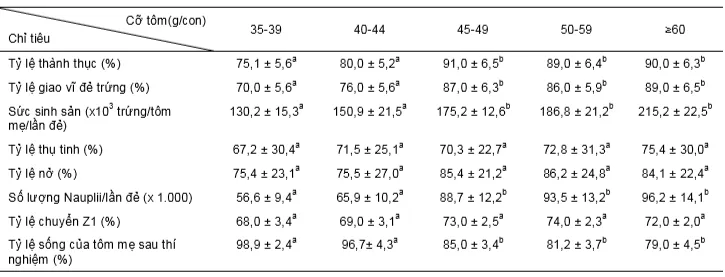
Within a broodstock population aged 8-9 months, the reproductive performance of whiteleg shrimp broodstock was directly proportional to shrimp size. Experimental results for shrimp in different size groups showed that the group of shrimp weighing 45 g/individual or more had statistically significantly higher maturation rates, mating and spawning rates, fecundity, and number of Nauplii/spawn compared to smaller size shrimp groups (Table 2; p < 0.05). The fecundity and number of Nauplii/spawn of female shrimp were directly proportional to the female shrimp's weight; however, in the weight group of 45g and above, this difference was not statistically significant (p > 0.05). Differences in fertilization rate, hatching rate, and Z1 conversion rate among treatments were not statistically significant (p > 0.05).
Table 2. Reproductive performance of Specific Pathogen-Free whiteleg shrimp broodstock in different size groups
Note: Data in the table are mean ± standard deviation, different letters in the same row indicate a statistically significant difference (p < 0.05)
Reproductive performance of Specific Pathogen-Free whiteleg shrimp broodstock at different ages:
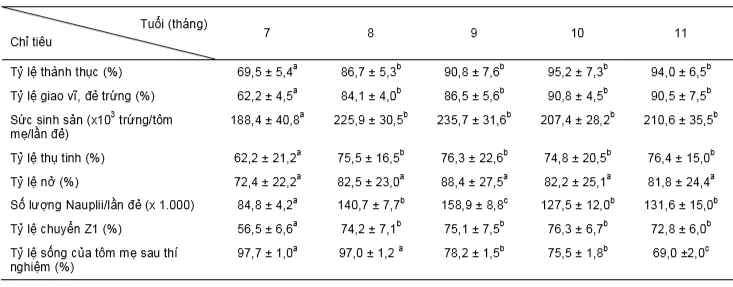
The 7-month-old shrimp group had the lowest reproductive performance, with statistically significantly lower maturation rates, mating and spawning rates, fecundity, fertilization rates, and Z1 conversion rates compared to shrimp groups 8 months old and older (p < 0.05). The number of Nauplii/spawn is an indicator for evaluating the reproductive efficiency of the broodstock. The 9-month-old shrimp group yielded the highest number of Nauplii/spawn (158,900 Nauplii), and the lowest was the 7-month-old shrimp (84,800 Nauplii; p < 0.05). The 8-month-old shrimp had the second highest number of Nauplii/spawn among the experimental treatments (140,700 Nauplii/spawn). However, the difference in the number of Nauplii/spawn between 8-month-old shrimp and shrimp 10 months old and older was not statistically significant (p > 0.05).
Table 3. Reproductive performance of experimental shrimp at different ages
Note: Data in the table are mean ± standard deviation, different letters in the same row indicate a statistically significant difference (p < 0.05)
Conclusion:
The age and size of SPF whiteleg shrimp broodstock affect their reproductive performance. Shrimp groups weighing 45 g/individual or more have higher reproductive performance compared to smaller weight shrimp groups, and an age of 8-11 months is most suitable for the reproduction of SPF whiteleg shrimp broodstock.
Source: Journal of Science and Development