Whiteleg shrimp is one of the most commonly farmed shrimp species today. However, the increase in farming area and the intensification of shrimp farming have led to the emergence and spread of many dangerous diseases, affecting the water quality of the culture pond. This makes the farmed animals susceptible to opportunistic pathogens.
Fluctuations in physicochemical factors directly affect the immune system of whiteleg shrimp and increase their susceptibility to bacterial diseases. Low (4.6-5) or high (9-9.5) water pH levels have been shown to impair the shrimp's immune system, thereby significantly impacting their resistance to Acute Hepatopancreatic Necrosis Disease (AHPND).
Experiment to determine the LD50 value of the bacterium V. parahaemolyticus
The experiment to determine the LD50 value was arranged using a completely randomized design with four treatments having infection doses differing by 10-fold and one uninfected control treatment.
Effect of water pH on the cumulative mortality rate of Litopenaeus vannamei shrimp
The experiment was set up with different pH levels: 6.3, 7.3, 8.3, 9.3, and 10.3. The experiment was conducted for 240 hours. The pH in the tanks was kept stable throughout the experiment.
Effect of water pH on the immune system of Litopenaeus vannamei shrimp
Whiteleg shrimp were randomly arranged in the system with different pH levels: 6.3, 7.3, 8.3, and 9.3. Each tank contained 10 shrimp corresponding to each sampling time point.
Effect of water pH on the susceptibility of Litopenaeus vannamei shrimp to the bacterium V. parahaemolyticus
Shrimp were experimentally infected via immersion for 2 hours. Each tank contained 20 shrimp at pH levels of 6.3, 7.3, 8.3, and 9.3.
Results and Discussion
LD50 dose of the bacterium V. parahaemolyticus
The experimental results showed that shrimp infected with the bacterium V. parahaemolyticus exhibited disease symptoms such as lethargy, slow reflexes, and some showed signs of anorexia after 1 day of infection. Shrimp began to die after 2 days of infection, and the number of dead shrimp gradually increased until day 10.
Previous research results indicated that the LD50 dose of Vibrio strains varies depending on the bacterial strain, infection method, and shrimp size.
Effect of water pH on the cumulative mortality rate of Litopenaeus vannamei shrimp
The research results showed that shrimp in high pH treatments (9.3 and 10.3) exhibited disease symptoms such as lethargy, slow reflexes, and began to die after 24 hours of the experiment. The cumulative mortality rate of shrimp gradually increased with increasing water pH. After 144 hours, the cumulative mortality rate was 100% in the pH 10.3 treatment; 27% in the pH 9.3 treatment.
Effect of pH on the cumulative mortality rate of whiteleg shrimp
Crustaceans in general are very sensitive to changes in environmental factors, especially pH. Fluctuations in water pH significantly affect the survival rate, disease resistance, and growth of shrimp.
Effect of pH on the growth of the bacterium V. parahaemolyticus
The growth of the Acute Hepatopancreatic Necrosis Disease (AHPND) causative bacterium V. parahaemolyticus in TSB medium at different pH levels was examined in this experiment. The results showed that the bacterium could grow at various pH levels, from 6.3 to 9.3. Among these, the optimal pH range for bacterial growth was 8.3 and 9.3.
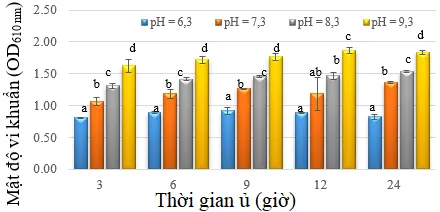
Effect of pH on the growth of the bacterium V. parahaemolyticus
Effect of pH on the immune system of Litopenaeus vannamei shrimp
Quantitative results showed no statistically significant difference in total hemocyte count when shrimp were cultured at different pH levels from 0 to 72 hours. At 96 hours, the total hemocyte count in the high pH 9.3 treatment was significantly higher than in the low pH treatments.
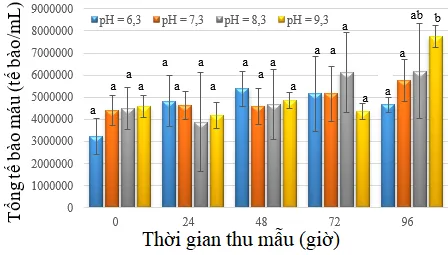
Changes in total hemocyte count of Litopenaeus vannamei shrimp at different pH levels
Hemocytes in crustaceans play an important role in the immune system. After being stressed by environmental factors, the shrimp's immune system is weakened, thereby affecting the fluctuation of total hemocyte count, which is also considered a normal symptom in the natural immune response of crustaceans.
The activity of free oxygen radicals showed no statistically significant difference at different pH levels at 0 hours. However, after 24h and 48h, the activity of free oxygen radicals significantly decreased in the low pH treatment. The reason for the difference in free oxygen radical activity at 24h and 48h could be due to the weakened immune function of shrimp after being transferred from optimal pH to low and high pH levels. At subsequent sampling times (72 hours and 96 hours), the activity of free oxygen radicals at all pH levels increased, which could be due to the gradual recovery of the shrimp's immune system.
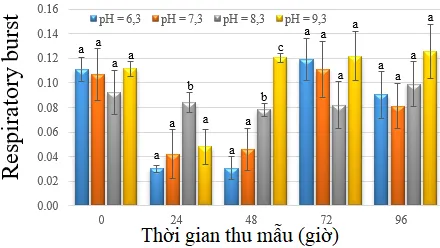
Changes in the activity of free oxygen radicals of Litopenaeus vannamei shrimp at different pH levels
Effect of pH on the susceptibility of whiteleg shrimp to the bacterium V. parahaemolyticus
Vibrio is considered an opportunistic bacterial pathogen for farmed shrimp. Stress factors such as starvation, salinity shock, toxic gas, and injury are considered primary risk factors that facilitate the development and outbreak of disease.
Whiteleg shrimp become more susceptible to Vibrio pathogens when cultured under low (6.5) and high (10.3) pH conditions. The phagocytic and bacterial clearance capabilities of shrimp cultured under low and high pH conditions are much lower than those of shrimp cultured at a normal pH of 8.2. Whiteleg shrimp become more susceptible to the Acute Hepatopancreatic Necrosis Disease (AHPND) causative bacterium when water pH fluctuates between 8.5 and 9.5.
When environmental factors change, especially fluctuations in water pH (decreasing or increasing), the immune response process will be impaired, thereby creating conditions for pathogens to develop and cause disease in farmed animals.
Conclusion
The study has demonstrated that pH affects the growth of the Acute Hepatopancreatic Necrosis Disease (AHPND) causative bacterium in whiteleg shrimp. Furthermore, fluctuations in water pH, especially when water pH drops low (6.3, 7.3), have impaired the shrimp's immune system (total hemocyte count and free oxygen radical activity), thereby significantly affecting their susceptibility to AHPND.
Source: Nong Lam University, Ho Chi Minh City