Technical Article

EVALUATION OF THE ANTIBACTERIAL ABILITY OF CLEVER AND PROSUR AGAINST THE BACTERIAL STRAIN VIBRIO PARAHAEMOLYTICUS VP4-24 CAUSING TPD DISEASE IN SHRIMP

Translucent Post-larval Disease (TPD) in Pacific white shrimp (Litopenaeus vannamei) post-larvae, caused by the bacterial strain Vibrio parahaemolyticus Vp4-24 (as identified by Dr. Dang Thi Hoang Oanh - School of Fisheries, Can Tho University, https://thuysanvietnam.com.vn/xac-dinh-kha-nang-gay-benh-tpd-cua-chung-vi-khuan-vibrio-parahaemolyticus-vp4-24/), is one of the major challenges in the current shrimp farming industry. The search for effective, safe biological antibacterial products is a sustainable approach to minimize damage and limit the use of traditional antibiotics. This study aims to evaluate the antibacterial activity of two biological products, Clever and Pro Sur, against the V. parahaemolyticus TPD strain. The experiment was conducted using the agar disc diffusion and test tube methods, employing different product concentrations to determine the zone of inhibition and colony growth.

Solution TrackShrimpMay 28, 2025👁 98 views
Click to listen to AI-narrated summary (1.2×)
AI Summary

Generate an English summary for EVALUATION OF THE ANTIBACTERIAL ABILITY OF CLEVER AND PROSUR AGAINST THE BACTERIAL STRAIN VIBRIO PARAHAEMOLYTICUS VP4-24 CAUSING TPD DISEASE IN SHRIMP

AI-generated summary based on the full article content below.

Editorial Framing

Why this article matters

    Full Article

    Translucent Post-larval Disease (TPD) in whiteleg shrimp (Litopenaeus vannamei) caused by the bacterial strain Vibrio parahaemolyticus Vp4-24” is one of the major challenges for the current shrimp farming industry. This study aimed to evaluate the antibacterial activity of two biological products, Clever and Pro Sur, against the V. parahaemolyticus TPD strain. The experiment was conducted using agar disc diffusion and test tube methods, employing different product concentrations to determine the zone of inhibition and colony growth. The results showed that both products exhibited good antibacterial efficacy, with Pro Sur at 1.5% concentration demonstrating a strong inhibition zone (2.3 cm). The study confirms the potential application of biological products in preventing and controlling TPD, aiming to reduce antibiotic use in aquaculture.
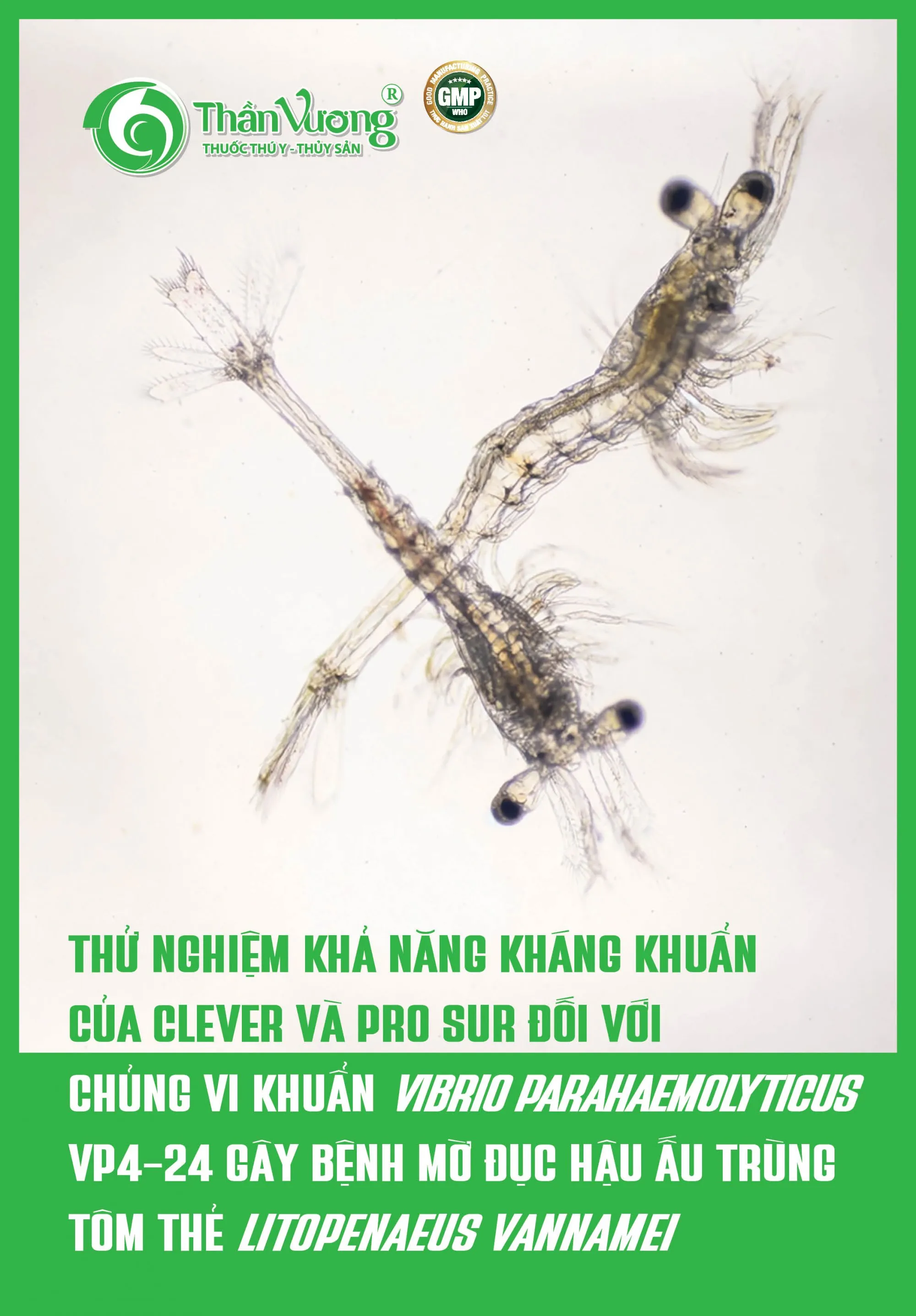
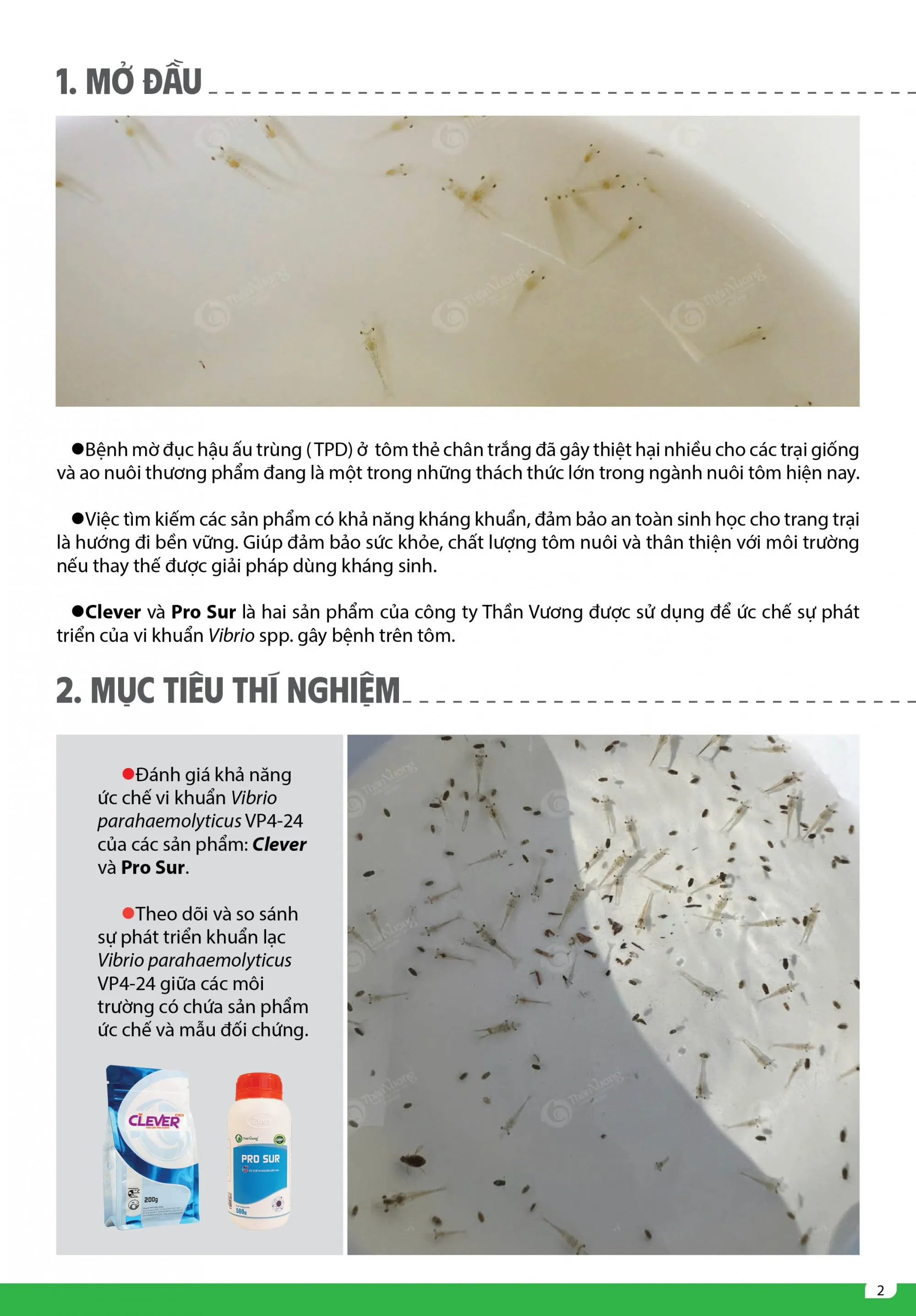
    Report on Experimental Antibacterial Capacity - updated content
    Report on Experimental Antibacterial Capacity - updated content 2_1

    1. Introduction

    Translucent Post-larval Disease (TPD) in whiteleg shrimp (Litopenaeus vannamei) caused by the bacterial strain Vibrio parahaemolyticus Vp4-24. Amidst restrictions on antibiotic use due to concerns about residues and antibiotic resistance, biological products with antibacterial properties are becoming a sustainable trend. This study aims to evaluate the antibacterial efficacy of two commercial products, Clever and ProSur.

    2. Experimental Objectives

    • To evaluate the inhibitory capacity of Clever and Pro Sur products against Vibrio parahaemolyticus TPD.
    • To compare colony growth between samples with products and control samples.
    Report on Experimental Antibacterial Capacity - updated content 3
    Report on Experimental Antibacterial Capacity - updated content 4
    Report on Experimental Antibacterial Capacity - updated content 5

    3. Materials and Methods

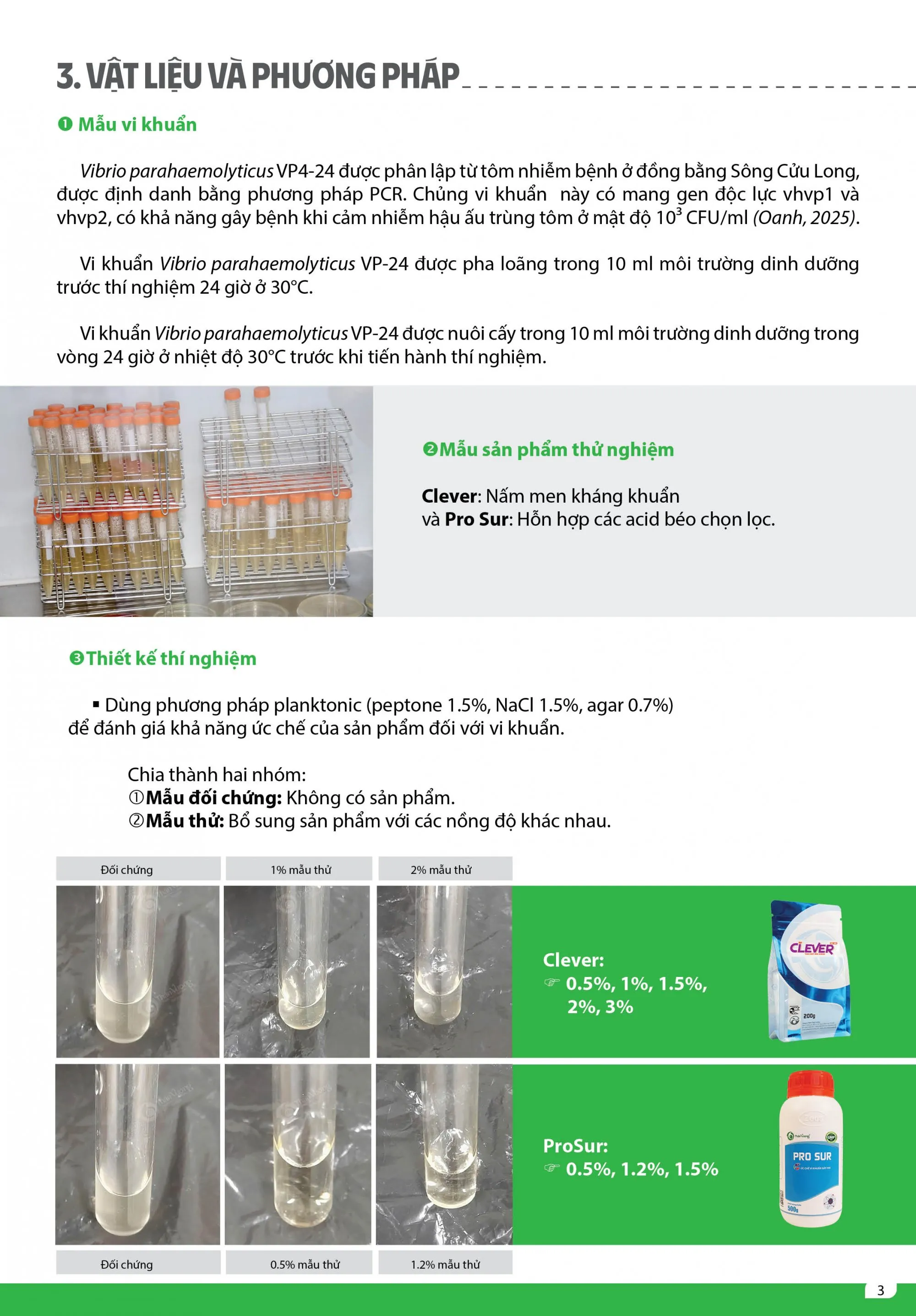
    3.1. Microorganisms

    The Vibrio parahaemolyticus bacterial strain causing TPD was cultured in a nutrient medium at 30°C in 10 ml overnight.

    3.2. Test Products

    • Clever: powder form, used at concentrations: 0.5%; 1%; 1.5%; 2%

    • ProSur: liquid form, used at concentrations: 0.5%; 1.2%; 1.5%

    3.3. Experimental Design

    • Agar disc diffusion method: measuring the diameter of the inhibition zone

    • Test tube method: observing turbidity and bacterial growth

    • Control group: no product used

    • Each treatment was replicated at least 3 times.

    4. Experimental Results

    4.1. Inhibitory Efficacy of Clever Product

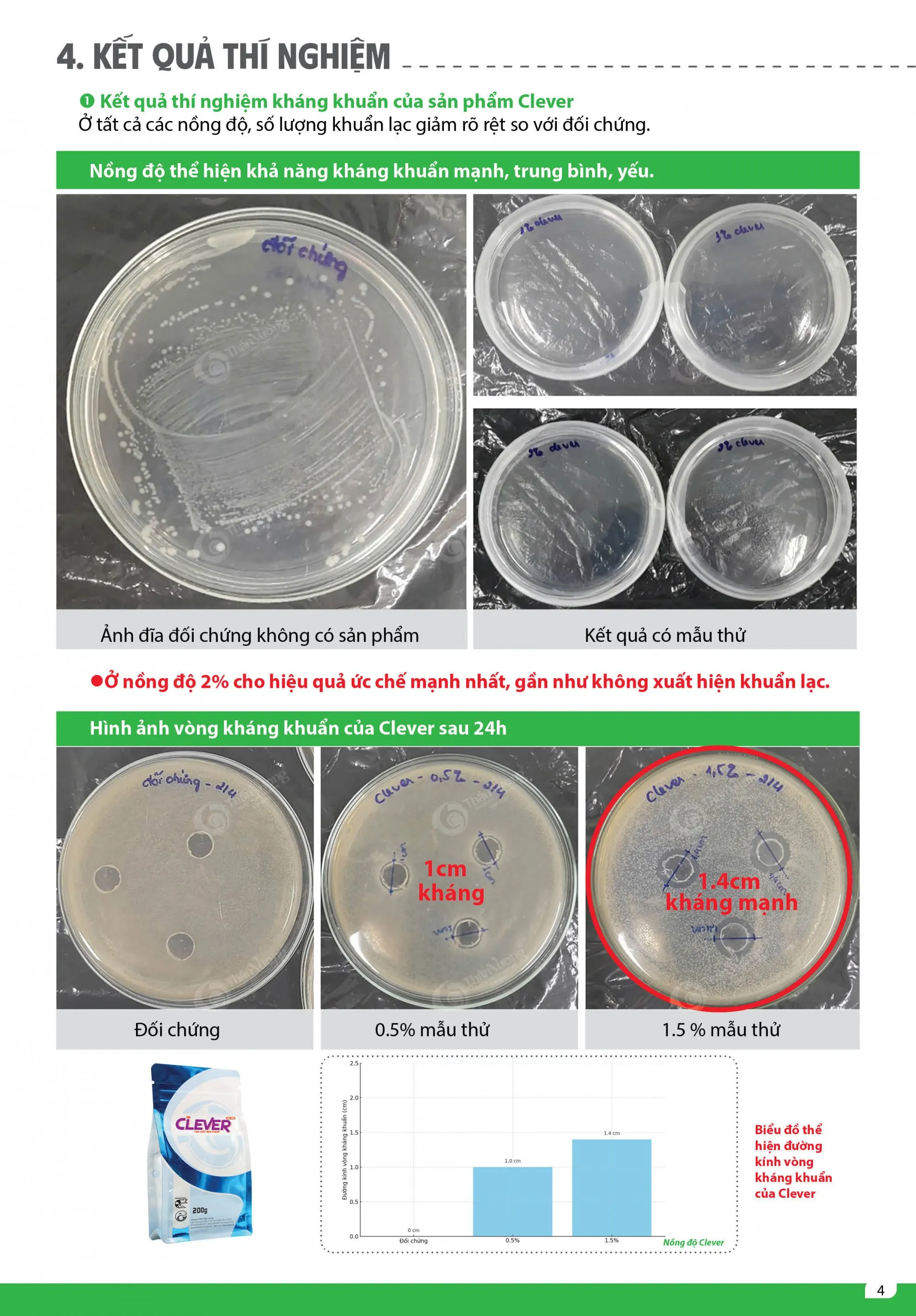
    • 0.5%: inhibition zone 1.0 cm

    • 1.5%: inhibition zone 1.4 cm

    • 2%: strong antibacterial efficacy, with almost no colony formation

    4.2. Inhibitory Efficacy of ProSur Product

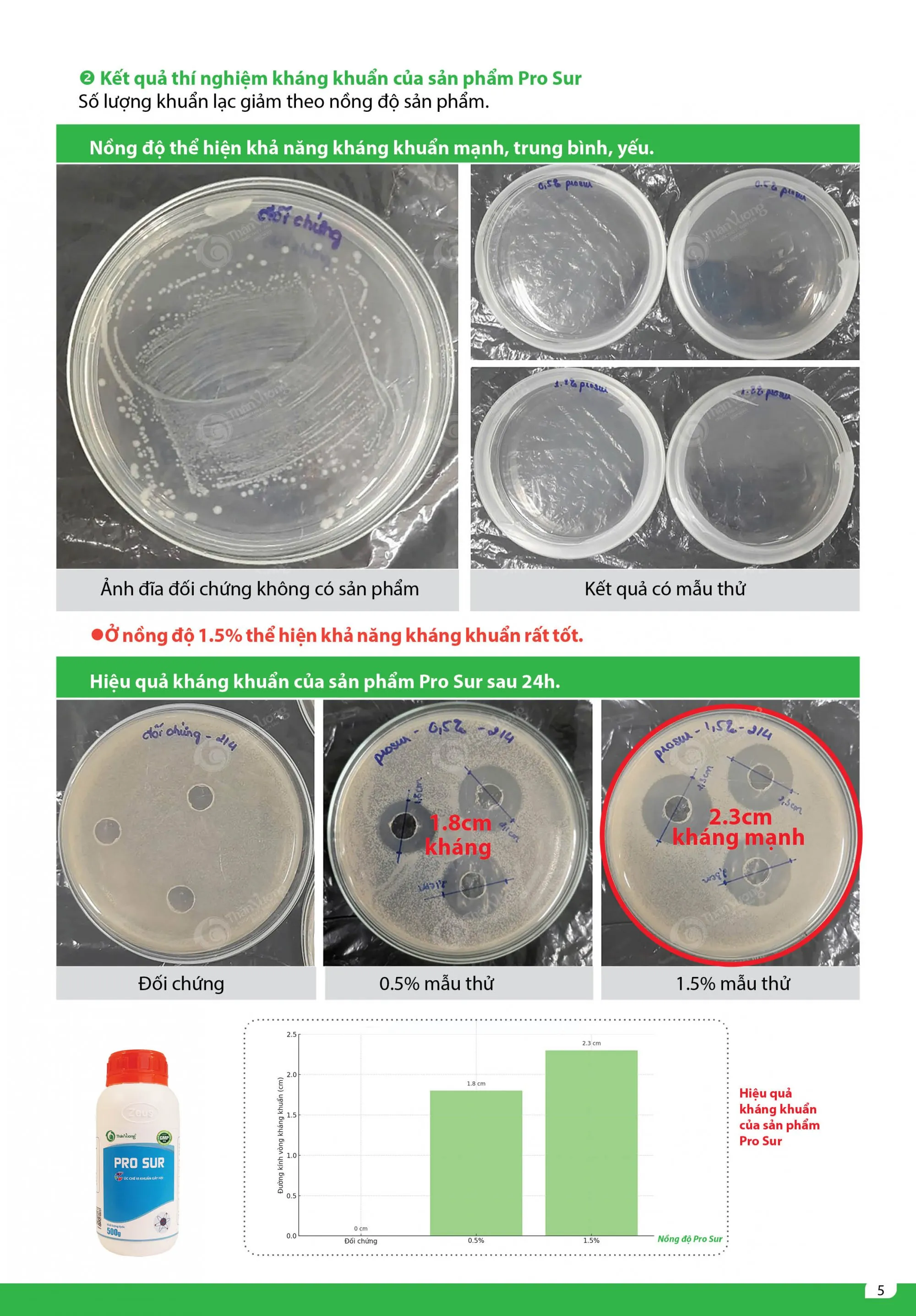
    • 0.5%: inhibition zone 1.8 cm

    • 1.5%: strong inhibition zone up to 2.3 cm

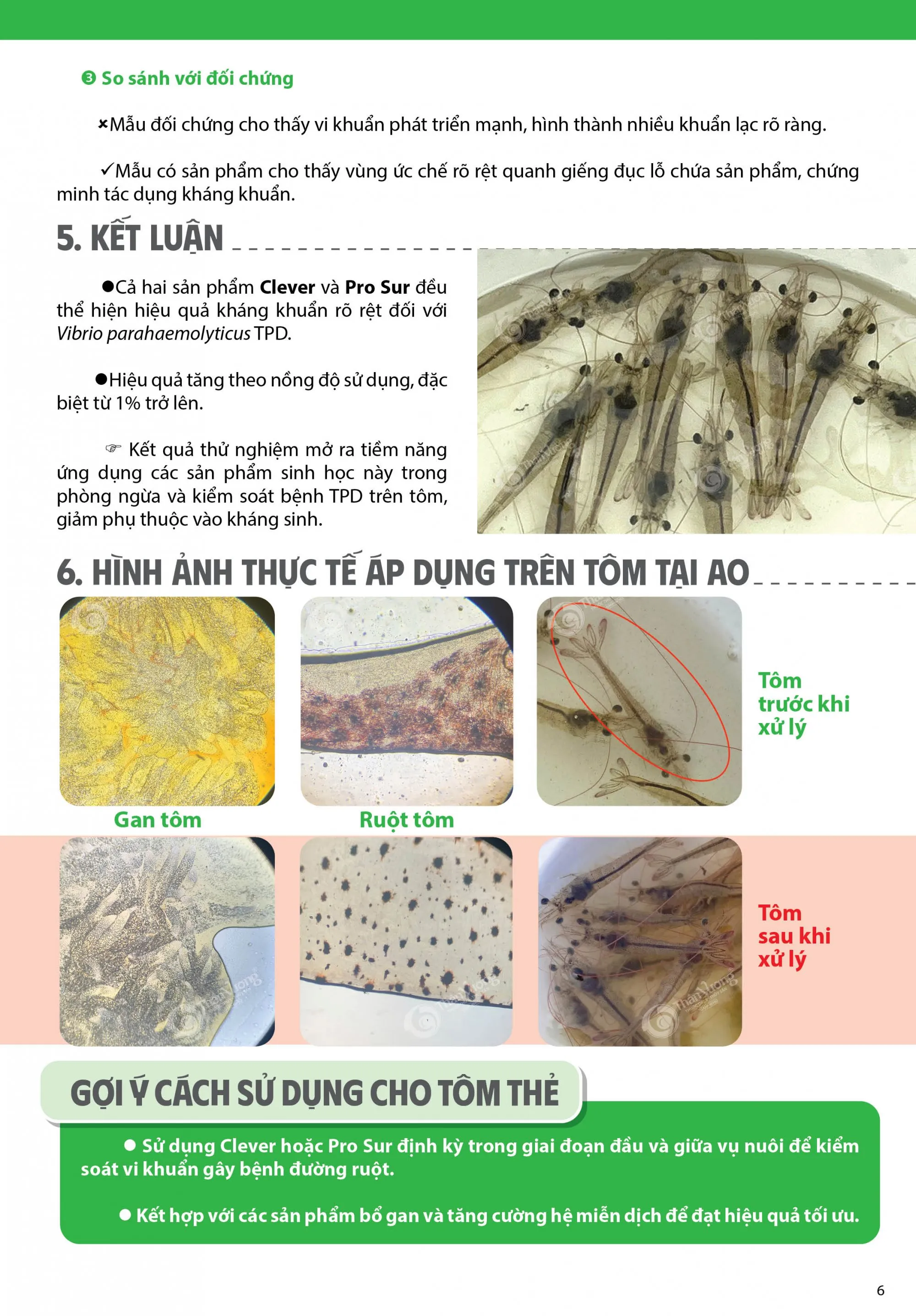
    4.3. Control Comparison

    • Control plate: strong and clear colony growth

    • Product plate: clear inhibition zone, especially at concentrations ≥ 1.5%

    4.4. Field Observations

    • Shrimp using the products showed clear intestines and hepatopancreas, with few disease symptoms

    • Control shrimp suffered from hepatopancreatic necrosis, opaque intestines, and white feces.
    Report on Experimental Antibacterial Capacity - updated content 6

    Discussion

    The results showed that both Clever and ProSur products effectively inhibited the growth of V. parahaemolyticus causing TPD. ProSur demonstrated superior efficacy at 1.5% concentration, evidenced by a larger inhibition zone and higher solution clarity. This is a positive sign for the application of biological solutions to replace or reduce antibiotics in shrimp disease prevention.

    5. Conclusion

    • Both Clever and Pro Sur exhibited good antibacterial activity against V. parahaemolyticus causing TPD.

    • ProSur was more effective at 1.5% concentration with an inhibition zone of up to 2.3 cm.

    • This study opens up practical application directions for biological disease prevention in whiteleg shrimp.

    6. Recommendations

    • Combine products that support liver function and boost immunity to achieve optimal disease prevention efficacy.

    References

    1. FAO (2022). Antimicrobial resistance and aquaculture.

    2. Lallemand Animal Nutrition. (2021). Biological control in shrimp farming.

    Please contact the Than Vuong team for more detailed information.

    Author: Than Vuong Lab

    Contact email: info@thanvuong.com
    Related Products

    Products linked to this topic

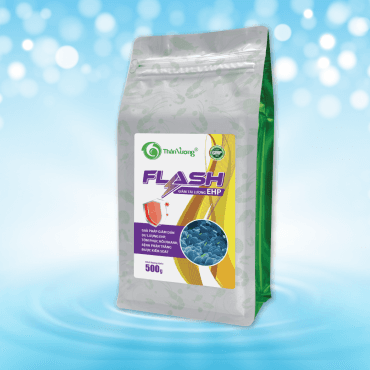
    Product reference for FLASH
    shrimpThần Vương Blue

    FLASH

    Giảm bùng phát EHP, tôm phục hồi nhanh, bệnh phân trắng được kiểm soát

    Product reference for CLEVER
    shrimpThần Vương Blue

    CLEVER

    Tinh chất men kháng khống chế bệnh chết sớm và phân trắng

    More Reading

    Related technical articles

    SỰ THAY ĐỔI CỦA HỆ VI SINH ĐƯỜNG RUỘT DO SỰ NÓNG LÊN TOÀN CẦU. ĐIỀU HÒA SỨC KHỎE VẬT CHỦ VÀ TÌNH TRẠNG BỆNH Ở ĐỘNG VẬT BIẾN NHIỆT
    Research InsightShrimpFebruary 28, 2026

    CHANGES IN GUT MICROBIOTA DUE TO GLOBAL WARMING. REGULATING HOST HEALTH AND DISEASE STATUS IN POIKILOTHERMIC ANIMALS

    Tóm tắt nội dung chính: Sự nóng lên toàn cầu làm thay đổi hệ vi sinh vật đường ruột của tôm thẻ chân trắng Thái Bình Dương bằng cách[...]

    Toàn cảnh thị trường tôm thế giới 2025 — Dữ liệu từ Shrimp Insights (Tháng 2/2026)
    Technical articleShrimpApril 9, 2026

    Global Shrimp Market 2025 Overview — Shrimp Insights Bulletin February 2026

    Tổng hợp thị trường tôm thế giới 2025: Ecuador dẫn đầu xuất khẩu (1.39M tấn, +15%), EU tăng nhập khẩu mạnh nhất (+21%), Mỹ biến động[...]

    CÁ HỒI TRONG ĐIỀU KIỆN STRESS: CỦNG CỐ TUYẾN PHÒNG THỦ ĐẦU TIÊN
    Solution TrackShrimpFebruary 27, 2026

    SALMON UNDER STRESS CONDITIONS: REINFORCING THE FIRST LINE OF DEFENSE

    As the aquaculture industry increasingly develops strategies for animal health protection, functional nutrition has become a key fac[...]

    Technical Advisor

    Aquaculture Q&A

    🦐

    Help us serve you better

    Share your name + phone so we remember your pond next time — no repeating yourself.

    • 🔒 Tech team only — never shared with third parties
    • 📨 No spam, no promotional SMS
    • 💾 History saved on your device — clear anytime