Shrimp is an important aquaculture species. Shrimp often suffer from stress due to oxidative imbalance, also known as oxidative stress, leading to cell damage, weakening, and mortality.
Green algae as a potential feed additive to improve survival rate and oxidative stress status of Pacific whiteleg shrimp larvae.
To maintain shrimp health, efficiency, and production, strengthening the immune system and antioxidant defense is crucial. Natural antioxidants found in microalgae can be used to enhance cellular protection against stress-induced damage, offering a promising alternative to carcinogenic synthetic antioxidants.
Commercial antioxidants such as Butylated Hydroxytoluene (BHT) and Butylated Hydroxyanisole (BHA) have been incorporated into feed to reduce oxidative stress damage in aquatic animals. However, the use of both these synthetic antioxidants has been restricted due to their carcinogenic and toxic properties in animals.
This has led to the search for natural antioxidant compounds instead of relying on dangerous synthetic ones. In recent years, besides their role as feed in aquaculture hatcheries, microalgae have also been studied as feed additives due to their richness in natural antioxidants, pigments, and bioactive compounds.
Microalgae are the first link in the food chain, an indispensable live feed source in hatchery technology as well as commercial farming of aquaculture species.
Marine microalgae, Tetraselmis sp., belonging to the Chlorophyta phylum, have a rapid growth rate and can tolerate a wide range of temperature and pH factors. Tetraselmis sp. is a widely used algal species in aquaculture because it contains sufficient amounts of protein, lipids, carbohydrates, and fatty acids essential for cultured species. This algal species is also known for its rich source of bioactive compounds, such as: vitamin E, carotenoids, phenolic compounds, and terpenes, and possesses antioxidant and antibacterial properties.
Antioxidants in microalgae are primarily contributed by their bioactive compounds such as carotenoids, amino acids, unsaturated fatty acids... Although the nutritional and antioxidant content of the feed will be higher with a higher microalgae content, only a certain level of microalgae can be assimilated by shrimp. However, no studies have reported on the efficacy of Tetraselmis sp. in combating stress for Pacific whiteleg shrimp (L. vannamei) larvae. The purpose of this study was to evaluate their efficacy when supplemented into the feed of Pacific whiteleg shrimp (L. vannamei) larvae.
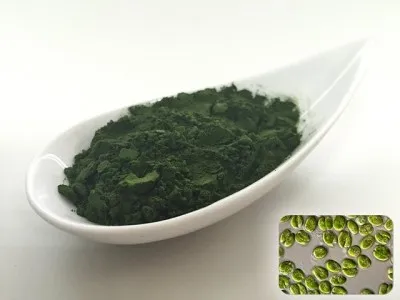
Supplementation of green algae Tetraselmis chuii for shrimp larvae
Freeze-dried T. chuii microalgae cells were ground and then combined with commercial feed at microalgae/feed weight percentages of 25%, 50%, 75%, 100%, and a commercial feed without microalgae supplementation was used as a control. The prepared feed was then ground to a size of 300 mm.
In the treatments supplemented with T. chuii algae at T100 and T75 weight percentages, the highest antioxidant activity and better anti-free radical formation effects were observed compared to other treatments.
The data from the study showed that supplementing green microalgae into the feed helped improve and maintain water quality in the rearing tanks. Meanwhile, temperature, salinity, light, and pH factors showed no significant differences among treatments throughout the experiment.
Supplementation of 25% green microalgae (T25) (51.0 ± 0.0%) into commercial feed resulted in a 2.4-fold increase in antioxidant activity compared to the unsupplemented feed (21.4 ± 3.1%). In this study, the highest survival rate of shrimp larvae was achieved in the T50 fed group (97.6 ± 1.4%), followed by T75 (85.6 ± 3.5%).
Salinity stress challenge: After 2 hours of exposure to freshwater, PL fed a microalgae-rich diet showed a significantly higher survival rate compared to the control group. And the survival rate of shrimp in the freshwater challenge was 100% in the larval group fed with 50% green microalgae Tetraselmis chuii (T50), followed by T75. In fact, all PL shrimp larvae fed with T50 remained alive and active even after 4 hours of freshwater exposure.
This study shows that supplementing Tetraselmis chuii microalgae at 50-75% not only provides sufficient nutrients for shrimp larvae but also enhances their resistance to stress and oxidative damage, thus leading to higher survival rates and greater stress tolerance. Pacific whiteleg shrimp larvae supplemented with green microalgae Tetraselmis chuii showed higher resistance when exposed to salinity stress, and the microalgae also contributed to improving water quality throughout the rearing period.
This study demonstrated that supplementing 50% Tetraselmis chuii, which has high antioxidant properties, can improve the survival of post-larval shrimp as well as maintain water quality. Therefore, the current findings suggest the applicability of these microalgae species as a valuable natural antioxidant source that can be used as a supplementary additive for L. vannamei shrimp larvae.
Source: 2 Lúa