In October 2022, the Natural Resources Institute Finland (Luke) announced the successful development of the Pneumatic-driven Recirculating Aquaculture System (PaRAS) with a flexible module that saves energy and increases capacity. Recently, the model has seen improvements in culture tanks, overcoming the drawbacks of traditional RAS systems.
More Flexible
“RAS technology faces many challenges, but the main obstacles are excessively high investment capital and operating costs," according to Tapio Kiuru, an aquaculture expert at Luke. Additionally, RAS farms consume a lot of energy. This is also the biggest obstacle for RAS farms, especially in the context of continuously rising energy costs, according to Tapio Kiuru.
Luke's PaRAS model operates on the principle of a mixed tank. The size of a single water treatment tank is approximately 32 m. However, the difference from conventional RAS systems is that PaRAS uses low-pressure compressed air to move water, add oxygen, and remove carbon dioxide. The removal of carbon dioxide also helps regulate the water's pH. Kiuru states that this is a strategy for fish production under conditions of high ammonia and low pH. Low concentrations of carbon dioxide can accumulate in the water but are not harmful and are sufficient to reduce the water pH below 7. In that case, the ammonia excreted by the fish will be in a non-toxic ionized form.
The aeration, flow, and solids removal systems are also separate tanks within the PaRAS system. These systems continuously dose peroxide to improve water quality and prevent off-flavors. When hydrogen peroxide decomposes in water, it produces pure water and oxygen as final products – improving the overall oxygen balance throughout the system.
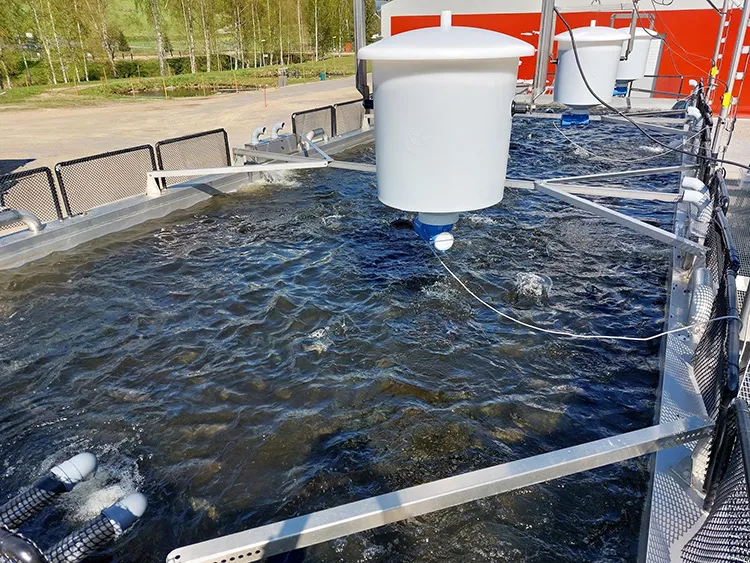
Furthermore, because the aeration, flow, and solids removal systems are separate tanks, they do not share water sources with the PaRAS culture tanks. This ensures absolute biosecurity and helps fish farms implement the "all-in, all-out" procedure correctly, cutting off sources of pathogen transmission between different groups within a phase. The fish culture tanks occupy 80% of the farm area, and water treatment technology is integrated directly into the tanks. In other words, PaRAS farms can double their capacity compared to conventional RAS farms. Kiuru stated that the separate tank system for aeration, flow, and solids removal is one of the key differences between PaRAS and RAS. PaRAS also does not require a biological water treatment process but only needs an additional biofilter.
PaRAS tanks can be isolated from the centralized biological filtration process at any time without affecting feeding or production. Luke uses feed specifically designed for RAS systems to maintain and improve water quality. PaRAS is essentially a module, easily transportable worldwide in standard containers; furthermore, the installation process for PaRAS is much easier than building a traditional RAS farm. The PaRAS cleaning system helps improve profitability because farmers do not need to move fish to separate cleaning tanks, so the feeding phase is not interrupted.
Odor Control
Off-flavors are a problem encountered by many RAS farms. High production costs combined with poor product quality lead to losses for RAS farms. There are many ways to prevent off-flavors, but they are expensive and increase investment costs, labor costs, prolong the production cycle, and can cause fish to lose weight during the water purification process. However, the "strength" of PaRAS lies in improving quality and eliminating off-flavors through its solids separation and aeration system. As a result, the fish feeding phase is not interrupted.
To date, the PaRAS model has been tested for farming rainbow trout and European whitefish in Finland with promising results. Trials on Atlantic salmon are expected to begin in 2024.
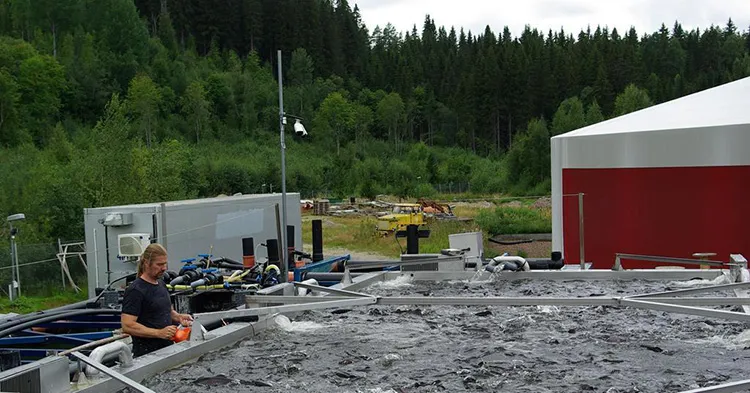
According to Kiuru, rainbow trout are the most suitable species for the PaRAS system, but this model is also effective for all other aquaculture species, including tilapia. Luke has received cooperation proposals from many shrimp and other fish farms, beyond cold-water fish and salmon.
To date, Kiuru and his colleagues have conducted two small-scale laboratory trials and eight large-scale trials with the PaRAS model. The fish yield obtained so far is 24 tons. The results show that the farms experienced no technical issues, fish grew rapidly, feed conversion ratio was good, and mortality rates were very low. Fish fed well and intake was better compared to conventional RAS systems. Luke aims to commercialize the PaRAS model as soon as possible.
>> Although RAS technology has been upgraded over the past two decades, costs and efficiency have not significantly improved due to ongoing challenges with capacity, water quality, and product quality. However, PaRAS has the potential to overcome all these drawbacks.
According to Fishfarmingexpert