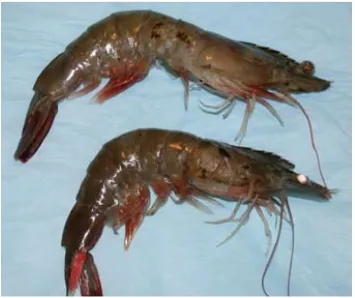
 Effects of chronic nitrate toxicity include dark blister-like lesions on the shell and anterior segments near the tail, a sign of shrimp stress. The image shows the upper shrimp with truncated antennae and an abnormally short anterior appendage.
Summary: In culture environments with water at 1/3 seawater salinity, shrimp survival and growth were significantly affected at nitrate levels above 220 mg/L. Nitrate can lead to reduced feeding, impaired metabolism, and endocrine dysfunction. Nitrate toxicity is a more pronounced issue for shrimp cultured in low-salinity waters. Shrimp exposed to high nitrate concentrations exhibit shorter antennae, abnormal gills, and hepatopancreatic lesions.
In shrimp farming, one of the main waste products of concern is nitrogen, which appears as ammonia, nitrite, and nitrate. Ammonia is excreted by animals and also arises from the decomposition of organic solids such as uneaten feed. This ammonia can be directly removed from the water through assimilation by heterotrophic bacteria, algae, and plants. Ammonia can also be removed from ponds and aquaculture systems through nitrification. This is a two-step process carried out by autotrophic bacteria called nitrifiers. Ammonia is converted to nitrite, and nitrite is then converted to nitrate.
Compared to nitrate, both ammonia and nitrite are extremely toxic to shrimp. Ammonia and nitrite levels should be maintained at negligible levels in commercial ponds and biofiltration systems as shown in Figure 1. However, nitrate will continue to accumulate, and high nitrate concentrations are also toxic to shrimp.
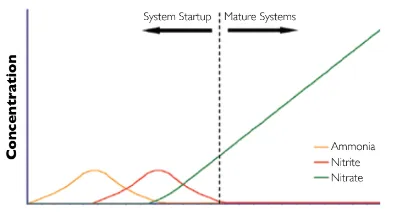 Figure 1. Nitrogenous waste concentrations over time during typical shrimp production using nitrification.
Methods to reduce nitrate levels (water exchange or biological denitrification technology) are costly and resource-intensive.
Little is known about the long-term toxic effects of nitrate on shrimp. Anecdotal claims are often made about what nitrate levels are considered safe. Some recommend keeping nitrate below 100 mg/L, while others feel comfortable with over 500 mg/L on their farms. To eliminate this confusion, the authors conducted studies to determine which concentrations have a negative impact on shrimp production over an extended period.
Impact of nitrate
Whiteleg shrimp were exposed to different nitrate levels in small-scale 150L tanks for 6 weeks at approximately 1/3 seawater salinity (salinity 11 g/L). Table 1 presents a summary of the effects of nitrate concentrations on shrimp production.
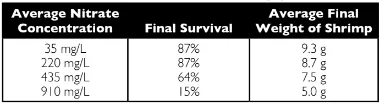 Table 1. Long-term effects of elevated nitrate concentrations on shrimp production.
No statistically significant differences were observed in survival or growth for shrimp exposed to 35-220 mg/L nitrate. However, above 220 mg nitrate, shrimp survival and growth were significantly affected. Shrimp exposed to the maximum nitrate level of 910 mg/L performed very poorly. Several possibilities could explain the observed growth inhibition and increased mortality, including reduced feeding, impaired metabolism, and endocrine dysfunction.
Salinity and Nitrate
Additional nitrate exposure experiments were conducted across a range of salinities from brackish to seawater (salinity 2-18 g/L). Shrimp production was significantly affected in the lowest salinity group.
This study indicates that nitrate toxicity is a more significant concern for shrimp in low-salinity waters. At low salinities, shrimp must expend considerable energy to regulate their osmotic pressure to compensate for the reduced saline environment. This is a stressor for them, so when additional stress in the form of high nitrate levels is introduced, shrimp cannot cope well.
Health Effects
The easiest way to determine the toxic effects of nitrate on shrimp is to examine parameters such as survival and growth. Farmers can also assess other physiological characteristics, such as antennae, gills, and hepatopancreas.
Shrimp exposed to high nitrate concentrations for extended periods exhibit shorter antennal length, abnormal gills, and lesions in the hepatopancreas. Short antennae and gill abnormalities are often considered early clinical signs of declining shrimp health.
The hepatopancreas of shrimp produces digestive enzymes and is responsible for promoting the normal absorption of digested feed. A type of lesion observed in shrimp exposed to high nitrate concentrations is shown in Figure 2. These cells are dilated and lack an epithelial membrane, which may be a consequence of poor feeding or abnormal feed metabolism.
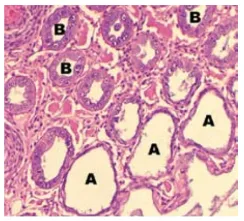 Figure 2. Lesions in the hepatopancreas of shrimp exposed to high nitrate levels for extended periods. A = abnormal, dilated cells lacking an epithelial layer. B = normal cells.
In addition to affecting animal health, physical and biological changes can lead to a loss of value for shrimp, resulting in reduced profits for producers.
Perspective
This experiment indicates that caution is needed when considering shrimp farming in waters with nitrate levels exceeding 220 mg/L. Furthermore, marine shrimp cultured at very low salinities have reduced nitrate tolerance. It is hoped that this information will inform shrimp farmers to help them make management decisions regarding the balance between resource conservation and nitrate control.
Dr. David D. Kuhn.