A new study has discovered exactly how shrimp respond to heat stress – a breakthrough that could help reduce mortality rates in farmed shrimp during periods of high water temperatures.
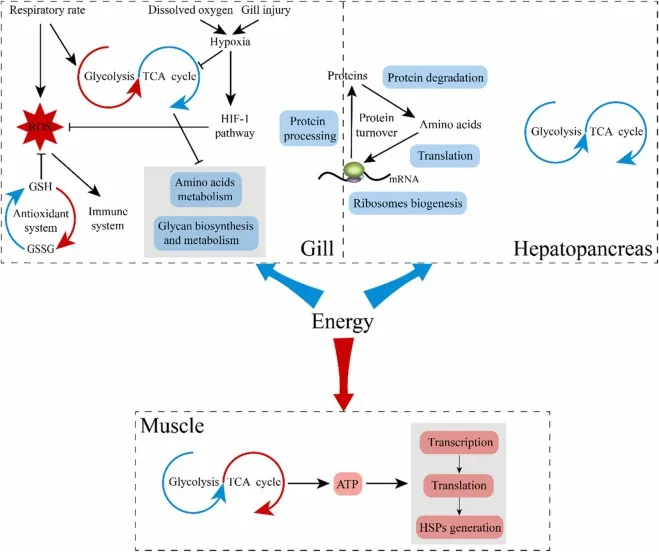
Diagram illustrating the distinct responses and energy redistribution among three tissues (gills, hepatopancreas, muscle) under heat stress.
Pacific white shrimp ( Litopenaeus vannamei ), a species with high economic value and superior breeding characteristics, has become one of the world's major aquaculture species.
However, continuous water temperatures above 35 °C lead to high shrimp mortality rates. As a result, a research team led by Professor LI Fuhua from the Institute of Oceanology, Chinese Academy of Sciences (IOCAS), recently investigated the mechanisms of L. vannamei's response to such high temperatures. They state that their study has provided new insights into the energy redistribution strategy in Pacific white shrimp to cope with heat stress.
According to the researchers, most previous studies on heat stress were limited to single tissues or a few indicators. However, the spatial network of cooperation among different tissues and its relationship with energy in response to heat stress remained unclear.
In this study, the researchers conducted comparative and transcriptomic analyses on three tissues of heat-stressed shrimp, including the hepatopancreas, gills, and muscle. They found that energy-related genes were the main altered genes, which infers that energy flow can be redistributed among different tissues when subjected to heat stress.
This research not only provides a comprehensive understanding of the molecular mechanisms of L. vannamei's response to high temperatures but also lays the foundation for exploiting heat-tolerant genes and proposing effective strategies to cope with high-temperature environments.
Dr. Zhang Xiaoxi, the first author of the study, stated: “Understanding the cooperation of different animal tissues in response to heat stress is the basis for clarifying the regulatory mechanisms of various species under heat stress.”
We found that different tissues can cooperate simultaneously through energy redistribution to respond to heat stress. Professor Zhang Xiaojun, co-author, stated: “Less energy is transferred into protein turnover in the gills and hepatopancreas to maintain minimal survival, and more energy is needed for the muscle mass to escape adverse conditions.”
This work not only provides a comprehensive understanding of the molecular mechanisms of Pacific white shrimp (L. Vannamei) response to high temperatures but also lays the foundation for exploiting heat-tolerant genes and proposing effective strategies to cope with high-temperature environments.
Source: thefishsite
For more details on the original article: https://www.sciencedirect.com/science/article/pii/S0147651322004407