Astaxanthin produced by a genetically modified yeast strain has been shown to be more effective than synthetic alternatives in improving the immune system and coloration of farmed whiteleg shrimp.
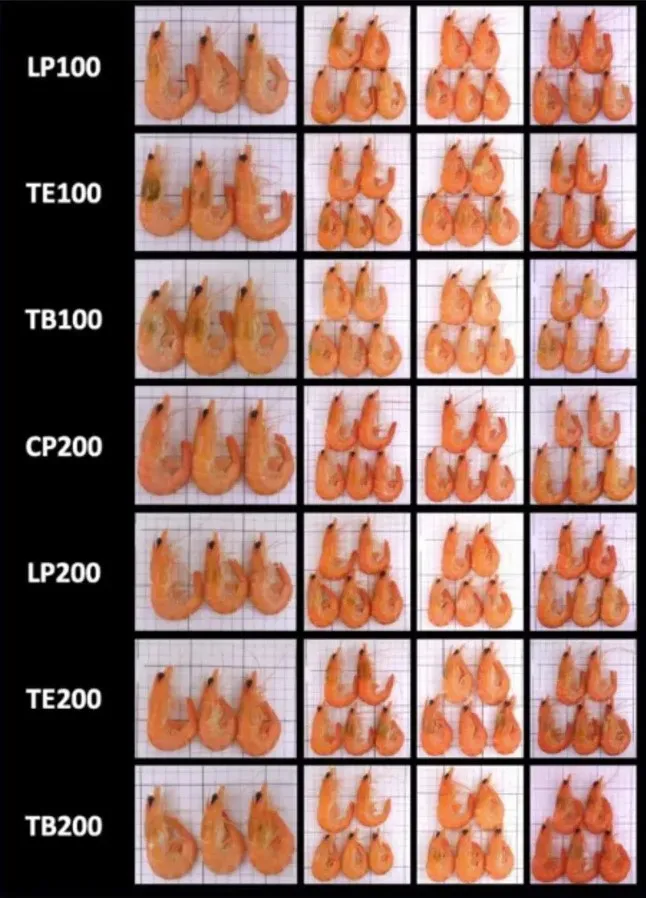 Effect of astaxanthin in the diet on shrimp body coloration. (A) Digital analysis points of shrimp body and (B) Weekly photos after cooking
A team of researchers from Chung Hsing National University, China Medical University Hospital, and National Taiwan Ocean University compared the effects of astaxanthin produced by a genetically modified yeast strain Kluveromyces marxianus (referred to as 3S, 3'S-ASTX) with a synthetic alternative, on genes related to immunity and red coloration in whiteleg shrimp (Penaeus vannamei).
The study also examined the potential commercial use of 3S, 3'S-ASTX produced by Kluveromyces marxianus, to investigate whether shrimp fed diets containing astaxanthin could exhibit non-specific immune responses.
Additionally, the researchers analyzed the impact of astaxanthin on shrimp's resistance to Vibrio parahaemolyticus infection.
Currently, the algae Haematococcus pluvialis, yeast Xanthophyllomyces dendrorhous, and bacteria Paracoccus carotinifaciens are used for the commercial production of two natural stereoisomeric forms: 3S and 3R.
However, the production of natural astaxanthin is costly, mainly due to low yields and limited sources.
Chemically derived astaxanthin is often used as a feed additive in aquaculture, but synthetic forms can be toxic to humans and the production process can cause environmental pollution.
Effect on shrimp coloration
The researchers stated in a press release: “Our results showed that redness and yellowness significantly increased by the second week in all shrimp fed astaxanthin-supplemented diets, compared to those fed the control diet”.
However, they noted that the results showed no dose-dependent difference in coloration among shrimp fed astaxanthin-supplemented diets.
“We observed that shrimp receiving TE200, supplemented with 3S, 3'S-AST derived from K. marxianus, had the highest redness values at weeks 1 and 2, compared to those receiving other astaxanthin-supplemented diets,” they reported.
Immune-boosting properties
Immune responses, including phagocytic activity, superoxide anion production, phenoloxidase activity, and immunity-related genes, were examined on days 0, 1, 2, 4, 7, 14, 21, and 28.
Overall, shrimp receiving AST-supplemented feed exhibited higher immune responses on days 7 and 14 compared to the control feed.
“Our findings indicate a range of physiological benefits of 3S astaxanthin, 3'S-AST derived from K. marxianus; these include improvements in survival, pigmentation, stress tolerance, disease resistance, and immunity-related gene expression,” they explained.
They added: “The incorporation of astaxanthin into the diet improved shrimp redness, immune parameters, and resistance to V. parahaemolyticus infection.”
They further emphasized that astaxanthin derived from K. marxianus demonstrated superior performance compared to chemical astaxanthin, making it a potential feed additive in shrimp farming.
They explained: “The use of 3S astaxanthin, 3'S-AST derived from K. marxianus, improved various immune parameters and prevented V. parahaemolyticus infection in shrimp.”
According to Thefishsite