For over a decade, whiteleg shrimp have been permitted for farming in the Mekong Delta provinces. With advantages such as fast growth, high yield, shorter culture periods than black tiger shrimp, and promoted as being more resilient to environmental fluctuations, whiteleg shrimp have been embraced by farmers, and the farming area has continuously expanded, now reaching 100,000 hectares. However, in recent times, shrimp farmers have suffered heavy losses. The reasons are disease outbreaks attacking shrimp and erratic fluctuations in shrimp prices. Finding the causes and solutions to overcome this situation has become an urgent need, supporting farmers during this difficult time and contributing to the more stable and sustainable development of the shrimp industry.
To increase shrimp farming efficiency, it is necessary to consider the objective factor of market prices and the subjective factor of stocking implementation.
Shrimp Price Factor in the Market
Of course, this only revolves around whiteleg shrimp. Prices are determined by global and domestic supply and demand. In Vietnam, no one has enough potential to manipulate raw shrimp prices, a product that cannot be stored for long; everything follows market mechanisms and the law of supply and demand.
The world's shrimp farming powerhouses are Indonesia and Ecuador, which farm shrimp in the Southern Hemisphere, stocking throughout the year and harvesting from late March annually. India, China, Thailand, and Vietnam farm shrimp in the Northern Hemisphere, harvesting from May annually. This is normal, but each country and region has different weather conditions, which can cause shrimp stocking to be earlier or later. This allows shrimp processing facilities to have more stable raw materials and the market to have a more consistent supply. Generally, shrimp prices will gradually decrease from May and recover by September, as that is when the supply is strongest. However, there are also unpredictable times. For example, in early 2018, due to weak consumption, major markets still had inventory, and Indonesian shrimp had a good harvest and entered the season early, causing global shrimp prices to fall low by late April, and our fresh shrimp prices also decreased, making farmers hesitant to stock. Or in 2019, due to disease outbreaks, farmers were not keen on stocking for the off-season crop, leading to a localized shortage of raw shrimp, and by mid-August, raw shrimp prices had increased sharply.
In summary, raw shrimp prices basically tend to be low from May to September. For the rest of the year, prices are better. Conversely, farmers calculate how to somewhat avoid concentrating harvests too much during the aforementioned period to reduce the glut of raw shrimp and limit price reductions due to supply and demand impacts. This is contradictory, because the harvest period mentioned above is the result of the most favorable seasonal calendar. The proposed solution is to share risks, with farmers stocking in staggered crops, extending the harvest period.
Cost of Shrimp Farming in Vietnam
Our shrimp farming costs (production costs) vary due to farming techniques, stocking density, capital capacity, local environmental conditions, etc. In short, due to both subjective and objective factors. These factors inherently interact with each other. It might seem easy to determine which factor has the most impact on shrimp farming costs, but in reality, it's not.
Approach to Factors Affecting Production Costs Through Analysis of Farming Methods
Two common farming methods are earthen ponds and lined ponds. Earthen ponds can utilize some nutrients from the soil. Risks include residual chemicals from previous crops at the pond bottom, difficulty in cleaning the pond bottom during farming, etc., so the stocking density is less than 100 shrimp per square meter. In recent times, with many disease outbreaks, this pond farming method has revealed an additional disadvantage: diseases are harder to treat due to uncontrolled bacterial proliferation at the pond bottom.
On a large scale, the success rate of pond farming is only 30% (*). From there, the method of lined pond farming developed, with small pond areas, allowing for high-density shrimp farming, high yield, and also a high success rate, over 70% (*). Clearly, lined pond farming is more efficient. However, it requires a large investment, which the majority of farmers cannot afford due to limited capital from years of losses. In reality, due to lower investment, the cost of earthen pond farming will be lower than that of lined pond farming. In return, the yield of lined ponds is very high, and overall, lined ponds generate better profits. These two methods coexist, with lined pond farming tending to expand. In the cost structure of the two farming methods, the difference lies more in farming techniques than in other factors, which do not vary significantly.
(*): Quoted from Analysis of Input Factors in Earthen Pond and Lined Pond Whiteleg Shrimp Farming Models. Dr. Nguyen Duy Hoa and Eng. Nguyen Xuan Hoang
Approach to Factors Affecting Production Costs Through Analysis of Cost Structure
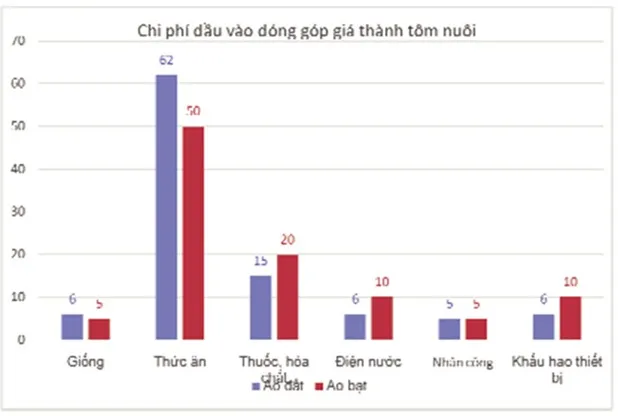
The article by Dr. Hoa and Eng. Hoang in the aforementioned citation shows the cost structure of the two shrimp farming methods as follows:
- The factor with the highest proportion is feed, accounting for 50-62%. The proposed solution is to focus on saving feed and reducing feed prices. Saving feed means controlling shrimp feeding to be just enough, without excess that causes waste and water pollution. Reducing feed prices by cutting intermediate layers.
- The next factor is medicines, chemicals, minerals, nutrition..., accounting for 15-20%. The solution is still to save and use the right pond products needed.
- Energy for oxygenation, water pumping, water treatment, lighting... accounts for 6-10%.
- The factor with the lowest proportion is postlarvae, accounting for 5-6%.
This approach shows that saving and reducing feed prices play the largest role.
Source: Dr. Ho Quoc Luc - Former Chairman of VASEP, Chairman of the Board of Directors of FIMEX VN