The workshop is a forum for delegates to exchange and share issues related to aquaculture feed, as well as propose solutions for the sustainable development of the aquaculture feed industry.
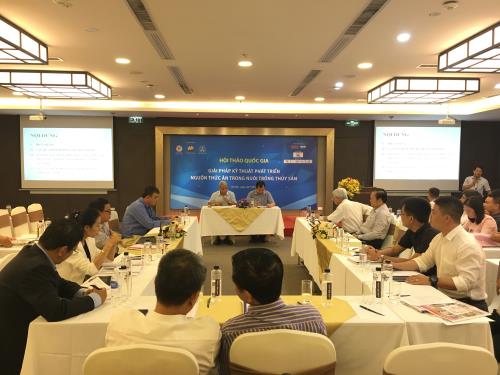
National workshop on technical solutions for developing aquaculture feed sources
On the afternoon of July 20, the Directorate of Fisheries (Ministry of Agriculture and Rural Development), in coordination with relevant units, organized the "National workshop on technical solutions for developing"
aquaculture feed".
Mr. Tran Dinh Luan, Deputy Director General of the Directorate of Fisheries, stated that the workshop is a forum for delegates to exchange and share issues related to aquaculture aquaculture. At the same time, businesses, managers, and researchers shared experiences and proposed solutions for the sustainable development of the aquaculture feed industry, reducing production costs for farmers.
According to Mr. Tran Cong Khoi, from the Aquaculture Department, in 2017, the total number of certified products in circulation was 3,061 products; of which, feed products accounted for 1,877 products (1,634 domestic products, 243 imported products). Aquaculture environment treatment products accounted for 1,184 products (1,114 domestic products, 70 imported products).
According to development orientation, aquaculture feed and aquaculture environment treatment products must meet the following requirements before being circulated on the market: declaration of applicable standards and conformity declaration as regulated; quality consistent with declared standards; product information submitted to the Ministry of Agriculture and Rural Development as regulated.
Additionally, imported aquaculture feed and aquaculture environment treatment products must undergo quality inspection. Organizations and individuals are permitted to import aquaculture feed and aquaculture environment treatment products containing chemicals, biological products, microorganisms, and raw materials for aquaculture feed production that are on the list of chemicals, biological products, microorganisms, and raw materials for feed production allowed for use in aquaculture in Vietnam.
According to the Directorate of Fisheries, feed plays a crucial role in aquaculture, often accounting for 40-70% of production costs. In recent years, research on aquaculture nutrition and feed has made rapid advancements in both breadth and depth, with many types of nutritionally balanced feeds capable of improving the health of farmed aquatic species being researched and applied in production.
In 2017, the country had 218 industrial animal feed production facilities, with a total designed capacity of over 31 million tons; of which, the designed capacity for aquaculture feed was 5.8 million tons; imported raw materials for animal feed production amounted to 18.1 million tons, equivalent to 5.5 billion USD, including: high-protein feed approximately 7.2 million tons; high-energy feed approximately 10.4 million tons; supplementary feed approximately 500,000 tons…
In 2018, Vietnam's fisheries sector aims to achieve a total aquatic product output of 7-7.5 million tons; of which, wild-caught aquatic products will be 3-3.5 million tons (a decrease of 11.5% compared to 2017 to protect aquatic resources), and aquaculture output will be 4 million tons. The country also strives for the fisheries economy to contribute approximately 2.8-3% of the national GDP by 2020, with a total export turnover value reaching 11 billion USD. With great potential, Vietnam's aquaculture industry is developing strongly, playing a crucial role in the country's socio-economic development./.
Thanh Trung/BNEWS/TXVN