This article is an abridged translation and summary from Aquaculture (Ecuador) Document No. 128, April 2019 – to provide farmers with a method to improve the efficiency of Pacific white shrimp farming in low-salinity water by supplementing K+ and Mg2+ ions in the diet.
In Ecuador, heavy rains occur every winter, significantly reducing salinity in estuaries, thereby affecting the production of shrimp farms using this water source. Shrimp farming in low salinity leads to a series of environmental management challenges due to the deficiency of some essential minerals. This causes stress to farmed shrimp, which is why finding alternatives to compensate for low salinity through appropriate nutrition is truly necessary.
Previous studies have shown that shrimp exposed to low salinity stress have low immunity and reduced resistance against infections from various pathogens, and the simultaneous presence of nitrogen compounds (especially ammonia and nitrite) in shrimp farming systems also significantly increases their toxicity because these compounds tend to have synergistic effects. Therefore, when farming shrimp in low salinity, it is necessary to ensure that water quality parameters are always within suitable limits for shrimp development to minimize losses.
The deficiency of major ions, especially potassium (K+) and magnesium (Mg2+), is adjusted in the water by supplementing salts of these minerals, to achieve the necessary concentrations equivalent to those of diluted seawater at the same salinity.
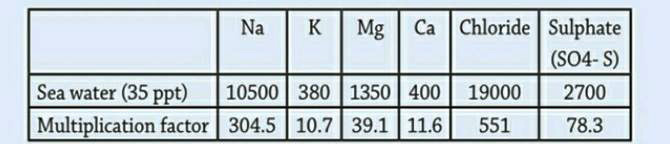
Seawater with a salinity of 35 ppt is considered the standard. To obtain the desired mineral content at different salinities, the water salinity (in ppt) is multiplied by factors for each mineral.
At the same time, to facilitate good development for farmed shrimp, the ion ratio of minerals in specific low-salinity water (Na+:K+, Mg2+:Ca2+, etc.) should be similar to seawater. For example: the Na+:K+ ratio should be 28:1, Mg2+:Ca2+ should be 3.4:1, and Ca2+:K+, approximately 1:1. Adjust when water has a low ratio of mineral ions by supplementing these minerals into the shrimp's diet.
Osmoregulation in Shrimp
Pacific white shrimp can live in waters with salinity ranging from 0.5 to 60 ppt.
Osmoregulation in crustaceans is an important physiological function in their adaptation to environmental changes. The osmoregulatory capacity of Pacific white shrimp gradually decreases as they reach maturity, with juvenile shrimp having the best osmoregulatory ability.
Among penaeid shrimp species, Pacific white shrimp are one of the best osmoregulators. Pacific white shrimp can achieve optimal survival and growth rates in water with salinity ranging from 20 - 25 or 26 ppt.
The Importance of Potassium and Magnesium for Farmed Shrimp Survival
Potassium (K+) is an intracellular cation essential for ion regulation, acid-base balance, and basic metabolic processes. K+ is crucial for activating the Na+/K+ ATPase enzyme. Enzyme activity can be directly related to K+ concentration; a deficiency of K+ will affect effective osmoregulation, leading to an imbalance between K+ and Na+ concentrations in the blood, which can be fatal to shrimp.
The lack of K+ concentration in culture water has a negative impact on shrimp survival. In experiments with PL18-28 shrimp adapted to salinity from 36 ppt - 4 ppt for 48 hours and maintained for an additional 24 hours in solutions with different added salts, K+ supplementation measures helped increase survival rates by 20% and 42% after 24 and 48 hours, respectively, compared to no potassium supplementation. This indicates that the need for potassium in freshwater is very important for shrimp survival.
Other studies have reported that under low salinity conditions, diets containing K+ complexes support higher growth rates compared to basal diets. This demonstrates the benefits of K+ supplementation, especially for shrimp farmed in low-salinity waters.
Potassium and magnesium are essential cations for the growth, survival, and osmoregulation of crustaceans. Mg2+ is the second most abundant intracellular cation, required by crustaceans because it acts as a cofactor in many important enzymatic reactions to maintain normal organismal activity. It is involved in osmoregulation, protein synthesis, and growth. Mg 2+ is also crucial in bone tissue metabolism and neuromuscular transmission. The Na+/K+ ATPase enzyme is very important in osmoregulation and ion regulation in environments adapted to low salinity. In crustaceans, without Mg2+, this enzyme does not hydrolyze ATP. At low salinity, Mg 2+ concentration also correlates with shrimp survival rates.
Supplementing Minerals into Shrimp Diet
With the aim of demonstrating that the use of mineral-supplemented feed under low salinity conditions leads to improvements in growth, survival rate, and FCR, an evaluation was conducted at a shrimp farm using a recirculating system at 5 ppt salinity in Taura, Guayas province (Ecuador). Ponds used ranged from 6 to 12 hectares (ha).
The initial weight of the experimental shrimp was 0.4 to 0.6 grams, and the stocking density was 13 - 15 PL/m2. Three feeds were supplemented after the animals reached 4 grams, with a protein content of 35%, with and without added mineral salts: standard formula feed (B35S E01), low-salinity formula feed No. 1 (B35P BS01), and low-salinity formula feed No. 2 (B35 BS02).
Feed was applied in the ponds twice daily and adjusted based on feeding trays. Low-salinity formula feed (pellets, 1.8 x 3 mm for BS01 and BS02 fed from when shrimp reached 4 to 5 grams), then switched to larger pellets of 2.2 x 5 mm from 9 grams until harvest.
Results: Analysis showed that ponds receiving low-salinity feed BS02 had the highest survival rate, weight, and yield.
When analyzing the Mg2+ and K+ content in the tested feeds, the relationship between these two minerals was found to be 0.26, 0.49, and 0.93 for feeds E01, BS01, and BS02, respectively. These relationships, in increasing order, correlated with the survival rate, yield, weight, and final growth rate of the shrimp, indicating that the relationship between these factors has a significant impact on shrimp performance.
The results show that shrimp production can be significantly improved, and therefore, to achieve better profitability when farming shrimp in low salinity, it is necessary to supplement minerals in the shrimp's diet, especially Mg 2+ and K +.
Source: https://www.aquaculturealliance.org