Pathogen can threaten freshwater polyculture systems
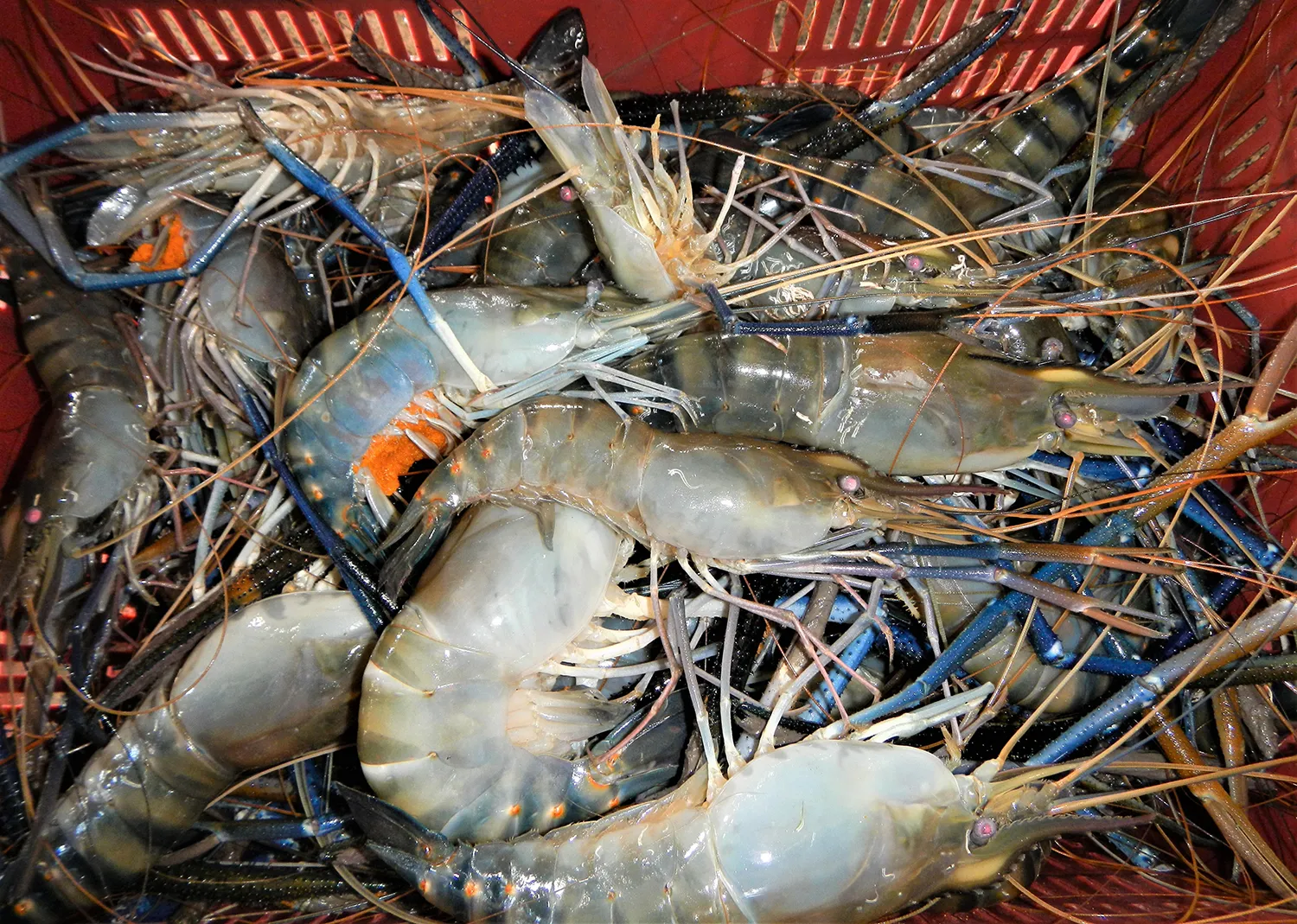
Figure 1. This study is the first report and description of the natural occurrence of Decapod Iridescent Virus 1 (DIV1) - a novel virus in giant freshwater prawn (Macrobrachium rosenbergii), an important aquaculture species worldwide
Giant freshwater prawn (Macrobrachium rosenbergii), originating from Malaysia, Vietnam, Cambodia, Thailand, Myanmar, Bangladesh, India, Sri Lanka, and the Philippines, and introduced to many other countries, is an economically valuable crustacean in aquaculture. It is generally known to be less susceptible to certain viral diseases compared to penaeid shrimp (e.g., black tiger shrimp, whiteleg shrimp, etc.).
Recently, novel viruses studied in crustaceans include Iridovirus (CQIV) in redclaw crayfish (Cherax quadricarinatus) and SHIV in whiteleg shrimp (Penaeus vannamei). In March 2019, the Executive Committee of the International Committee on Taxonomy of Viruses (ICTV) approved the proposal for a new species Decapod Iridescent Virus 1 (DIV1) within the genus Decapodiridovirus, which includes SHIV and CQIV. To date, DIV1 has been detected in whiteleg shrimp (Penaeus vannamei) and some other penaeid shrimp species; red swamp crayfish (Procambarus clarkii); Oriental river prawn (Macrobrachium nipponense) and giant freshwater prawn (M. rosenbergii) in China, indicating that DIV1 poses a new threat to the shrimp farming industry.
In recent years, a new disease has been studied in giant freshwater prawn (M. rosenbergii) farms in China, commonly referred to as “white head” or “white spot”. Infected shrimp exhibit a white triangular area under the rostrum, with mortality rates potentially reaching up to 80%.
Study Setup
Samples of giant freshwater prawn (4 - 6 cm in length) and red swamp crayfish (5 - 7 cm in length) were collected from a pond with high mortality rates at a farm in the east-central coastal province of Jiangsu, China. In the same pond, other crustacean species - including other shrimp species and small crustaceans (such as Cladocerans) - were also sampled for further analysis. Carcasses of whiteleg shrimp (5 - 7 cm) were collected from the bottom of an adjacent pond - a pond heavily infected one month prior.
All collected samples underwent several examinations.
Results and Discussion
In this study, we investigated a farm where giant freshwater prawn and red swamp crayfish coexisted with other natural crustacean species – showing very high mortality rates after mass mortality of whiteleg shrimp in an adjacent pond. PCR results showed that all samples were negative for several viruses including WSSV, IHHNV, AHPND, IMNV, CMNV but positive for DIV1.
Giant freshwater prawn samples showed the highest DIV1 infection rates, ranging from 3.16 × 10⁸ to 9.83 × 10⁸, higher than all other naturally infected species in this and previous studies, indicating that the disease in giant freshwater prawn samples in this case was due to severe DIV1 infection. Therefore, this is the first confirmation of the causative agent for “white head” symptoms in giant freshwater prawn farms. Additionally, we also identified DIV1 as a natural pathogen for red swamp crayfish and Oriental river prawn.
During sample collection and processing, it was observed that most giant freshwater prawns exhibited clear clinical signs, including a distinct white triangular area under the rostrum, hepatopancreatic atrophy, pale hepatopancreas, empty gut (Figure 2), and some shrimp also showed slightly white muscle and antennal necrosis.
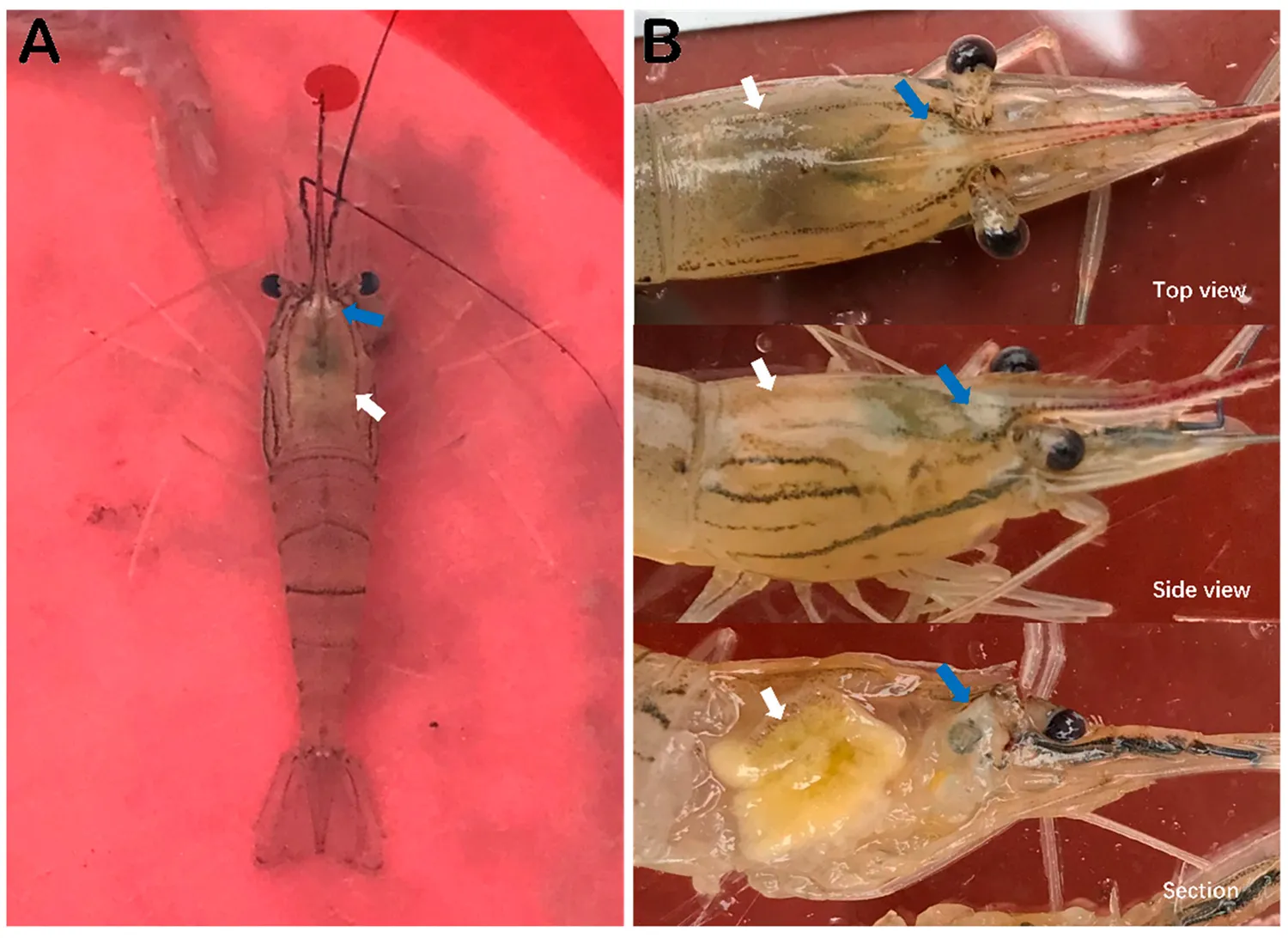
Figure 2. Clinical signs of naturally DIV1-infected giant freshwater prawn. (A) Overall view of a diseased shrimp in water. (B) Close-up of the cephalothorax. Blue arrow indicates the white area under the rostrum. White arrow indicates hepatopancreatic atrophy, pale hepatopancreas, and yellowish hepatopancreas
The susceptibility of giant freshwater prawn, Oriental river prawn, whiteleg shrimp, and red swamp crayfish to DIV1 and WSSV infection differs. Many farms in Jiangsu, Guangdong, and Zhejiang provinces in China, as well as in Southeast Asia and Africa, polyculture giant freshwater prawn, black tiger shrimp, and whiteleg shrimp. Due to the tolerance of giant freshwater prawn to WSSV, polyculture was considered a good approach for shrimp farms. However, the emergence of DIV1 has disrupted this approach and verified our previous warning that polyculture with different crustacean species can pose risks for disease spread, an increase in susceptible species, and pathogen evolution, based on our early epidemiological surveillance in shrimp.
Giant freshwater prawn and whiteleg shrimp infected with DIV1 both exhibited hepatopancreatic atrophy with surface discoloration and empty gut. However, these symptoms are not specific and can also be caused by other diseases - such as White Spot Syndrome Virus (WSSV), Taura Syndrome Virus (TSV), and Acute Hepatopancreatic Necrosis Disease (AHPND) – and the discoloration is similar to AHPND. It is noteworthy that “white head” is a typical clinical sign for on-site diagnosis of DIV1-infected giant freshwater prawn.
Perspective
The results of all conducted tests - including symptom description, known pathogen detection, histopathological and cytological observations, and other studies - confirmed that the so-called “white head symptom” in giant freshwater prawn is caused by DIV1 infection. Additionally, this study also provides evidence to report that red swamp crayfish (Procambarus clarkii) and Oriental river prawn (Macrobrachium nipponense) are susceptible to DIV1.
The disease is likely transmitted from the adjacent pond where whiteleg shrimp died during a DIV1 outbreak due to a lack of biosecurity in farm management. Our results indicate that DIV1 can threaten freshwater polyculture systems with various crustacean species.
Source: www.aquaculturealliance.org
Summarized translation by: Trần Thị Thúy Quyên