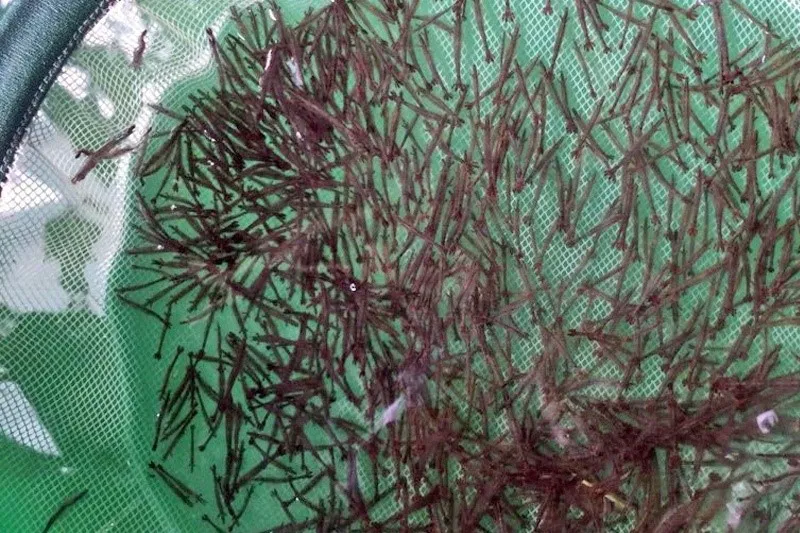
Black tiger shrimp postlarvae. Illustrative image: Internet
To evaluate the impact of salinity changes on the growth and survival rate of black tiger shrimp (Penaeus monodon), the research team of Huynh Thanh Toi and Nguyen Thi Hong Van (Faculty of Fisheries, Can Tho University) conducted a study on the effect of salinity shock during the stocking phase on the growth of black tiger shrimp reared using Biofloc technology.
Black tiger shrimp (Penaeus monodon Fabricius, 1798) is a large-sized species with delicious meat, wide adaptability to farming environments, fast growth, and high export value. Therefore, black tiger shrimp is a popular aquaculture species in Vietnam's marine shrimp farming industry, especially in the Mekong Delta. In 2014, Vietnam's farmed black tiger shrimp production was 260,000 tons over a farming area of 590,000 ha. The farming area is mainly concentrated in the Southern Delta region, accounting for 93% of the national area and 84.4% of the total national production (Directorate of Fisheries, 2014).
Currently, two-stage shrimp farming has been applied in intensive shrimp farming. The nursery stage aims to produce larger, disease-free, fast-growing postlarvae, reducing losses during the grow-out phase. Biofloc technology is currently widely applied in the nursery rearing of aquatic species to effectively remove excess nitrogen, while also maintaining nutrient levels and water quality at a safe level for the farmed shrimp.
In shrimp farming, salinity is a crucial factor determining productivity during the stocking and grow-out process, especially in the Mekong Delta. The reason is that due to climate change, extreme weather phenomena such as prolonged heavy rainfall can cause a sudden drop in pond salinity, making shrimp care difficult. Especially during the stocking phase, changes in salinity can significantly affect the growth and survival rate of black tiger shrimp. Therefore, it is necessary to determine the appropriate salinity range for black tiger shrimp development.
Evaluating the Impact of Salinity Shock During Black Tiger Shrimp Stocking
The experiment was conducted with 7 treatments divided into 2 groups.
- Group 1: salinity shock was performed: including 5 treatments, shrimp from 20‰ salinity were directly stocked at 5‰, 10‰, 15‰, 20‰ (control), and 30‰ salinity.
- Group 2: the remaining 2 treatments were divided into 2 subgroups for rapid acclimation from 20‰ to 5‰ salinity within 3 hours, and slow acclimation from 20‰ to 5‰ salinity over 3 days.
Each treatment was replicated 3 times and arranged in a completely randomized design in plastic tanks containing 70 liters of water, at a density of 2 individuals/liter. Shrimp were fed 4 times/day with feed No. 1 (40% protein) from CP Company, with feeding based on shrimp body weight.
Biofloc was created by adding molasses daily to the shrimp nursery tanks to achieve a C/N ratio of 10/1.
Results
After 20 days of nursery rearing, environmental factors were found to be within the suitable range for shrimp development. Sudden changes in salinity during the stocking process did not significantly affect shrimp growth, but did impact their survival rate.
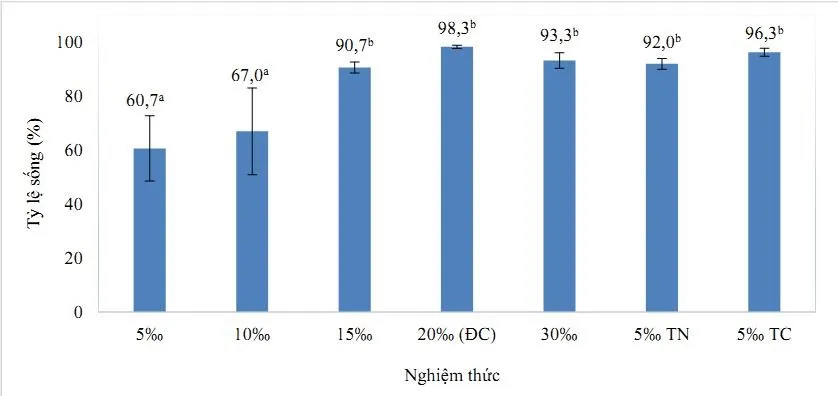
Shrimp survival rate after 20 days of nursery rearing
The results showed that the greater the salinity shock, the lower the shrimp survival rate. Specifically, when shrimp were subjected to salinity shock from 20‰ (suddenly reduced to 5-10‰), the survival rate was lowest, only reaching 60.7% - 67.0%. The highest survival rate was in the control treatment at 98.3%, with no significant difference compared to treatments with a 5‰ salinity reduction shock and an increase in salinity from 20‰ to 30‰. Rapid and slow acclimation of shrimp postlarvae did not affect the growth and survival rate of farmed shrimp.
Shrimp growth and weight were not affected by salinity shock; however, length growth was impacted, with greater salinity shock leading to lower shrimp length growth.
Based on the experimental results, farmers should acclimate shrimp before stocking them into ponds, or if stocking directly, the salinity difference should not exceed 5‰ to ensure it does not affect shrimp development. In cases of heavy and prolonged rainfall, an overflow weir should be designed to drain surface water, thereby preventing sudden changes in salinity.
It is hoped that the results from this study will provide additional information for farmers to adopt appropriate shrimp nursery and farming methods, adapting to the current rapidly changing weather environment.
Source: Vietnam Journal of Agricultural Sciences