A total of 86 samples of tra catfish fingerlings collected from Rach Ngong River in Can Tho were observed for pathological signs and fresh mounts were examined for parasites.
Methods for parasite analysis and identification
Ectoparasite examination was performed by taking mucus from the body, fins, and gills, preparing fresh mounts, and observing them under a microscope (10-40X). Endoparasite examination was performed similarly by taking mucus from the intestine and stomach, preparing fresh mounts, and observing them under a microscope (10-40X).
The level of parasitic infection was characterized by two parameters: prevalence (TLN) and intensity of infection (CĐN).
- Prevalence (%) = (Total number of infected fish / Total number of fish examined) x 100
- Intensity of infection = Number of parasites / organ, slide, field of view
Parasite classification was based on morphological characteristics: external shape, size of spores, cysts, polar capsule structure, cilia, etc.
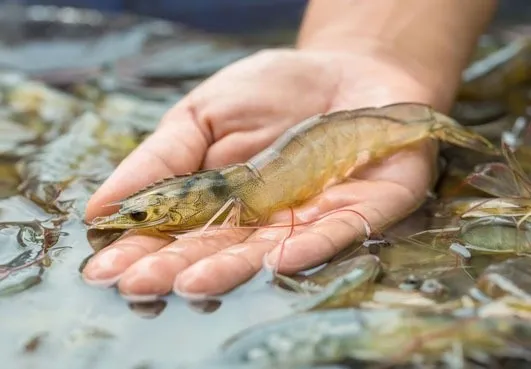
External signs of tra catfish samples living in the natural environment
The internal organs showed no abnormal signs of disease. However, parasite examination results showed that wild tra catfish are often infected with parasites in organs such as skin, gills, stomach, and intestines, with varying prevalence and intensity of infection depending on the parasite species.
Parasite species composition in wild tra catfish
Parasite examination results on 86 wild tra catfish samples identified 8 parasite genera belonging to 2 groups:
- Endoparasite group: Myxobolus, Ichthynonytus, Protoopalina, and Bucephalopsis
- Ectoparasite group: Myxobolus, Heneguya, Trichodina, Dactylogyrus, Gyrodactylus
Protozoan group (Protozoa) parasitic on wild tra catfish
Morphological observation under the microscope identified 3 parasitic genera: Myxobolus, Henneguya, and Trichodina. The skin and gills were the two organs most frequently found infected with these three Protozoa genera. The genus Myxobolus parasitized the skin of tra catfish with the highest prevalence (61.6%) compared to other genera.
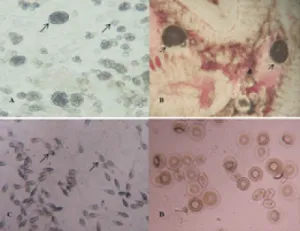
Morphology of Protozoan parasites on wild tra catfish; (A-B) Myxobolus spores and cysts; (C) Henneguya spores; (D) Trichodina (sun-like protozoan)
Among the 3 ectoparasite genera found, Trichodina had the highest prevalence on tra catfish gills, accounting for 79.4%.
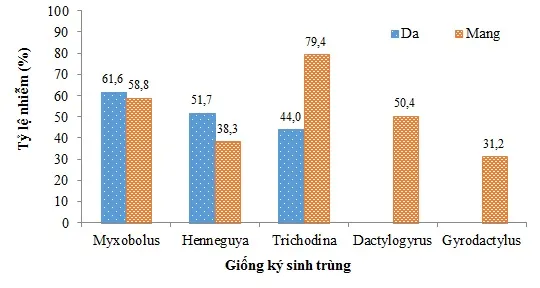
Prevalence of ectoparasite group
Ectoparasitic monogenean group
The monogenean group parasitized wild tra catfish at a relatively low density. The monogenean group commonly parasitic on fish includes the genera Dactylogyrus and Gyrodactylus, and they were found parasitizing the gills of tra catfish.
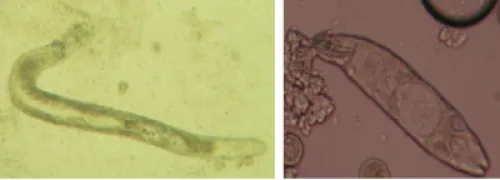
Monogenean group parasitic on wild tra catfish; (A) Dactylogyrus (16-hook fluke); (B) Gyrodactylus (18-hook fluke)
Endoparasite group
Myxobolus is a parasite genus with a relatively wide host range in wild tra catfish, parasitizing both the skin and gills of fish, as well as parasitizing and forming cysts in the intestines of wild tra catfish.
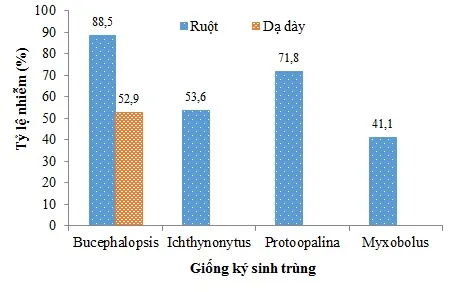
Prevalence of endoparasites in wild tra catfish
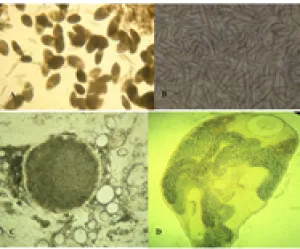
(A): Ciliated protozoan Ichthyonuctus; (B): Protoopalina; (C): Myxobolus cyst; (D): Digenean fluke Bucephalopsis
The digenean fluke genus Bucephalopsis had the highest prevalence among the 4 endoparasite genera. Although Ichthionyctus and Protoopalina parasitized in large numbers, these two species did not harm the fish; they only exacerbated the disease when fish suffered from enteritis.
Conclusion
There are 8 parasite genera found in wild tra catfish: Myxobolus, Henneguya, Trichodina, Dactylogyrus, Gyrodactylus, Ichthyonyctus, Protoopalina, and Bucephalopsis. Of these, 5 genera parasitize the skin and gills, and 4 genera parasitize the intestines and stomach. The number of parasites infecting wild tra catfish depends on the species composition and the parasitic organ. Most tra catfish samples collected from the wild were healthy, showing no pathological signs.
Source: Can Tho University Journal of Science