The increase in aquaculture activities leads to more frequent disease outbreaks, causing significant economic losses for farmers. Infectious Myonecrosis Virus (IMNV), White Spot Disease (WSD), and Early Mortality Syndrome / Acute Hepatopancreatic Necrosis Disease (EMS / AHPND) appear in every shrimp farming season in Asia.
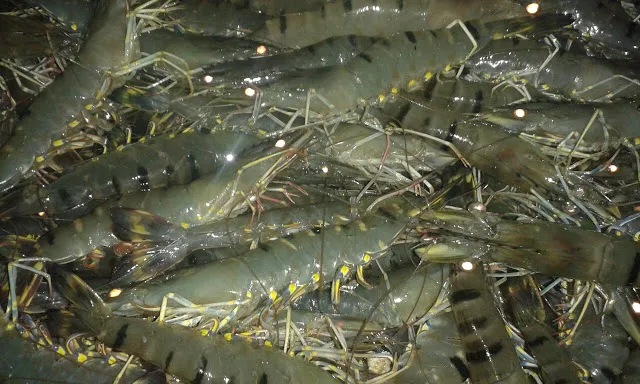
Viral diseases remain a major challenge. However, the shrimp farming industry now needs to be more cautious about non-viral diseases, especially bacterial diseases caused by Vibrio spp. Vibrio has been known as a bacterial pathogen in shrimp since the 1990s, but more commonly in the larval stage. However, there have also been many reports of Vibrio diseases during the grow-out phase. Currently, Vibrio-related diseases affect production and cause significant losses for the aquaculture industry in general and the shrimp industry in particular.
Vibrio and disease issues:
Vibrio is one of the causes of primary and secondary infections. For primary infections, Vibrio has become a concern after Tran et al. (2013) reported Vibrio parahaemolyticus as the causative agent of AHPND. Interestingly, a researcher in Vietnam found virulence genes of V. parahaemolyticus in Vibrio harveyi. In recent years, the transfer of virulence genes (plasmids) not only between V. parahaemolyticus strains but also to different Vibrio species has received increasing attention.
For secondary infections, Phuoc et al. (2009) showed a significant increase of Vibrio campbellii in shrimp co-infected with WSSV; increasing up to 105 CFU/ml, whereas initially V. campbellii was only 102 CFU/ml. There was no difference in cells infected by WSSV with or without V. campbellii co-infection, meaning V. campbellii co-infection was not affected by WSSV virulence. However, co-infection with WSSV and V. campbellii or V. harveyi caused higher and faster mortality compared to normal WSSV infection.
Furthermore, Manilal et al. (2010) reported that non-pathogenic Vibrio alginolyticus became virulent after WSSV developed in the pond. In some cases, V. alginolyticus has been used as a probiotic to compete with V. harveyi.
Monitoring Vibrio in shrimp ponds:
Based on the harmful effects of Vibrio on shrimp diseases, researchers monitor Vibrio levels in pond water as well as in cultured shrimp. Monitoring Vibrio in pond water is quite common. Many farms monitor Vibrio in pond water according to standard operating procedures (SOPs), but currently, not many farms monitor Vibrio in shrimp bodies. To increase reliability, sampling is carried out to monitor Vibrio levels in shrimp tissues such as hemolymph, hepatopancreas, and intestine.
The case of White Feces Disease (WFD) in Chanthaburi, reported by Somboon et al. (2012), demonstrated the importance of knowing Vibrio levels in shrimp tissues (hemolymph and intestine). The report showed different total Vibrio compositions in the hemolymph and intestine of shrimp collected from normal ponds and ponds with WFD outbreaks. Controlling Vibrio at permissible levels is crucial to keep shrimp in a desired condition. Allowing Vibrio growth to exceed the permissible range will lead to a higher risk of infection.
Supplements to control Vibrio in shrimp intestines:
Previously, many farms applied antibiotics to control Vibrio, especially during the nursery stage. This led to many cases of rejected shrimp exports due to banned antibiotics being detected or antibiotics exceeding permissible levels.
More importantly, antibiotics are not meant for daily use in normal and healthy shrimp. Improper use of antibiotics can lead to several issues related to antibiotic resistance.
Bacterial antibiotic resistance affects the choice of therapeutic drugs for human and animal use. Antibiotic residues in animals cause health concerns in humans. And a worrying issue is "superbugs" resistant to multiple types of antibiotics.
To control infectious bacterial diseases in shrimp farming, natural, antimicrobial supplements can be applied along with various strategies, such as improving pond water quality and host health.
Organic acids can be an option to control Vibrio in shrimp intestines. In in vitro experiments, Adams and Boopathy (2013) reported that a low dose of formic acid had a good inhibitory effect on Vibrio strains. The growth of Vibrio bacterial strains is affected by changes in environmental pH. The pH value for complete inhibitory treatment is ≤ 5. The growth ability of V. harveyi and other Vibrio species is inhibited when the pH is lower than or at 5. When the pH is above 5, V. harveyi can adapt to the acidic environment and survive.
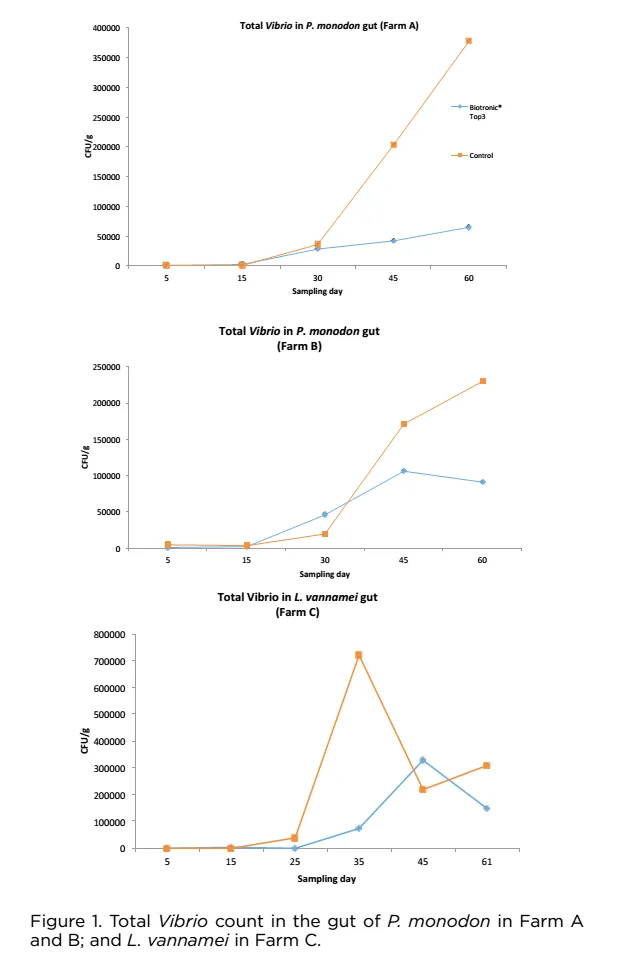
Some small-scale trials were conducted to evaluate the effect on shrimp growth and the ability to control Vibrio density in the intestines of Penaeus monodon and L. vannamei. For P. monodon, researchers conducted trials on 2 farms. Three ponds were selected in each farm for treatment. The treated feed in this trial had a dosage of 0.8 kg/ton of feed. For L. vannamei, the trial was conducted on one farm where 2 selected ponds were used for the treatment diet and 2 ponds were controls.
Figure 1 shows the total Vibrio count (TVC) in shrimp intestines up to day 60 (DOC 60). Treated ponds showed similar results. TVC in treated ponds (farms A, B, and C) decreased to lower levels compared to control ponds.
Table 1. Data collected from farms A, B, and C
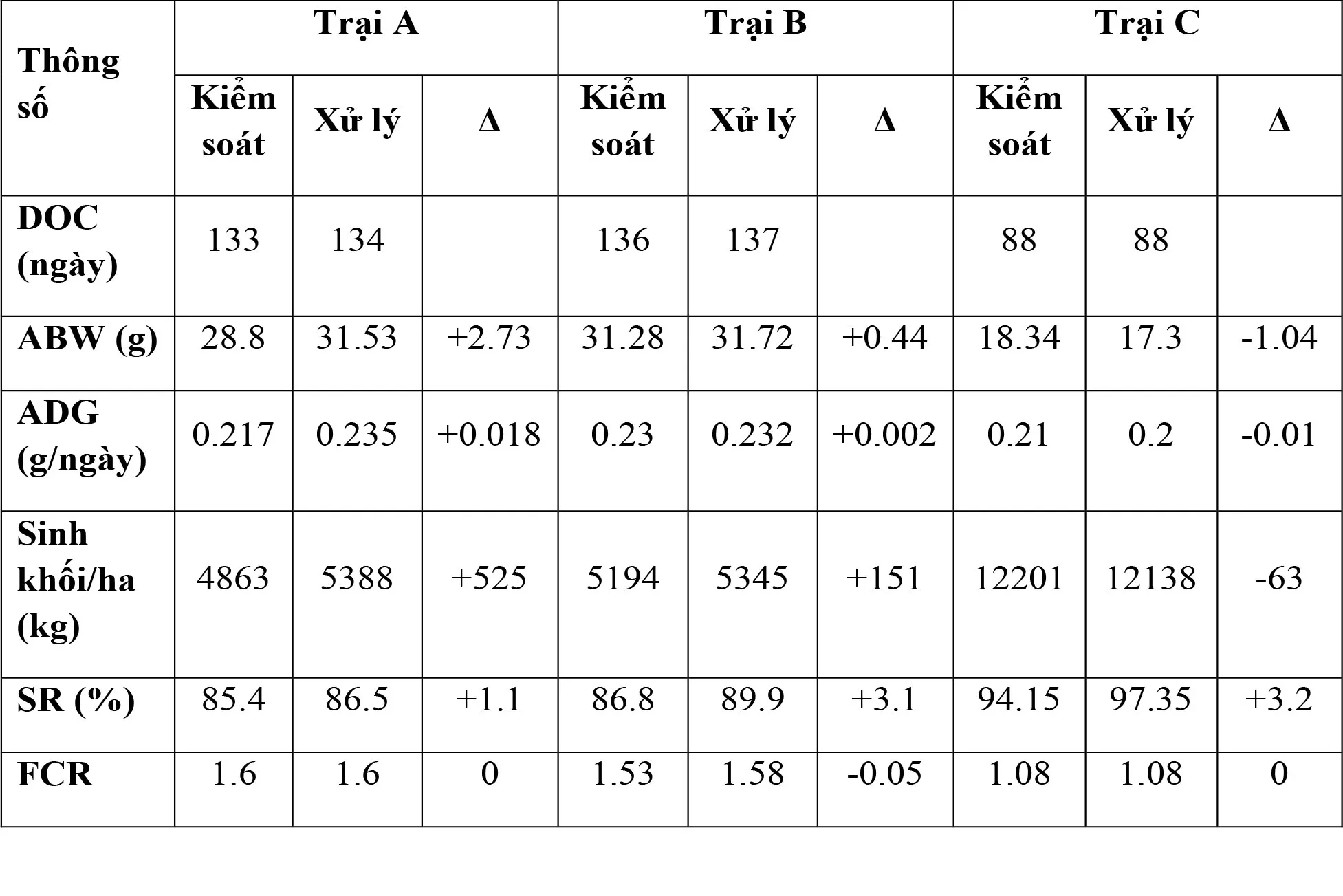
The results showed that shrimp fed with treated feed performed better than those in control ponds in terms of survival rate, weight, growth, and biomass. The survival rate of shrimp in treated ponds across all 3 farms improved compared to controls. More importantly, the diet containing the organic acid mixture had no negative impact on shrimp growth. The average growth of shrimp in treated ponds was higher by 0.2 g/day.
Conclusion:
To control disease issues caused by Vibrio, it is important to monitor and control Vibrio levels in shrimp intestines. Supplement products can be used to control Vibrio levels. Organic acids (e.g., formic acid) can work to control many Vibrio bacterial strains. However, reducing pH will be an issue when applying high doses of acid, as shrimp growth will be affected. An organic acid mixture at a very low dose has been proven (in vivo) to have no negative impact on shrimp growth. It can be seen that the use of organic acids to control Vibrio in shrimp is necessary, but farmers need to consider the dosage to achieve the highest efficiency for the pond.
Source: aqtinfo.com
Translated by: Trần Thị Thúy Quyên