Using rice bran and wheat bran as organic carbon sources significantly aids in controlling nitrogen compounds and enhancing production in Pacific white shrimp nursery systems
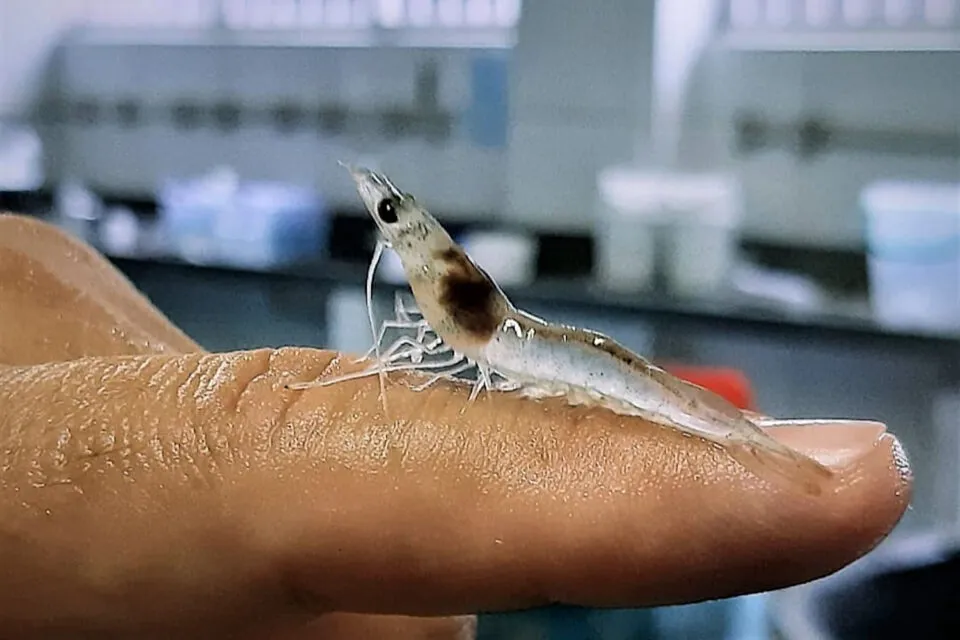
In intensive Pacific white shrimp farming systems with minimal water exchange, the microbial community (heterotrophic and nitrifying bacteria) stimulated by organic carbon sources in the water aids in the transformation of nitrogen compounds into less toxic compounds (nitrate) and also microbial biomass. Several organic carbon sources have been used (molasses, plant bran, dextrose, and sugar) to stimulate bacterial growth. However, in recent years, new strategies such as synbiotics have been incorporated into intensive aquaculture production, considered to have potential for shrimp farming.
Synbiotic systems are the result of anaerobic or aerobic processes carried out by microorganisms (probiotics) on plant or animal substrates, bran, and other carbohydrates (prebiotics). Thus, probiotic microorganisms promote the breakdown of complex organic molecules into simpler ones and provide a balanced amount of micronutrients and macronutrients for animals in aquaculture systems. Furthermore, there is the production of organic acids such as lactic, acetic, and butyric acids. This provides a balance among microorganisms and contributes to a more balanced organic carbon level in the system.
This study evaluates the effect of anaerobic and aerobic processes using rice bran and wheat bran as organic carbon sources (synbiotic) on the growth of Pacific white shrimp postlarvae in seawater and low-salinity nursery systems.
Study Setup
Three experiments were conducted with seawater and low-salinity water. For the seawater experiment, a tank with 35‰ salinity water was disinfected with 13 mg/L chlorine and dechlorinated by aeration for 72 hours. Subsequently, inorganic fertilization was applied with urea (4.5 g N/m³), triple superphosphate (0.3 g P/m³), and sodium silicate (0.23 g Si/m³). In the low-salinity water experiment, seawater was diluted to 2 g/L salinity, disinfected with 13 mg/L chlorine, and dechlorinated by aeration for 72 hours. Subsequently, organic fertilization was carried out as for the seawater experiment.
PL 10-24 were stocked at a density of 2,000 - 3,000 individuals/m³ and fed commercial feed (45% crude protein and 9.5% lipid) 4 times/day. Feeding rates were adjusted weekly based on shrimp growth rate, estimated consumption, and mortality.
To evaluate shrimp performance, at the end of each experiment, shrimp were weighed to determine final weight (g), feed conversion ratio (FCR), yield (kg/m³), and survival rate (%).
Water quality parameters in the experimental units such as dissolved oxygen (DO, mg/L), temperature (°C), and salinity (g/L) were monitored daily. Other parameters such as total ammonia nitrogen (TAN, mg/L), nitrite nitrogen (NO2 – N, mg/L), and alkalinity (mg CaCO3/L) were measured weekly.
Experiment 1
Organic fertilization was performed approximately 10 times. The fertilizer was processed through an anaerobic phase for 48 hours and an aerobic phase for 24 hours. During the experiment, the fertilizer was added to the experimental units every 3 days throughout the 42-day experiment. The organic fertilizer consisted of wheat bran (22.5 – 50 g/m³), molasses (12 - 25 g/m³), and sodium bicarbonate (4.5 - 10 g/m³). We added 0.5 g/m³ of a product containing Bacillus subtilis, B. licheniformis, Lactobacillus sp., Saccharomyces sp., and Pseudomonas sp. at 7.7 x 10⁸ CFU/g.
Experiment 2
Organic fertilization was performed approximately 10 times. The fertilizer was processed through an anaerobic phase for 24 hours and an aerobic phase for 24 hours. The organic fertilizer consisted of rice bran (<200 μm, 20 g/m³), molasses (2 g/m³), and sodium bicarbonate (4 g/m³). An additional 0.5 g/m³ of a product containing Bacillus subtilis, B. licheniformis, Lactobacillus sp., Saccharomyces sp., and Pseudomonas sp. at 5.5 - 6.5 x 10⁷ CFU/g was added.
Experiment 3
Organic fertilization was performed 8 - 10 times. The fertilizer was processed through an anaerobic phase for 24 hours and an aerobic phase for 24 hours. The organic fertilizer consisted of rice bran (<200 μm, 20 g/m³), molasses (2 g/m³), and sodium bicarbonate (4 g/m³). An additional 0.5 g/m³ of a product containing Bacillus subtilis, B. licheniformis, Lactobacillus sp., Saccharomyces sp., and Pseudomonas sp. at 6.5 x 10⁷ CFU/g was added. Additionally, in this experiment, to support the development of the microbial community and nitrification process in the experimental units, we added 2 shell pieces of Anomalocardia brasiliana as an artificial substrate (covering approximately 28% of the bottom area (25 x 24 x 5 cm), corresponding to 3.36% of the volume), reusing approximately 15% of the water in the shrimp nursery tank.
Results and Discussion
Water quality parameters remained within recommended ranges.
Table 1. Water quality parameters
|
Parameter |
Experiment 1 |
Experiment 2 |
Experiment 3 |
|
TAN (mg/L) |
0.3 ± 0.11 |
0.6 ± 0.36 |
0.33 ± 0.54 |
|
NO2 – N (mg/L) |
1.1 ± 0.49 |
1.56 ± 0.92 |
0.41 ± 0.13 |
|
Alkalinity (mg CaCO3/L) |
118.34 ± 16.5 |
128.31 ± 3.08 |
95.47 ± 41.04 |
Table 2. Nursery pond performance