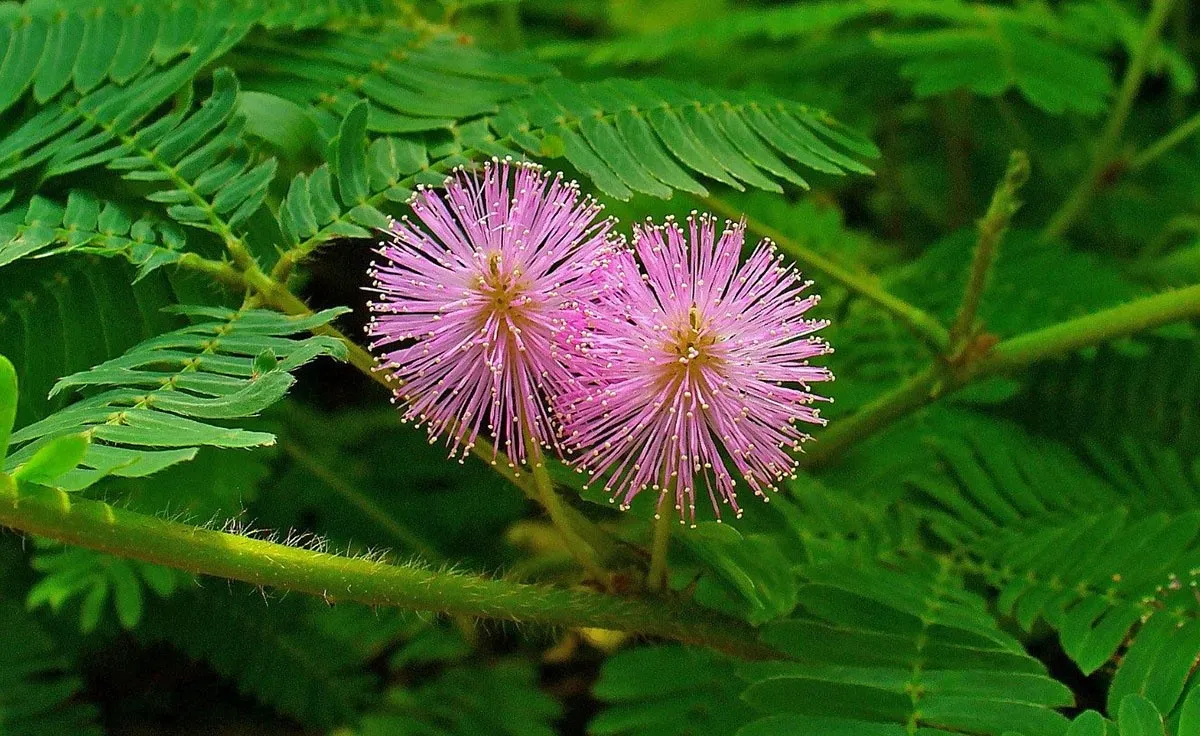
Mimosa pudica is widely distributed throughout Vietnam
A recent study has shown that supplementing feed with Mimosa pudica extract has a positive effect on hematological parameters and increases enzyme activity in the stomach and intestine of pangasius.
Application Potential of Mimosa pudica
Mimosa pudica, also known as the sensitive plant, has the scientific name Mimosa pudica L., belongs to the family Mimosaceae, has pinkish-red, spherical flowers, and is distributed throughout Vietnam (Đỗ Tất Lợi, 2004). Mimosa pudica is an annual herb; its most recognizable characteristic is that its leaves fold down when touched, hence its common name. It is a plant with short thorns and small branches, growing close to the ground, with light green leaves with red margins (15 – 25 pairs of symmetrical small leaves), and oval fruits 1.5 – 2.5 cm long (Joshep et al., 2013). It flowers from June to August. In Vietnam, Mimosa pudica is scattered everywhere, from the plains to mountainous areas below 1,000m altitude. The plant prefers light, growing in moist soil along riverbanks, roadsides, cultivated fields, and abandoned rice paddies, especially in the hot sandy central provinces.
According to Joshep et al. (2013); Ahmad et al. (2012), the crude methanol extract of Mimosa pudica leaves contains substances such as: Alkaloids, glycosides, flavonoids, steroids, phenols, and carbohydrates, thus possessing antibacterial, diuretic, antioxidant, anti-cancer, and anti-asthmatic properties, etc. (Sanaye et al., 2015). The plant has been studied for its application in treating human diseases, however, there are not many studies on the effects of Mimosa pudica on aquatic animals.
Application of Mimosa pudica in Pangasius
The study by Nguyễn Thị Hội (2018) aimed to evaluate the potential effects of Mimosa pudica extract on some blood physiological parameters and digestive enzymes in the intestine and stomach of pangasius.
Experimental setup: Pangasius fingerlings (weighing 13.96±0.32 g/fish) were acclimatized for 2 weeks before the experiment. Fish were supplemented with Mimosa pudica extract in their feed at concentrations of 0 g/kg, 0.4 g/kg, and 2 g/kg feed, fed continuously for 60 days, and samples were collected on day 0, day 30, and day 60. Fish were starved for 24 hours before sampling.

Mimosa pudica extraction method
Results
Results from the study showed that Mimosa pudica extract has the ability to stimulate the non-specific immune response of pangasius (Pangasianodon hypophthalmus), with hematological parameters such as red blood cells, hemoglobin, hematocrit, and white blood cells all being higher compared to the control group without Mimosa pudica extract.
Thus, the increase in red blood cell count and hemoglobin concentration when supplementing with Mimosa pudica extract is beneficial for the fish's gas exchange activity, leading to better growth in pangasius.
Supplementing feed with Mimosa pudica extract reduces glucose levels and increases stress tolerance in fish. Furthermore, supplementing feed with Mimosa pudica extract increases the levels of pepsin and trypsin enzymes, which helps fish digest feed well and promotes faster growth.
The application of supplementing Mimosa pudica extract into aquaculture feed helps stimulate immunity, enhance resistance, and protect pangasius from harmful diseases. This is a new, effective, and cost-efficient measure due to its natural availability, contributing to reduced farming costs.
Source: Tép Bạc