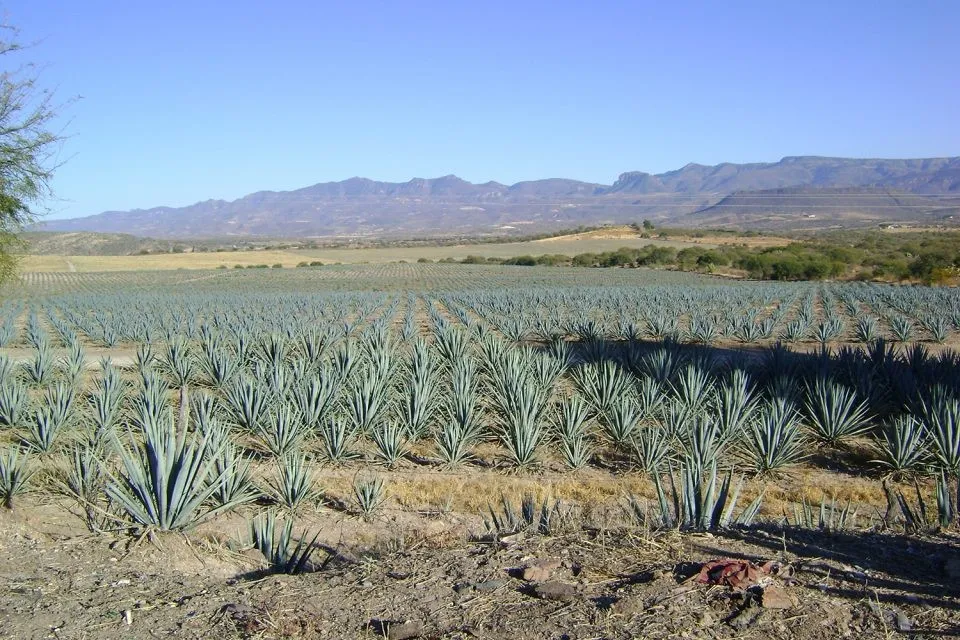
 The authors studied the effects of agavin - a natural sugar produced from agave plants - on the microbiota of Pacific whiteleg shrimp under farming conditions. Agave cultivation in Zacatecas, Mexico by Amante Darmanin, via Wikimedia Commons.
The diversity of microorganisms living in the digestive tract of any organism (microbiota) profoundly influences the host's physiology, from nutrient metabolism and immune system development to resistance against infection and enhanced growth performance. Several studies have highlighted the importance of the microbiota in their hosts, even in non-model organisms like shrimp.
The composition of the microbiota in whiteleg shrimp (Litopenaeus vannamei) depends on environmental factors such as water salinity and diet, and biological factors such as the associated organ and developmental stage. The farming environment strongly influences the microbial exchange between water, sediment, and shrimp. This exchange is essential to maintain an adequate balance among beneficial, harmless, and pathogenic bacteria.
There are various approaches to modulate the shrimp microbiota through feeding, improving growth rate, disease resistance, and productivity. One such approach is dietary supplementation with probiotics, which promote their activity in the shrimp digestive tract by inhibiting the proliferation of pathogens, stimulating immune responses, and enhancing shrimp growth, survival rate, and nutrient absorption. A second strategy is through dietary supplementation with prebiotics to promote growth, survival, and positive immune activity, also reducing the relative abundance of potential pathogens.
Agavin is a natural sugar produced from agave plants, which are cultivated for various purposes, including the production of fiber, food, beverages, and tequila, among others.
Its potential as a prebiotic in aquaculture has been largely unexplored, and there have been no previous reports on the effects of agavin on the hepatopancreas and gut microbiota of L. vannamei.
Study Setup
The study was conducted in an earthen pond in Mexico. The experiment was carried out under semi-intensive farming conditions with 20% daily water exchange, manual feeding twice daily, and feed consumption monitored using feeding trays. All biological and abiotic factors were the same for all shrimp during the bioassay as all cages were submerged in the same pond.
The diets contained approximately 375 grams/kg crude protein and 95 grams/kg crude lipid with three levels of agavin; a basal diet (BD) without agavin; diet AG2 containing 2% agavin; and AG10 containing 10% agavin.
Results and Discussion
In this study, the application of a diet supplemented with 2% agavin showed a favorable effect on shrimp growth parameters, such as a significantly lower feed conversion ratio (FCR) and feed intake.
Supplementation of low-dose agavin (2%) in the diet showed a tendency to reduce the diversity and richness of the microbiota in the hepatopancreas and gut of shrimp compared to the basal diet. A decrease in the diversity and richness of the shrimp gut microbiota has also been observed when studying alternative prebiotics in diets. Our data unexpectedly showed that higher agavin dosages (10%) in the diet led to greater richness and diversity in both organs. However, this difference was not significant when compared to the basal diet. Nevertheless, an increase in richness and diversity has also been observed in the gut of shrimp using other prebiotics, while species diversity and richness decreased at higher prebiotic concentrations.
Generally, for different organisms, higher microbial diversity is associated with a healthier host status, as a more comprehensive number of species is often linked to stronger stability, resilience, and resistance to environmental stress due to functional redundancy. However, in humans and mice, an increase in gut microbial diversity and richness has been associated with pathological states such as the development of Alzheimer's disease and metabolic complications related to obesity or aging.
Similarly, conflicting observations regarding the relationship between species richness and diversity and host health have also been reported for shrimp, where greater microbial diversity does not necessarily equate to a healthier state. For example, the gut of healthy farmed shrimp has lower diversity and richness compared to shrimp affected by Acute Hepatopancreatic Necrosis Disease (AHPND). But other published studies have reported that AHPND is associated with a significant reduction in bacterial diversity in the stomach compared to healthy individuals. Conversely, the gut microbial diversity of shrimp with White Feces Syndrome (WFS) significantly decreased compared to asymptomatic individuals.
This study demonstrates that changes in the shrimp microbiota depend on the concentration of agavin in the diet. The overall microbial richness and diversity increased with high-dose agavin (10%). Conversely, the richness, diversity, and abundance of probiotic bacteria decreased with low-dose agavin (2%). Changes in the shrimp gut microbiota were observed to be dose-dependent on the prebiotic. And the effect of prebiotics in reducing microbial diversity and richness could be a result of the synthesis of short-chain fatty acids, which have shown similar effects on diversity indices in L. vannamei.
Overall, our results suggest that agavin could be an excellent prebiotic for hepatopancreas-related diseases due to its decisive impact on the microbial structure of this organ. This behavior also indicates that the microbial structure of the hepatopancreas might be more influenced by prebiotics than that of the gut. Interestingly, some studies have shown that the hepatopancreas microbiota has greater stability than the gut microbiota because it plays a crucial role in the host's energy and nutrient assimilation.
Supplementation with 2% agavin improved shrimp growth performance, although the abundance of beneficial microorganisms was significantly higher at 10% compared to the control. However, growth performance at 10% was similar to the basal diet. This could lead to the consideration that feed supplemented with 10% agavin would provide better protection than 2% against potential pathogens without compromising shrimp growth performance. These findings clarify that prebiotic concentration is crucial when implementing a prebiotic strategy in shrimp farming.
The probiotic potential of Bacillus bacteria, a type of multifunctional probiotic with tested capabilities to increase aquaculture profitability, is well-known. Numerous articles discuss the advantages of Bacillus as a probiotic in shrimp farming. Recently, the probiotic effects of Bacillus strains isolated directly from shrimp farms have been successfully demonstrated. This study suggests that the combination of Bacillus species with 10% agavin could offer benefits in shrimp farming.
Perspective
This study demonstrated the dose-dependent effect of agavin on the microbial composition and overall performance of L. vannamei. Although the objective of this study was not to elucidate the mechanisms by which agavin participates in the metabolism of L. vannamei, the inclusion of agavin in the diet promotes a healthy microbiota by increasing the abundance of beneficial microorganisms.
Further studies are needed to elucidate the role of agavin in improving shrimp growth rate and the abundance of beneficial bacteria through investigations addressing the expression of immune-related genes, which are influenced by agavin.
Source: Dr. Adrian Ochoa-Leyva