
While slow intensive shrimp farming seems to be effective in Latin America, Ecuadorian producers should be wary of the example in Asia, where even large investments in new technology could not solve the problems caused by overstocking.
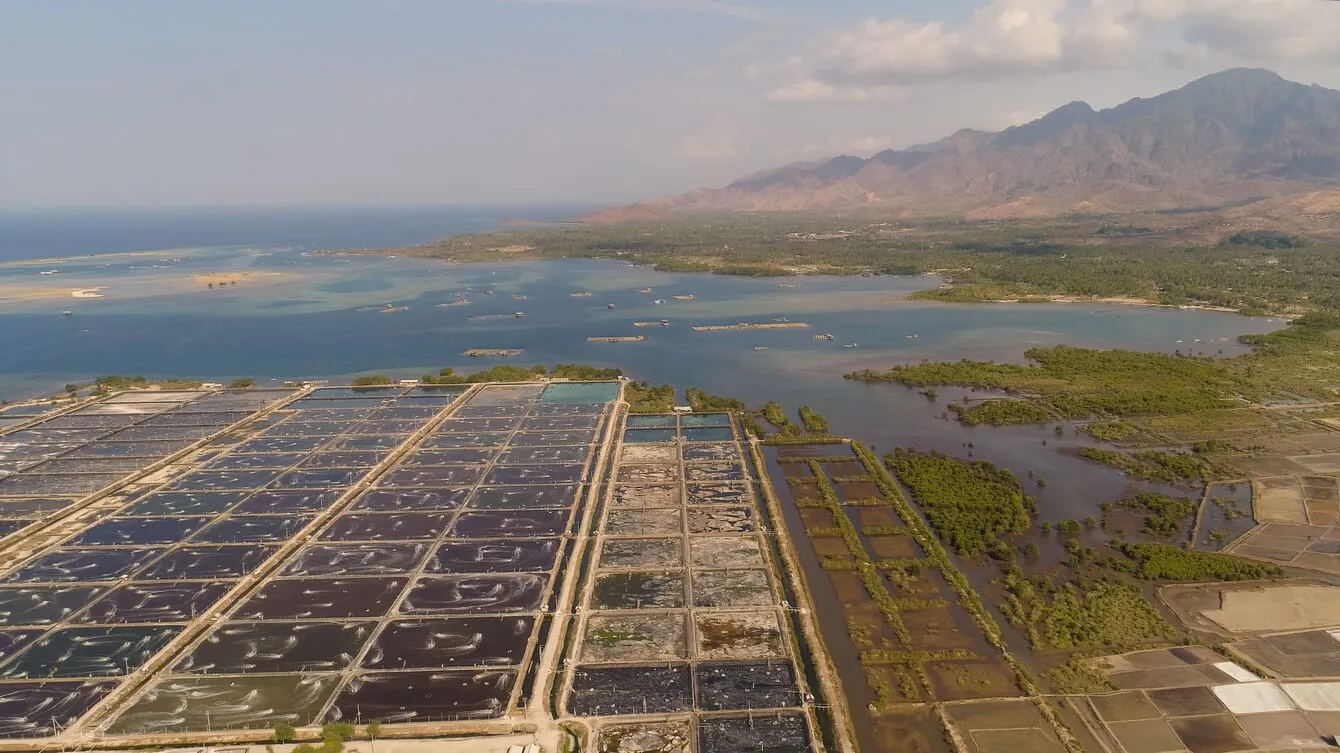
An aerial view of a large shrimp farm in Indonesia
Over the past few decades, as shrimp farming has developed, the general trend has been to farm at increasingly higher densities to increase production. In Latin America, the term “technification” is often used to describe this process - whereby the application of various forms of technology is used to increase stocking density.
When it works, the technification process increases shrimp production per unit of farmed area, leading to greater global shrimp output. However, it is only profitable when it increases the efficiency of shrimp farming and, most importantly, reduces production costs.
This was successful in Asia in the 2000s and is currently working well in Ecuador. But it is not a risk-free policy.
From 2002 to 2010, shrimp production in Asia increased from 1 million tonnes to 2.5 million tonnes, while production costs at a typical farm in Thailand decreased from 175 baht/kg to 90 baht/kg. During that period, farms implemented technological solutions to support growth: including aeration, automatic feeding, nursery rearing, SPF broodstock, genetics, improved nutrition and feed management, as well as exclusion biosecurity.More recently, Ecuador has followed a similar trajectory, with increased production leading to lower costs, even as inflation is rising.
Ecuador has essentially adopted similar technologies that Asia successfully implemented early on. Not dependent on seasonal cycles: thus allowing daily harvests and more shrimp to be processed. Through the application of technology, they have reduced costs while increasing productivity - similar to what Asia did in the early 2000s.
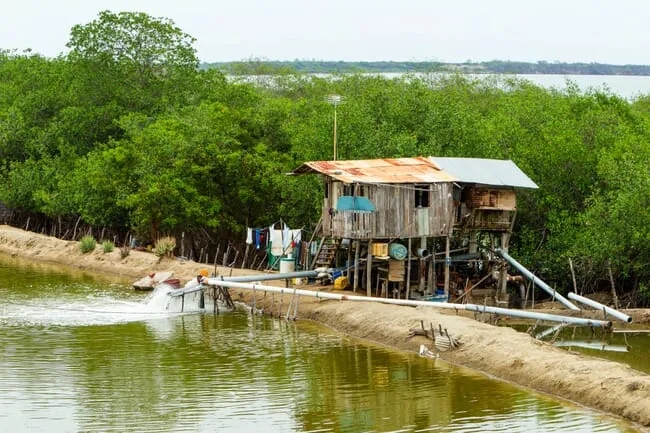
A simple shrimp farm on Puna Island, Ecuador
The Turning Point in Southeast Asia
The APHND disease (formerly known as EMS) in Southeast Asia in the early 2010s caused world shrimp supply to stagnate for two years and prompted India and Ecuador to ramp up production, albeit with relatively low-density techniques.
Meanwhile, in an effort not to fall behind these new players, countries like Thailand, Vietnam, Malaysia, and China decided to develop more intensive farming models, with more control measures, in increasingly smaller culture units with the goal of increasing production and overcoming disease problems.
Stocking densities increased from 100 shrimp/m2 to sometimes over 300 – 400 shrimp/m2. To achieve this, chemical disinfectants, increasingly more probiotics, and what are known as functional feeds were introduced into the equation.
Can New Technology Save Costs?
Highly competitive export markets are driving innovation and rapid responses in the shrimp farming sector. Many farmers are now looking at technology to transform farms that are uncompetitive today into competitive ones tomorrow.
We are hearing a lot about AI, IoT, and automation as ways to increase efficiency, and perhaps some technologies will indeed increase efficiency. However, adoption must come with understanding and proof that the additional costs will yield higher efficiency and a greater return on investment.
Caution is needed: if technology is adopted indiscriminately for its own sake, this can lead to losses rather than improving