
Technical Article

DANGEROUS VULNERABILITY IN WHITE SPOT SYNDROME VIRUS TESTING

New research shows that point-of-care (POC) tests for shrimp only detect White Spot Syndrome Virus (WSSV) infection at high levels, indicating that shrimp farmers need a better solution.

Solution TrackShrimpDecember 21, 2023👁 46 views
Click to listen to AI-narrated summary (1.2×)
AI Summary

Generate an English summary for DANGEROUS VULNERABILITY IN WHITE SPOT SYNDROME VIRUS TESTING

AI-generated summary based on the full article content below.

Editorial Framing

Why this article matters

    Full Article

    New research shows that shrimp point-of-care (POC) tests only detect high levels of White Spot Syndrome Virus (WSSV) infection, indicating that shrimp farmers need a better solution.
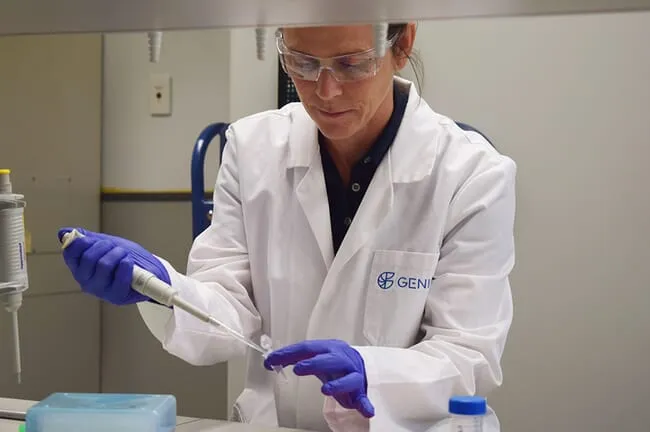
    Genics-Melony-Sellars-lab-research


    Dr. Melony Sellars working in the Genics laboratory


    Beginning in 2019, Australia's Commonwealth Scientific and Industrial Research Organisation (CSIRO) partnered with the country's shrimp industry stakeholders in a comprehensive study of WSSV testing methods. The newly published research report - An Evaluation of Point-of-Care (POC) Tests for White Spot Syndrome Virus (WSSV) - compared existing commercial tests designed to detect WSSV on commercial shrimp farms with laboratory PCR tests.

    “At the time of the study, point-of-care tests had become a commonly used disease detection method for shrimp farmers, a situation that persists to this day. However, with the publication of CSIRO's findings, it is time for an urgent re-evaluation of testing methods,” said Dr. Melony Sellars, shrimp disease expert and CEO of Genics, regarding the new findings.

    “CSIRO's study compared and evaluated five WSSV tests, including three rapid antigen-type tests and two PCR-based tests. The study clearly showed that the evaluated POC test kits yielded poorer limits of detection (also known as sensitivity) when compared to laboratory PCR tests,” she added.

    Among the issues with POC kits, CSIRO highlighted the gap between user expectations and the actual sensitivity of field test kits.

    “The lack of sensitivity of these POC testing systems actually creates a false sense of security for shrimp farmers. The findings of the CSIRO study have significant implications for the global aquaculture industry because the current expectation of shrimp farmers is that POC tests can detect WSSV in the early stages of infection, providing early warning of the disease. However, the CSIRO study identified significant problems with the evaluated POC test kits, meaning that in reality, they are not a solution for early warning and prevention of WSSV,” Dr. Sellars argued.

    The need for a strategic change

    “For shrimp farmers, the conclusion from the CSIRO study is clear: to avoid devastating WSSV outbreaks, the shrimp industry urgently needs to switch to using laboratory PCR tests for routine screening instead of relying on POC kits and testing systems. Notably, such laboratory PCR tests must also be validated by laboratory personnel, as all tests vary in performance based on equipment, chemistry, personnel, and operating conditions,” Dr. Sellars concluded.

    Source: thefishsite

    Translated by: PKT THẦN VƯƠNG CO.

    Related Products

    Products linked to this topic

    Product reference for MAX 4000
    shrimpThần Vương Blue

    MAX 4000

    Vi sinh đặc hiệu khử NO2

    Product reference for HERB GUARD
    shrimpThần Vương Blue

    HERB GUARD

    Tăng cường chức năng gan, cải thiện màu sắc khối gan tụy

    Product reference for PRO GUT
    shrimpThần Vương Blue

    PRO GUT

    Hệ men tiêu hóa cao cấp chuyên dùng cho nuôi tôm ao bạt

    Product reference for LALSEA BIOREM
    allNguyên liệu

    LALSEA BIOREM

    Khử NH3, xử lý hữu cơ sinh học, hiệu quả ở độ mặn cao

    More Reading

    Related technical articles

    SỰ THAY ĐỔI CỦA HỆ VI SINH ĐƯỜNG RUỘT DO SỰ NÓNG LÊN TOÀN CẦU. ĐIỀU HÒA SỨC KHỎE VẬT CHỦ VÀ TÌNH TRẠNG BỆNH Ở ĐỘNG VẬT BIẾN NHIỆT
    Research InsightShrimpFebruary 28, 2026

    CHANGES IN GUT MICROBIOTA DUE TO GLOBAL WARMING. REGULATING HOST HEALTH AND DISEASE STATUS IN POIKILOTHERMIC ANIMALS

    Tóm tắt nội dung chính: Sự nóng lên toàn cầu làm thay đổi hệ vi sinh vật đường ruột của tôm thẻ chân trắng Thái Bình Dương bằng cách[...]

    Toàn cảnh thị trường tôm thế giới 2025 — Dữ liệu từ Shrimp Insights (Tháng 2/2026)
    Technical articleShrimpApril 9, 2026

    Global Shrimp Market 2025 Overview — Shrimp Insights Bulletin February 2026

    Tổng hợp thị trường tôm thế giới 2025: Ecuador dẫn đầu xuất khẩu (1.39M tấn, +15%), EU tăng nhập khẩu mạnh nhất (+21%), Mỹ biến động[...]

    CÁ HỒI TRONG ĐIỀU KIỆN STRESS: CỦNG CỐ TUYẾN PHÒNG THỦ ĐẦU TIÊN
    Solution TrackShrimpFebruary 27, 2026

    SALMON UNDER STRESS CONDITIONS: REINFORCING THE FIRST LINE OF DEFENSE

    As the aquaculture industry increasingly develops strategies for animal health protection, functional nutrition has become a key fac[...]

    Technical Advisor

    Aquaculture Q&A

    🦐

    Help us serve you better

    Share your name + phone so we remember your pond next time — no repeating yourself.

    • 🔒 Tech team only — never shared with third parties
    • 📨 No spam, no promotional SMS
    • 💾 History saved on your device — clear anytime