BDK.VN - After 10 years of economic development with shrimp, Mr. Tran Hoang Vu - Director of Hoang Vu Co., Ltd. (Hamlet 3, Binh Thoi Commune, Binh Dai District) has accumulated valuable experience for effective shrimp farming. By thoroughly understanding shrimp behavior, mastering farming techniques, combined with the application of scientific and technical advancements, and effective management methods, in the 2017 farming season, few shrimp farmers achieved as great success as Hoang Vu facility.
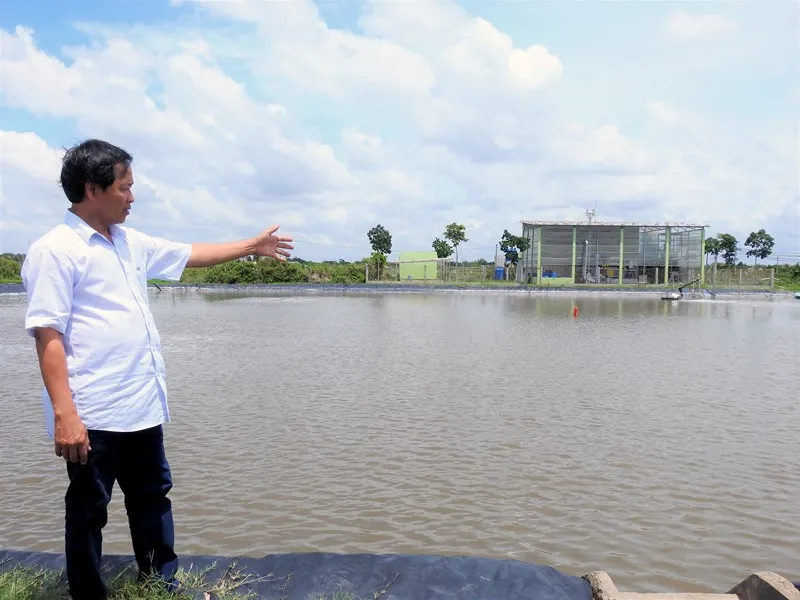
Mr. Hoang Vu introduces a shrimp pond combined with an experimental model of a biomass waste energy recycling system
Mastering Farming Techniques
In 2017, Mr. Vu's shrimp farm had 12 ponds, with a total area of 10ha, stocking 2.7 million Pacific whiteleg shrimp postlarvae. After 110 days of farming, he harvested 63 tons of shrimp, with a size of 28 - 30 shrimp/kg, selling for nearly 9.5 billion VND, with a profit of over 5.8 billion VND after deducting costs. According to him, this success was due to a close and systematic combination of scientific farming methods, the application of modern technology with practical experience, and the ability to grasp market factors.
After several failures with shrimp, he realized that "favorable timing" is very important, so he only farms when the weather is good, during the main season, and only one crop per year. At the same time, after many years of farming, the pond environment gradually deteriorates due to the use of many chemicals affecting shrimp health, easily leading to disease outbreaks during the farming process. The excessive costs for farming equipment such as oxygen systems, chemicals, and antibiotics also drive up the production cost of shrimp, sometimes leading to successful harvests but very low profits, high risk of failure, and multi-faceted environmental damage.... Mr. Vu's approach began to change. He identified a new farming method.
Before the main season, he fills all ponds with water. 45 days before stocking, he selects a stocking pond, choosing one out of every 2 or 3 adjacent ponds to thoroughly prepare, including drying the pond, tilling the soil, applying CaO + Dolomite lime, and then using a small roller to compact the bottom. Water is treated with chlorine separately in an adjacent pond before being supplied to the farming pond. This is to avoid environmental fluctuations such as clear water not developing color, pH fluctuations, and low alkalinity due to direct chlorine chemical treatment, which greatly affects the health of shrimp postlarvae during the first 30 days after stocking. Shrimp are stocked at a high density in pond 1. At 35 - 40 days of age, the sluice gate is opened to allow shrimp to move to pond 2 to reduce density.
The second issue in shrimp farming is ensuring oxygen for the shrimp. During the farming process, Mr. Vu noticed that current paddlewheel aerators are heavy, bulky, consume a lot of electricity, pose operational risks, and are not highly effective because they only generate oxygen on the pond surface, causing rapid water evaporation and quick pond depletion. Alternatively, installing plastic pipes and pumping air down is costly and very laborious for renovation and operation, especially when shrimp are diseased and require flushing, while shrimp need a lot of dissolved oxygen in the water. Therefore, he researched and sought out bottom aerators. Currently, his shrimp farm has fully installed this type of aerator, which offers superior efficiency, stable oxygen levels in the water, and dissolved oxygen readings above 5mg/l. He commented: “One of these aerators is two to three times more effective than a paddlewheel aerator. For a 5,000m2 pond yielding 7 tons of shrimp, I only need to install 4 machines at the four corners of the pond. This equipment also saves more electricity, is lightweight, easy to operate and maintain, requires less labor, and has been used for over 9 years without damage.” Additionally, he uses automatic feeders to save labor, accurately calculate the amount of feed for shrimp, avoid waste and excess feed, and prevent pond fouling.
Investing in Technology Development
Hoang Vu Company boldly allowed the Institute of Nanotechnology (Vietnam National University, Ho Chi Minh City) to "borrow land" to install an experimental model of a local biomass waste energy recycling system, serving research on aquaculture waste treatment and conversion into electrical energy through new-generation solid oxide fuel cells. The system was installed by technicians and researchers from Kyushu University (Japan) and the Institute of Nanotechnology in September 2016, and began operation in April 2017.
At the recent Workshop on Applications of Nanotechnology in Agriculture (WANA 2018), Assoc. Prof. Dr. Yushuke Shiratori (Kyushu University - Japan) presented the initial effectiveness of the experimental model at Hoang Vu Co., Ltd. The experimental model is a system comprising modern technological equipment, including: a water filtration membrane system, an anaerobic digestion tank, a fuel cell power generation station, an aeration unit, and a carbonization system. The experimental pond, with an area of 3,000m2, also underwent prior water treatment like other ponds. During the farming period, pond water is continuously drawn up, treated through the water filtration system, and clean water is discharged back into the pond 24 hours a day.
Shrimp pond waste, mixed with sugarcane bagasse, coconut fiber, and other agricultural waste, is processed through an anaerobic digestion tank to produce biogas and biogas sludge. This sludge is treated in a carbonization system to form porous charcoal, which is then used as fertilizer for experimental chili gardens, resulting in abundant fruit. Biogas is used as fuel to operate the SOFC power generation system. This electrical energy is used to power the oxygen aerators for the shrimp ponds.
The techniques employed have yielded very promising initial results. The experimental shrimp pond achieved the highest yield among the 12 ponds, with shrimp growing fast, experiencing fewer diseases, and having a high harvest rate. At the same time, it has initially addressed environmental issues by utilizing agricultural waste for electricity generation. "I always believe in doing things that benefit the community. Therefore, I will continue to collaborate and apply the experimental model. I hope that when the research project is successful, many shrimp farmers can widely adopt it, contributing to reducing risks and achieving more effective shrimp farming," said Mr. Hoang Vu.
The project "Research on aquaculture waste treatment and conversion into electrical energy through new-generation solid oxide fuel cells - contributing to the sustainable development of the Mekong Delta" is part of the Science and Technology Research Partnership for Sustainable Development (SATREPS) program, co-funded by the Ministry of Education, Culture, Sports, Science and Technology of Japan and the Japan International Cooperation Agency (JICA), led by the Institute of Nanotechnology, and implemented over 5 years (2015 - 2020).
Source: Dong Khoi Newspaper