Gracilaria seaweed farming in ponds has seen steady growth in Indonesia over the past 30 years. While demand continues to rise, both seaweed farmers and processing plants recognize that methods need to be improved, as the industry is reaching its environmental limits.
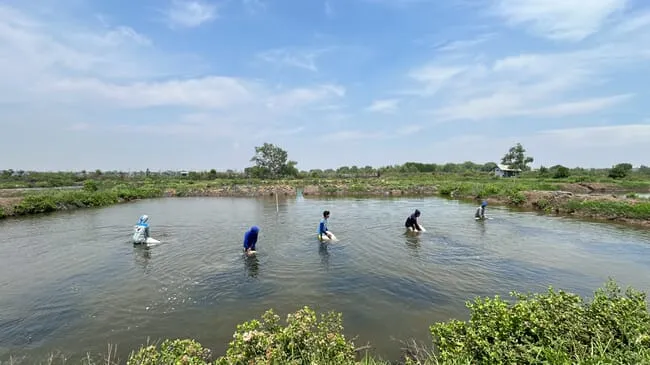
Gracilaria cultivation is very popular in Indonesia, but may be reaching its environmental limits © Sambung Asa
Derived from red seaweeds like Gracilaria and Gelidium, agar is commonly used in baked goods such as donuts, jellies, and other confectionery. It is also a popular base material for seaweed bioplastic startups, many of which hope to scale up soon.
According to an Indonesian agar producer, market sentiment is positive: “In our traditional markets of Western Europe and Japan, volumes are increasing. We also see rising demand from emerging markets such as Turkey, Poland, India, and Malaysia.”
However, the company director remains concerned. “Agar production generates a lot of waste. When we started our factory decades ago, there was no one around. Situated amidst fields, we could distribute our leftovers as compost to farmers. Now our factory is surrounded by houses. We are running out of options.”
Water is another issue. Producing one kg of agar requires hundreds of liters of fresh water, and water scarcity is now a frequent reality for residents living around factories during the dry season.
Finally, regulations from the European Union are becoming increasingly stringent, as the agar company director explains: “Buyers ask us where our seaweed comes from, whether we can prove it is sustainably farmed. We cannot do that, we buy from intermediaries; it’s too complex for us to deal with hundreds of small farmers. And how can we prove they don’t use chemical fertilizers? They all use them.”
As issues of waste, water, and regulations escalate, innovators have begun seeking alternative solutions.
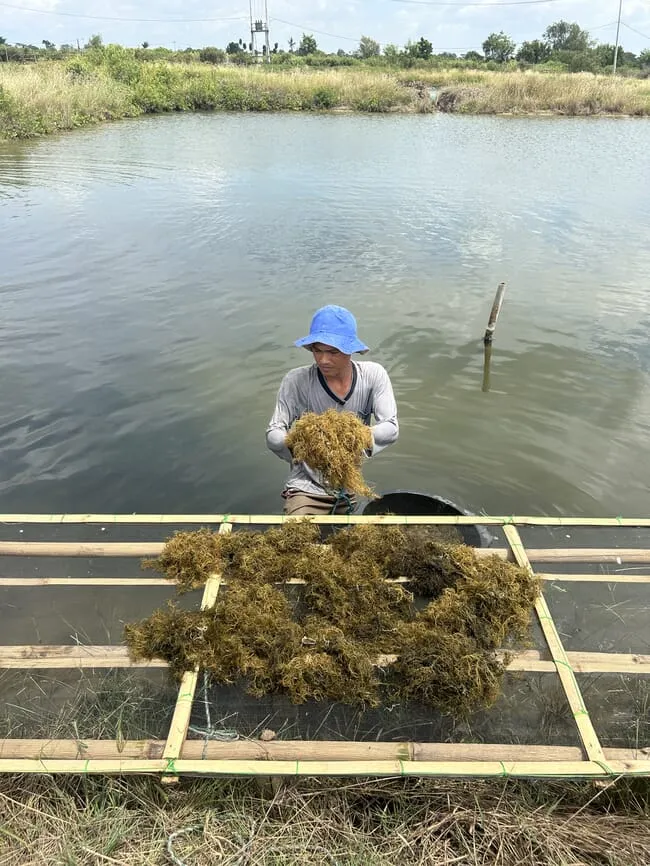
Innovative seaweed farmers are changing the way seaweed is produced.
Sustainable pond farming
On the north coast of West Java, Sambung Asa is working to restore abandoned shrimp ponds. As co-founder Yudhistira Wiryawan explains: “Intensive shrimp and fish farming – where up to 60 percent of feed is wasted – has significantly degraded water quality in this area. The carrying capacity of this land for aquaculture is no longer there; only seaweed and well-adapted, low-value fish species like tilapia can survive here. By responsibly cultivating seaweed, we hope to improve water quality once again, which will also bring jobs to the region.”
To avoid the need for fertilizers, Sambung Asa co-cultivates Gracilaria with milkfish. Most importantly, the company advocates a data-driven approach, with regular measurements to replace current methods. According to Wiryawan: “Seaweed farming is not that expensive. But why is it not effective? Often it’s due to a lack of understanding of what’s happening in the water. There’s a data gap that we are trying to build now.”
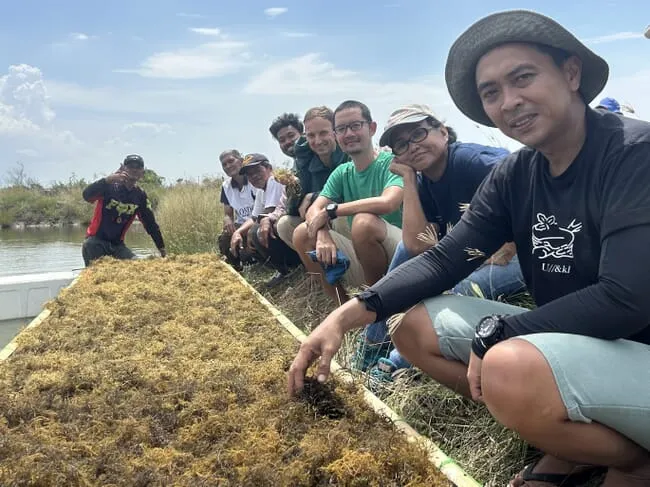
Sambung Asa uses an integrated aquaculture approach to avoid the need for fertilizers © Sambung Asa
New ideas around processing
In terms of processing, the Australian startup Uluu is working to build its first factory to produce plastic alternatives from Gracilaria seaweed in Sidoarjo. To avoid the waste and water issues that the first generation of seaweed processors are grappling with, Uluu uses a saltwater fermentation method. Co-founder Julia Reisser explains: “At scale, instead of washing and drying seaweed with fresh water, we can wet-mill that seaweed and then extract what we need. We don’t use any toxic chemicals or solvents in the process, it’s all water-based. Then we feed bacteria seaweed sugars to create a natural polymer that can replace fossil plastics, while still being biodegradable.”
The Jakarta-based bioplastic startup Ijo also takes a similar approach, using saline wash water and microorganisms. According to co-founder Rahadiyan Dewangga, the difference is capital. “We are self-funded. Biotechnology in Indonesia is something that domestic investors often don’t yet understand. And foreign investors tend to think Indonesia is too risky. So, we are looking to create our own seaweed food products to package them in our seaweed packaging, using our own seaweed-based products. We think it’s easier to find revenue there and grow more organically.”
Taking agar in a new direction
Lino Paravano founded Java BioColloid in 2008 to focus on innovative agar and carrageenan types and differentiate them from cheap, mass-produced Chinese products. He argues that Indonesian seaweed processors ultimately need to move entirely away from agar extraction and towards utilizing the nutritional value of the entire seaweed biomass, with the added benefits of minimizing waste and chemical use.
“It’s hard to compete with the prices and controlled conditions of synthetic fermented hydrocolloids like gellan gum and xanthan gum,” says Paravano. “Of course, currently agar and carrageenan still have their unique capabilities. But a lot of money is being poured into these synthetics, and I believe that one day they will be able to replace agar and carrageenan.”
Java BioColloid currently sells E-number-free fibers and texturizers that do not rely on extraction but instead use the entire seaweed. Research is underway to process seaweed completely without chemicals, which would allow the company to preserve all nutrients and achieve organic certification.
As Paravano concludes: “In 20 years, I don’t see us producing raw materials anymore. We will be producing whole, ready-to-eat seaweed food.”
PKT CTY THẦN VƯƠNG
SOURCE: THE FISHSITE