Maintaining a healthy shrimp population is essential for a successful farming season. Nutrition experts are striving to find optimal nutritional solutions for good growth, including Antarctic krill oil (Euphausia superba).
Promoting shrimp growth
Experts at LABOMAR, Brazil have conducted numerous valuable studies on the efficacy of astaxanthin krill oil (AKO) as a growth-promoting additive for Pacific whiteleg shrimp. In an unpublished study (personal communication), the research team conducted a nursery phase trial using Pacific whiteleg shrimp larvae fed with AKO supplementation at ratios of 0%; 1%, 3%, and 5% via a standard diet for shrimp postlarvae in 1 m³ outdoor tanks for 51 days.
After harvest, shrimp growth was evaluated, and an additional stress test was conducted to assess the shrimp's resistance to sudden changes in salinity (reduced from 39 g/L to freshwater) and temperature (27.9 to 19.2 ±0.9°C). The number of dead shrimp was the criterion for evaluating the shrimp's stress resistance.
The results showed that a minimum supplementation of 1% AKO was sufficient to promote and improve shrimp survival rates compared to 0% AKO. However, at a 5% AKO ratio, no shrimp mortality was detected after 30 minutes of exposure to the new environment. This confirms that all AKO supplementation ratios contribute to enhancing shrimp resistance to thermal and osmotic shock. At a 5% AKO ratio, shrimp also showed a significant increase in final body weight.
Another study (Rufino et al., 2020) at LABOMAR aimed to evaluate AKO-supplemented diets for juvenile Pacific whiteleg shrimp under osmotic stress conditions, using various oil mixtures affecting shrimp growth performance. Shrimp with an initial weight of 1 g/individual were cultured in 50 1 m³ tanks for 75 days under high salinity conditions (starting at 42 g/L and gradually decreasing throughout the trial period). Shrimp were fed commercial feed containing 38% crude protein coated with 1-3% AKO and/or soybean oil (SBO) (0AKO-3SBO; 1AKO-2SBO; 2AKO-1SBO, and 3AKO-0SBO%). The results showed that shrimp growth performance was significantly improved when AKO and SBO mixtures were added to commercial shrimp feed. Coating feed pellets for growing shrimp with an oil mixture containing 1% AKO and 2% SBO helped improve the final body weight of shrimp and increased production at normal salinity. However, during longer exposure to hypersaline conditions in the tanks, a minimum of 2% AKO mixed with 1% SBO was needed to ensure shrimp continued to gain weight. Shrimp survival rates were not affected by the oil additives.
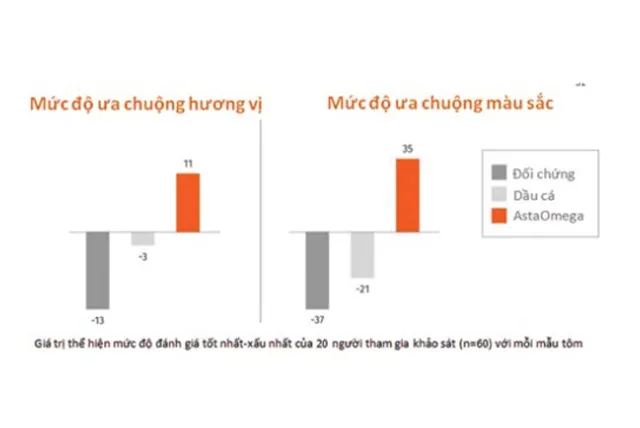
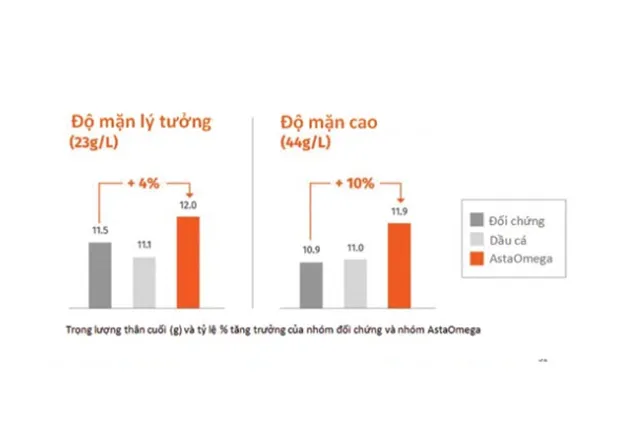
The final study, published in 2018, analyzed the efficacy of AKO when supplemented into the growth diet of Pacific whiteleg shrimp. The research team compared the growth performance effects of various oil sources, including soybean oil (SBO), fish oil (FO), and AKO at 3% and 5% ratios, when used under ideal or high salinity conditions. They also monitored important sensory evaluation criteria that end consumers care about, such as color, flavor, and shrimp meat quality. Juvenile Pacific whiteleg shrimp were cultured under ideal saline conditions (22 ±0.4 g/L) or high salinity (41 ±0.4 g/L) for 64 days and fed diets with similar nutritional content, although differing in essential fatty acid intake due to the different oil types. After 64 days, under ideal salinity, the final body weight of AKO-fed shrimp was 4% higher than the FO group.
The results showed that shrimp living in higher salinity environments grew the least when fed with SBO and FO, as high salinity typically reduces the final body weight of shrimp. However, shrimp fed with AKO had significantly higher final body weight compared to the other two experimental groups and were 10% higher than the SBO-fed shrimp group. Additionally, scientists found that AKO-fed shrimp also had a more appealing color and better flavor, making them more preferred by consumers.
Many unexplored benefits
AKO can be classified as a completely natural additive derived from Antarctic krill. This additive is rich in omega-3 fatty acids, EPA and DHA, as well as astaxanthin, which is a very strong antioxidant and enhances pigmentation in shrimp, especially during the early growth stages when many essential nutritional factors are needed.
The combined and chemical nutrients found in AKO are very important and can act as a feed attractant. Further research is needed to evaluate the synergistic potential and efficacy of AKO, but it is certainly a useful additive for shrimp hatcheries and can be used in various ways, such as throughout the feed production process, or coated onto dry feed, or mixed with fresh feed. The AKO used in the trials is an MSC-certified product manufactured by Aker Biomarine, a company that harvests Antarctic krill using sustainable methods. From this, shrimp farmers will have an additional sustainable option to achieve the goal of healthy and fast-growing shrimp.
Conclusion
5% AKO is an effective ratio to help improve the final growth of shrimp, enhance shrimp tail color and meat flavor, as well as fatty acid composition under all tested water conditions.