Tilapia (Oreochromis niloticus) is an important aquaculture species in our country. As tilapia farming develops towards intensification, diseases occur frequently and cause significant losses to farmers. Among these, ocular edema and hemorrhage caused by Streptococcus agalactiae are diseases that result in high mortality rates.
This study aims to determine the efficacy of inactivated Streptococcus agalactiae vaccine in tilapia.
Experimental Design
The experiment was designed as a completely randomized design with 4 treatments (each treatment replicated 3 times, 50 fish per tank) including: a control treatment injected with physiological saline (0.85% NaCl solution) and 3 vaccine injection treatments with doses of 0.05, 0.1, and 0.2 ml vaccine/fish, respectively. The vaccine was injected into the ventral region below the pelvic fin.
Challenge Infection: After 21 days of vaccination, fish were challenged with S. agalactiae bacteria.
Determination of Vaccine Efficacy
Vaccine efficacy was determined by the Relative Percent Survival (RPS) index and calculated using the formula: RPS = (1-A/B) x 100
A: % mortality of vaccinated group due to S. agalactiae
B: % mortality of control group due to S. agalactiae
Results and Discussion
Relative Percent Survival (RPS) of the Vaccine
Condition of fish after vaccination: Fish were active, reacted quickly to sounds, fins were not eroded/torn, no scratches or hemorrhages on the body, gills were bright red and shiny. Organ structures were firm, with no signs of swelling or softening, and no fluid accumulation. The survival rate of fish in all treatments after 3 weeks of vaccination was 100%.
Mortality Rate and Relative Percent Survival
After 2 days of challenge infection, fish in the positive control treatment began to show pathological signs such as anorexia, lethargic swimming near the water surface, swollen and cloudy eyes, hemorrhage, enlarged gallbladders, and fluid accumulation in the abdominal cavity of most examined fish. The mortality rate increased rapidly after 8 days and ceased after 17 days of challenge infection, with a total mortality rate of 70%.
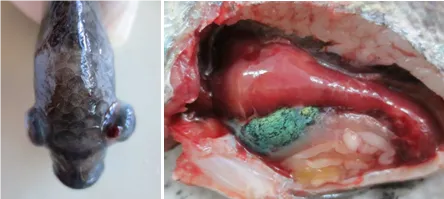
External (A) and internal (B) pathological signs of S. agalactiae-infected tilapia
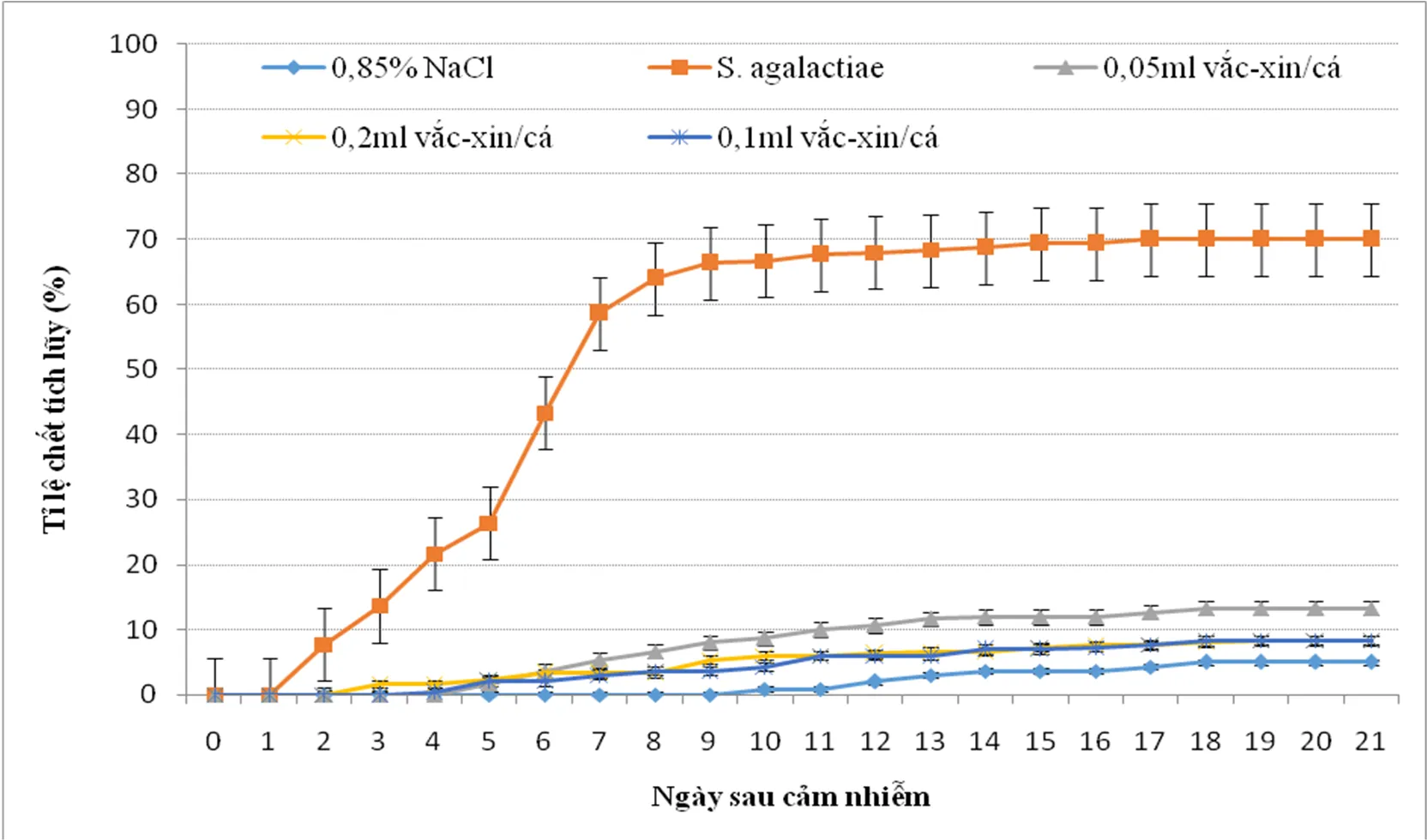
Cumulative mortality rate (%) of fish in experimental treatments
Changes in Hematological Parameters of Tilapia After Vaccination
Red Blood Cells
After 3 weeks of vaccination, the red blood cell count of fish in the vaccinated treatments increased. After challenge infection, the red blood cell count fluctuated in all challenged treatments. The decrease in red blood cell count is due to bacterial attack and lysis of red blood cells.
White Blood Cells
Total White Blood Cells
After 2 weeks of vaccination, the total white blood cell count in all vaccinated treatments increased compared to the unvaccinated group. Two weeks after challenge infection, the total white blood cell count in the 0.1 and 0.2 ml vaccine/fish treatments showed the highest increase. White blood cells play a role in phagocytosis and immune response against foreign agents entering the body. The increase in total white blood cells demonstrates the vaccine's ability to stimulate immunity in the experimental fish.
Lymphocytes
The number of lymphocytes increased after 1 week of vaccination and peaked after 3 weeks. After challenge infection, the number of lymphocytes continued to increase. The higher number of lymphocytes in the vaccinated treatments compared to the unvaccinated treatment indicates that the vaccine affects the specific immunity of fish. Lymphocytes are responsible for protecting the body through cell-mediated and humoral immunity.
Neutrophils
Three weeks after vaccination, the neutrophil count in the vaccinated treatments was higher. Neutrophils play a role in inflammatory responses and also have phagocytic capabilities before macrophages are recruited.
Monocytes
Monocytes are cells involved in the non-specific immune system with roles in phagocytosis, antigen destruction, and especially the ability to present antigens to initiate the specific immune response.
The monocyte count in all treatments did not change significantly after 3 weeks of vaccination. However, after challenge infection, the monocyte count in all vaccinated treatments increased.
Platelets
After 2 weeks of vaccination, the platelet count in the 0.2 ml/fish vaccine treatment was 7 times higher than the control. Platelets play an important role in blood clotting, especially during inflammation, and participate in the immune response.
After challenge infection, the platelet count was lower. Platelets decreased due to high bacterial density causing platelets to lose function and degenerate.
Antibody Titer
After 3 weeks of vaccination, the average antibody titer in all treatments increased and was higher than in the unvaccinated treatment. A high amount of antigen can stimulate a stronger immune response.
Conclusion
Under laboratory conditions, the inactivated Streptococcus agalactiae vaccine at a density of 108 CFU/ml is capable of stimulating the immune system in tilapia, starting from 1 week and lasting at least up to 4 weeks post-vaccination. After 3 weeks of vaccination, hematological parameters and average antibody titers in vaccinated fish significantly increased compared to unvaccinated fish. The vaccine's Relative Percent Survival (RPS) was 88.1% for both 0.1 and 0.2 ml/fish doses.
Source: Can Tho University Journal of Science