The industrial shrimp farming sector is constantly developing, with an increasing number of intensive farming models. One such model involves frequent water exchange, and the main requirement for this model is that the water source must be treated to be "clean" before being supplied to nursery ponds and grow-out ponds.
Three commonly used chemicals today are: Chlorin, potassium permanganate, PAC.
To provide proper treatment guidelines and cost savings for farmers, we offer additional information on these three chemicals, allowing farmers to choose the most suitable treatment method themselves.
1. Chlorine
Effects of chlorine in aquaculture
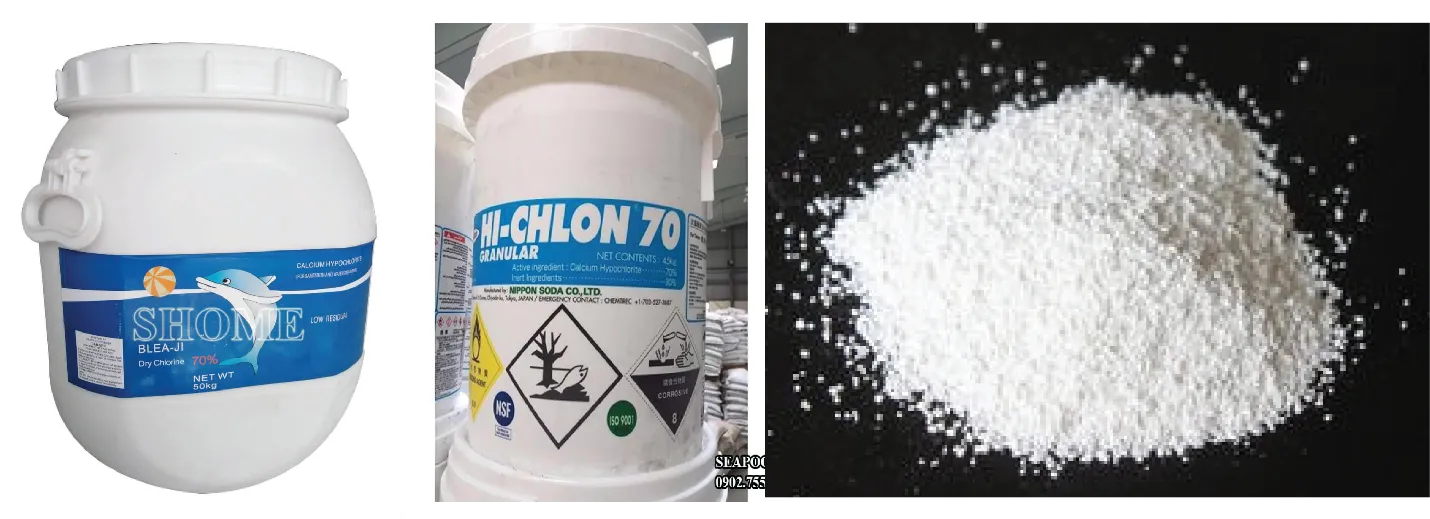
- In nature, chlorine exists in various forms such as: Chlorine gas (Cl2): 100% Chlorine; Calcium hypochlorite (Ca(OCl)2): 65% Chlorine; Sodium hypochlorite (NaOCl) and Chlorine dioxide (ClO2). Calcium hypochlorite is widely used in aquaculture. For aquaculture, chlorine has the following effects:
- Disinfecting ponds, lakes, equipment, tools, etc.
- Eliminating bacteria, viruses, algae, and plankton in the aquatic environment.
- Oxidizing organic matter and exotic pathogens in hatchery production.
Mechanism of action of chlorine
The mechanism of killing bacteria, algae, and plankton in the environment: chlorine acts on cells, destroying the enzyme system of bacteria. When enzymes come into contact with chlorine, hydrogen atoms in the enzyme's molecular structure are replaced by chlorine. As a result, the molecular structure changes, the bacterial enzymes become inactive, leading to cell death and organism death.
Some notes on using chlorine
- Chlorine has a very broad spectrum of disinfection, so beneficial bacteria in the water and pond bottom are easily destroyed.
- Chlorine is less effective against bacterial spores and its efficacy decreases in environments with high organic matter, high pH, and high water alkalinity.
- Chlorine is highly effective in low pH environments because when dissolved, it produces two forms, HClO and OCl-, both with bactericidal properties. Chlorine primarily dissociates into HClO at low water pH, and its disinfectant efficacy is many times higher than that of OCl-.
- When using chlorine to disinfect water, residual Cl gas can be toxic to aquatic animals, especially shrimp larvae and marine fish. Therefore, chlorine needs to be neutralized with sodium thiosulfate. To neutralize 1 mg/L of Cl2, 7 mg/L of sodium thiosulfate is required. And of course, we need to carefully assess chlorine residues in shrimp under 30 days old to avoid adverse effects and stress on shrimp.
- Note that the direct dosage in shrimp ponds should not exceed 3 ppm (3 kg/1,000 m3 of water) as it can cause toxicity to farmed shrimp.
Calculating the precise amount of chlorine for treatment is complex; therefore, caution is needed when using chlorine, especially for treating diseases in farmed aquatic animals.
Dosage
+ Disinfection of equipment, tanks, and tools: 100 - 200 ppm, from 100 – 200 kg per 1,000 m3 of water (30 minutes)
+ Pond bottom disinfection: 50 - 100 ppm. Treat when shrimp from the previous crop were affected by disease.
+ Pond water disinfection: 25 - 35 ppm when used directly in grow-out ponds without shrimp. However, after treatment with potassium permanganate and PAC, the chlorine dosage should be flexibly applied from 5-15 ppm (5-15 kg/1,000 m3) depending on the water source, season, and shrimp age.
+ Bacterial disease treatment: 1 - <3 ppm. Dosages >3 ppm should not be applied as they can easily cause toxicity and stress to shrimp. This method is very limited for use in ponds.
+ A note to recognize if chlorine has good activity and sufficient dosage is that after using chlorine, the water will become clearer after treatment. If the water turns turbid red after chlorine treatment, the treatment process and organic matter content in the water should be re-evaluated.
2. Potassium permanganate (KMnO4)
Commercial potassium permanganate comes in crystalline or powder form. For potassium permanganate, it must be dissolved in water before use to increase water treatment efficiency.
Currently, potassium permanganate is widely used in 2-stage and 3-stage water exchange farming models.
Mechanism of action of potassium permanganate (KMnO4)
- Potassium permanganate is a strong oxidizing agent that can oxidize both organic and inorganic substances. Potassium permanganate can kill bacteria, viruses, fungi, and algae by directly oxidizing cell membranes and destroying specific enzymes that control cellular metabolism.
- Potassium permanganate can precipitate Iron and Manganese according to the reactions:
3Fe2 + KMnO4 + 7H2O => 3Fe(OH)3 + MnO2 + K + 5H
3Mn2 + 2KMnO4 + 2H2O => 5MnO2 + 2K + 4H
-