
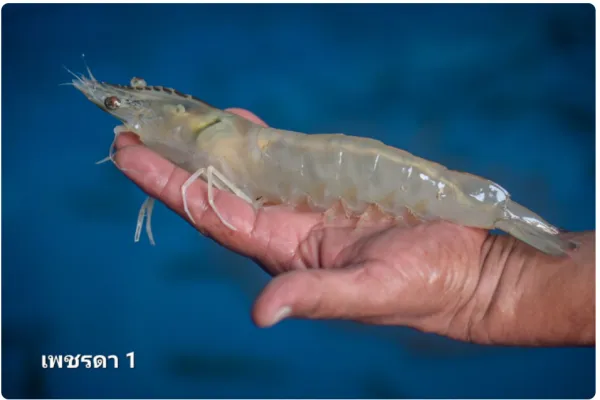
Petchada 1 strain was selected for its fast growth rate, and is one of two new whiteleg shrimp strains that researchers will help revive the aquaculture industry
According to the Thai Department of Fisheries, two new whiteleg shrimp strains have been successfully developed to strengthen Thailand's aquaculture industry, and this was reported in the Bangkok Post.
Praphan Leepayakul, Deputy Director-General of the Department of Fisheries, stated that the new strains – Petchada 1, a fast-growing genotype, and Sida 1, a disease-resistant genotype – will help safeguard the domestic shrimp farming industry. The Department has been working with the Agricultural Research Development Agency to revive the number of whiteleg shrimp farms, which has declined since 2012 due to outbreaks of Early Mortality Syndrome, also known as Acute Hepatopancreatic Necrosis Disease (EMS/AHPND).
Mr. Praphan said that the bacterial disease has caused significant damage to Thailand's aquaculture industry.
Whiteleg shrimp are in high demand in both domestic and international markets. It is a major export earner, generating an average income of 100 billion baht annually.
Mr. Praphan stated: "This development can help build a sustainable shrimp industry."
The new strains were developed by a team of marine biologists using selective breeding and molecular genetic markers.
To assess genetic diversity and study disease-free DNA, the research team selected various whiteleg shrimp strains from the United States, Guam, and Thailand.
The shrimp were fed in a biosecure system to study their growth potential and genetic diversity.
The study showed that Thailand's indigenous lines were best as a base population.
The Petchada 1 strain, developed at the Genetic Aquatic Animal Research and Development Center in Phetchaburi province, has high growth potential when compared to shrimp from other sources.
The Sida 1 strain, from the Genetic Aquatic Animal Research and Development Center in Nakhon Si Thammarat province, has the highest survival rate against EMS/AHPND compared to other strains.
Mr. Praphan stated: "It is still under research and development."
"The next step is commercial-scale testing. We hope that this will be a significant step towards a sustainable shrimp industry by reducing losses for shrimp farmers."
Source: Aquaasiapac
Translated by: Trần Thị Thúy Quyên