Research shows that the use of microalgae Chlamydomonas reinhardtii expressing dsRNA resistant to Yellow Head Virus (YHV) increases resistance and survival rates in Pacific white shrimp. This system has great potential in shrimp hatcheries.
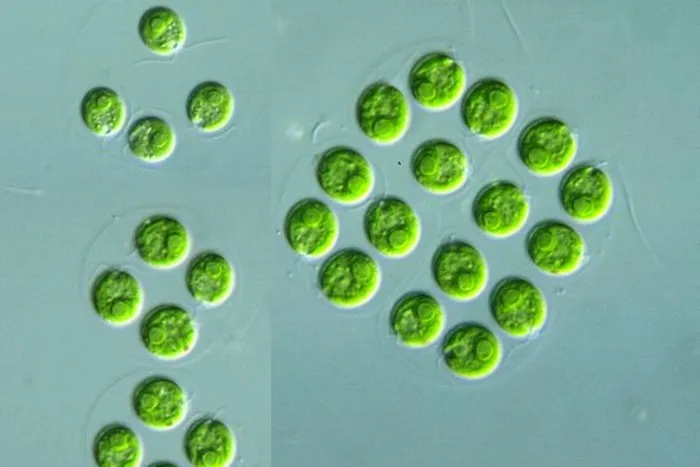
Microalgae Chlamydomonas reinhardtii has been studied as a cell factory for producing various types of biomolecules. The GRAS (Generally Recognized As Safe) certification for this algal species is due to its non-production of endotoxins or infectious agents. Therefore, using this microalgae as a feed ingredient for shrimp farming is an attractive alternative without concerns about health risks or environmental contamination.
The potential of dsRNA produced from the C. reinhardtii genome to protect shrimp from Yellow Head Virus (YHV) has been demonstrated by many previous researchers. Furthermore, chloroplast transformation in C. reinhardtii occurs via homologous recombination, leading to the integration of modified genes at a specific locus, whereas integration into the nuclear genome occurs randomly, causing instability. More importantly, chloroplast transformation can be achieved using non-photosynthetic mutant strains, allowing for the creation of marker-free transformants without the need for antibiotic selection.
This study created a homogeneous, stable C. reinhardtii chloroplast transformant expressing a dsRNA specific to Yellow Head Virus (YHV) in Pacific white shrimp and demonstrated the efficacy of the algal transformant as a feed supplement for controlling shrimp disease.
Research Methodology
The Chlamydomonas reinhardtii algae, named TN72, created by researchers, homogeneously expresses a dsRNA specific to the YHV pathogen from the University of Minnesota, USA.
Pacific white shrimp at the post-larval stage (PL30) were used in feeding trials and virus challenge tests. Shrimp were acclimated to 10ppt salinity with aeration for three days before the experiment. Shrimp were randomly divided into 4 groups (n=25) with 3 replicates per group:
- Treatment 1: Negative control (no algae fed, no infection)
- Treatment 2: Positive control (YHV infection only)
- Treatment 3: Shrimp fed reinhardtii SR algae – no dsRNA expression (density 5 × 10⁵ cells/ml)
- Treatment 4: Shrimp fed reinhardtii PYP algae – with dsRNA expression (density 5 × 10⁵ cells/ml).
On day 3 of the experiment, shrimp in groups 2, 3, and 4 were challenged with Yellow Head Virus (YHV).
Research Results
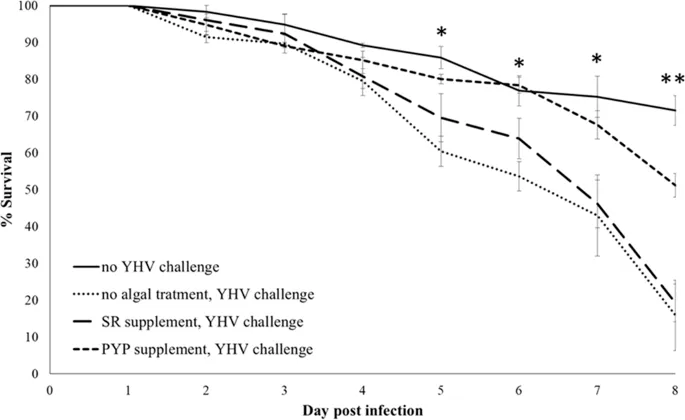
To demonstrate the antiviral efficacy of the PYP transformant expressing YHV-resistant dsRNA, an experiment was conducted by feeding shrimp with PYP algae before infection. Figure 1 shows that in Treatment 4, the survival rate of shrimp fed with C. reinhardtii PYP was higher compared to Treatment 1 (negative control: no algae treatment, no infection) and Treatment 2 (positive control: YHV infection only). After challenging shrimp with Yellow Head Virus (YHV), shrimp in Treatment group 2 had a survival rate of 50% after 6 days post-infection (dpi) and up to 84.1 ± 16.7% after 8 days post-infection (dpi).
On the other hand, the survival rate in Treatment 1 (no YHV infection) remained statistically significant at 70% on the last day of the experiment. Infected shrimp fed with C. reinhardtii SR (without dsRNA-YHV expression) had a mortality rate similar to Treatment 2. However, shrimp fed the same amount of PYP algal cells could maintain a survival rate of up to 50% after 8 days. There was a significant difference (p<0.01) compared to the treatments in Treatment 2 (YHV) and Treatment 3 (SR).
In the feeding trial, the SR group (fed with algal cells without dsRNA expression) showed a lower mortality rate between day 5 and day 6; however, the mortality rate subsequently increased to a level similar to that observed in Treatment group 2. This suggests that C. reinhardtii itself, by providing nutrients or natural products such as polyunsaturated fatty acids, helps shrimp resist viral infection.
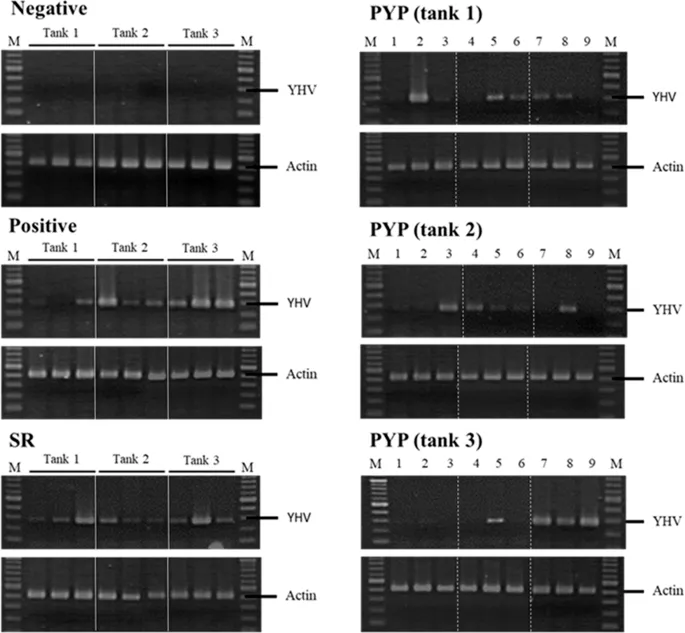
RT-PCR of Treatment group 2 with YHV showed that 88.9 ± 11.1% of the 9 remaining shrimp were infected with Yellow Head disease, and 100.0 ± 0.0% of the 9 remaining shrimp in Treatment group 3 were infected. Shrimp were fed C. reinhardtii SR algae. In contrast, in the group fed with C. reinhardtii PYP algae, the level of YHV infection was significantly lower (p<0.05) with an infection rate of 55.6 ± 11.1% for the 27 remaining shrimp from all tanks in this group (Figure 2).
To further improve the algal system, the use of other high-chloroplast-transcription promoters previously studied, such as psbA or the 16S rRNA promoter, could increase dsRNA production and, consequently, enhance shrimp's viral protection. An important point is the scalability of genetically modified C. reinhardtii algae, which lacks a cell wall.
Previous research has demonstrated that genetically modified strains, created by chloroplast transformation, can be scaled up in photobioreactors. Future studies will be necessary to address concerns regarding the use of live genetically modified organisms in aquaculture feed. For this, the inactivation of algal cells should be considered before adding them to shrimp feed ingredients.
In summary, the C. reinhardtii chloroplast transformants expressing dsRNA generated in this study show great potential as an effective way to combat viral diseases in shrimp farming. This system has significant potential for implementation in hatcheries producing PL shrimp. At this stage, shrimp are most susceptible to environmental changes and pathogens. Therefore, improving the overall disease resistance of PL shrimp is crucial for promoting sustainable shrimp aquaculture.
According to GlobalSeafood