
Oita Prefecture in southern Japan is the country's largest producer of flounder. Thanks to a new farming technique, commercial flounder aquaculture here is poised for even stronger growth.
That's because a new light source – green LED lights – is being implemented there. Under green light, flounder tend to gain weight faster, while different light wavelengths appear to regulate the release of melanin-concentrating hormone (MCH) – an appetite-regulating substance in the brain, causing fish to eat more.
Dr. Akiyoshi Takahashi, from Kitasato University, told Advocate: “We conducted several experiments with fin flounder (Verasper moseri) in different tanks. Those raised in bright tanks grew faster than those in dark tanks. We wanted to see if specific wavelengths affected growth and tested the effects of blue, green, and red light, corresponding to the primary colors. Green showed the highest effectiveness.”
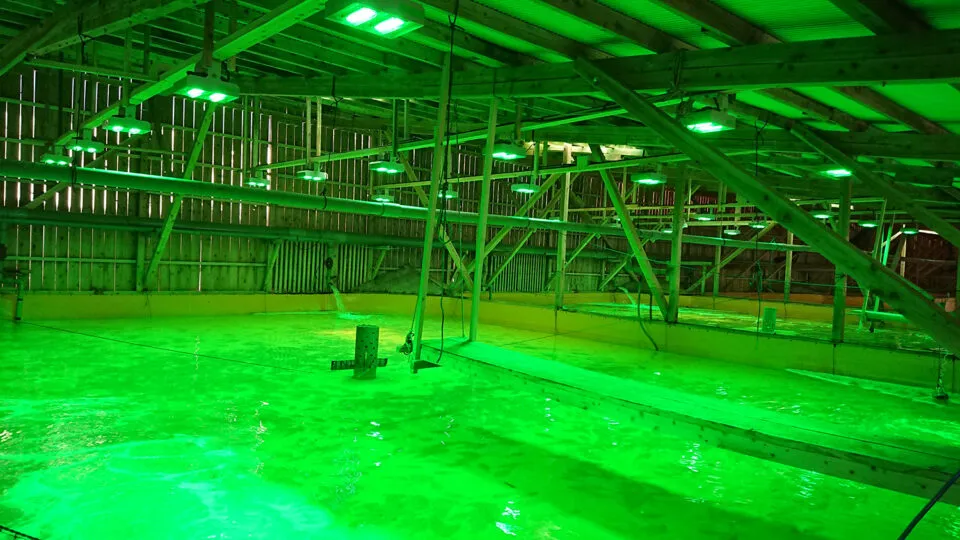 Green LED lights are being used at a flounder farm owned by Towa Suisan Co., Ltd., Oita Prefecture, southern Japan
Takahashi and his team found that under green light, fin flounder, olive flounder (Paralichthys olivaceus), spotted flounder (Verasper variegatus), and marbled flounder (Pseudopleuronectes yokohamae) became more active. The light also affected feeding behavior, with fish moving more while eating. Research with fin flounder showed that growth was also stimulated under standard rearing temperatures (14.9 degrees C) and lower temperatures (around 6.6 degrees C). Blocking outdoor light also proved effective.
Takahashi stated: “We believe that the endocrine and nervous systems stimulated growth under green light, but we don't know any specific details. MCH has an effect but doesn't seem to be the dominant hormone. We tested with rainbow trout, red sea bream, and yellowtail, but green light didn't seem to have much effect. Other research shows that green light is effective when culturing longtooth grouper (Epinephelus bruneus) at low temperatures, so we may need to determine the most effective color for different species. Different irradiation methods, such as using only green light during feeding, may be worth investigating. We also understand that green light penetrates to the depths where flounder live in nature, which is why green may have a particular effect on them.”
Green LED lights are currently being implemented at flounder farms in western Japan, while trials with fin flounder are underway in northern Japan and with spotted flounder in northeastern Japan. It is also being used for pre-release rearing of spotted flounder for reproduction purposes. Takahashi believes it can bring various benefits to farms.
He said: “Under green light, the weight of flounder increases 1.6 times faster than with standard farming methods, so farms can reduce rearing time and sell their products sooner. In turn, electricity and labor costs can be cut. Further research is needed, but due to better feed conversion efficiency, feed costs can also be saved.”
Light exposure is an important environmental factor that has long been used to promote biological processes, thereby affecting fish productivity and influencing production. With many fish species raised indoors in tightly controlled systems, aquaculture today relies more heavily on artificial light sources. Incandescent and fluorescent lights have long been traditional choices, but according to Dr. Juliette Delabbio, principal at Farm Biosecurity International, LEDs provide better control over three elements of ambient light – photoperiod, light intensity, and color – while their initial cost is offset by significant long-term energy savings.
Delabbio stated: “The focus of designing indoor lighting systems is not just on improving fish performance through photoperiod control.” “LED lighting systems provide a way to manipulate different aspects of indoor light that are practically inaccessible with traditional lighting systems. They allow for easy manipulation of light intensity and spectrum. These two factors can be designed into a lighting system so that they can be enhanced, changed, or eliminated to suit the development and needs of a specific species.”
With significant changes in the natural habitats of farmed species and the way LED lighting can control light intensity and spectrum, there is a great opportunity to improve lighting systems to significantly increase fish health and performance, Delabbio said. She noted that providing optimal light in indoor environments is very complex, but with LEDs, systems can be custom-designed to consider the fish's developmental stage and environmental factors such as tank substrate and water depth.
Delabbio stated: “For example, most larval fish species are extremely sensitive to rearing conditions. Their vision changes during development, which affects their foraging ability. Incorrect lighting can reduce successful prey capture rates and impact their survival. As researchers in Japan have noted, the light in a fish's natural environment is the light it is most comfortable with. This is also very important, and all three light factors – photoperiod, intensity, and spectrum – must be considered during rearing.”
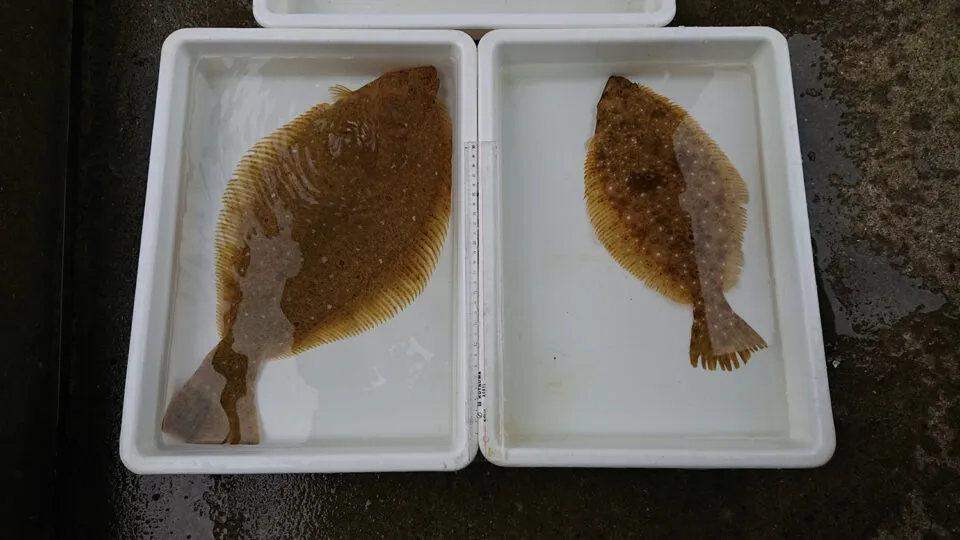 Flounder raised under green LED lights (left) and another raised under standard lights (right).
Back in Japan, many hope that green light can play a role in the recovery of northeastern Japan, devastated by the 2011 earthquake and tsunami. As part of a collaboration with the Japan Fisheries Research and Education Agency, Takahashi and his team are working in the affected areas. The decline in the number of fishermen has heavily impacted these areas, while fish catches, including chum salmon (Oncorhynchus keta), a staple species in the region, have also been low. Before the disaster, hardly any fish were farmed in northeastern Japan, but to regenerate the area, offshore salmon farming has begun. Meanwhile, land-based aquaculture may hold potential.
Takahashi stated: “With green LED lighting, farms will be able to produce fish more efficiently and cost-effectively. We hope to attract visitors by promoting disaster-affected areas as special production zones for spotted flounder. Flounder is a staple in sushi restaurants, and we can provide a stable supply to cities.”
“If green light can also enhance the production value of more expensive fish like pufferfish or sturgeon, farms will earn decent profits, and if we can eat these fish at lower prices, Japan's fish-eating culture will certainly spread even further,” he continued.
Takahashi and his team believe that green light can be effectively implemented in flounder farms in other countries and improve overall production and feed efficiency. In the future, green LED light will be used more to elucidate the mechanisms behind growth stimulation in flounder and increased feed intake. Research is also underway to examine the link between growth and physiological mechanisms responsive to light, such as circadian rhythms, also known as biological clocks.
Abridged translation from an article by Bonnie Waycott in GSA magazine