Adding probiotics to feed can enhance shrimp health and growth
Probiotics are widely used in animal husbandry and aquaculture because they improve feed value, contribute enzymes to the digestive process, and activate immune responses. Some bacterial species belonging to the genus Bacillus have been shown to improve growth performance and disease resistance, enhance the diversity of the gut microbiota, increase beneficial bacteria, and reduce the impact of harmful pathogenic bacteria in the gut flora of shrimp species such as whiteleg shrimp (Litopenaeus vannamei), one of the most commonly farmed crustacean species worldwide.
Many studies have reported that B. subtilis is beneficial when used as a dietary supplement for shrimp, but few studies have investigated the appropriate dosage of B. velezensis in whiteleg shrimp production.
Study Setup
Healthy whiteleg shrimp (body length: 3.0 ± 0.3 cm, body weight: 0.32 ± 0.8 grams) were collected from a shrimp farm in Yantai (Shandong Province, China) and acclimated at 25-27°C and 30 ppt salinity for 2 weeks before the start of the experiment. A total of 1,200 individuals were randomly stocked into 12 composite 60-liter tanks, with each tank containing 100 shrimp. Shrimp were fed 4 times daily at 6% of body weight and cultured for 8 weeks, including a two-week challenge experiment with Vibrio parahaemolyticus (after 42 days of the growth experiment).
The experiment investigated the effects of the Bacillus velezensis strain (designated BV007) on shrimp growth performance, immune response, and gut microbiota. Three experimental diets were prepared and supplemented with different levels of BV007 isolated from the gut of healthy shrimp: 105 CFU/g (BV1), 107 CFU/g (BV2), and 109 CFU/g (BV3). A control group received a basal diet (41.35% crude protein; 7.67% crude lipid) without any BV007.
The cumulative mortality rate of shrimp was recorded daily. After 42 days of feeding, the total number and weight of shrimp in each tank were quantified to calculate survival rate (SR, %), final body weight (FBW), final body length (FBL), body proportionality index (PI), and specific growth rate (SGR, %/day).
Research Results and Discussion
Many Bacillus strains are currently used as supplements in aquaculture feed. These probiotics not only produce essential micronutrients that promote better growth and feed utilization in farmed animals but also participate in the digestive process, breaking down nutrients such as carbohydrates, proteins, and lipids by producing extracellular enzymes (e.g., amylase, trypsin, lipase).
The results showed that the basal diet continuously supplemented with B. velezensis increased the growth performance of L. vannamei shrimp, consistent with previous studies on tilapia, carp, and grouper. There was a significant increase in final body length (FBL), length gain rate (LGR), final body weight (FBW), weight gain rate (WGR), proportionality index (PI), and specific growth rate (SGR) in shrimp fed with BV007 for 42 days compared to shrimp fed with the control diet.
The differences in growth performance could be attributed to enhanced digestive enzyme activities in the gut. There was a significant increase in various important digestive enzymes in the supplemented groups compared to the unsupplemented shrimp. Similar observations were also found for other aquaculture species such as sea cucumbers and Atlantic salmon fed diets supplemented with B. velezensis.
It was also noted that Bacillus species can secrete various exoenzymes that enhance host nutrition. As a result, the increase in digestive enzyme activity may be related to the increase in beneficial bacteria in the Bacillus-treated group, as they secrete beneficial enzymes such as proteases, amylases, and β-galactosidases. Furthermore, there were no indications of hepatopancreatic tissue damage or dysfunction caused by BV007 supplementation.
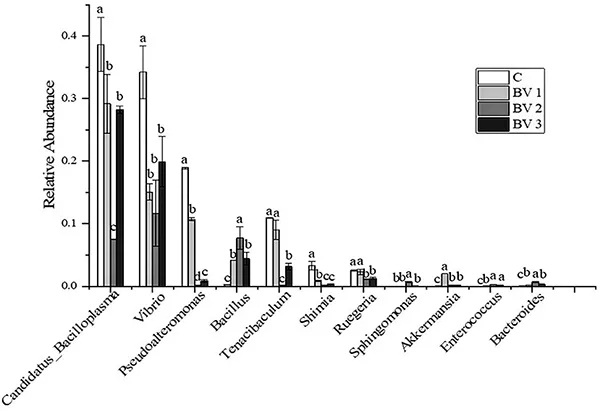 Figure 1: Quantitative diversity of 10 bacterial genera in the gut microbiota of L. vannamei fed diets containing 0 CFU/g (C), 105 CFU/g (BV1), 107 CFU/g (BV2), or 109 CFU/g (BV3) B. velezensis.
 Modulating immune responses and disease resistance is a primary function induced by probiotics. As a result, both cellular immunity (antibody-independent immune response) and humoral immunity (mediated by secreted antibodies, proteins, and some antimicrobial peptides present in extracellular fluid) are stimulated in response to pathogens. The phagocytic activity (an important component of the immune system) of L. vannamei hemocytes was increased with B. velezensis supplementation. Similarly, other studies have reported similar observations with the use of another Bacillus sp. that can activate the cellular immunity of black tiger shrimp (Penaeus monodon).
The gut microbiota of shrimp plays an essential role in immune mediation, nutrient metabolism, and homeostatic energy balance. Previous studies have shown that dietary probiotics for shrimp can effectively regulate the gut microbiota, improve growth performance, and enhance disease resistance. In this study, the bacterial communities supplemented with BV007 were more diverse than those in the control group. This could be due to altered metabolic activities or beneficial effects on the gut microbiota regulated by B. velezensis.
In the challenge experiment with V. parahaemolyticus, the cumulative mortality rate of the probiotic-treated groups was significantly lower than that of the untreated group, indicating that B. velezensis can improve the disease resistance of L. vannamei. Similar results have also been demonstrated by other studies, where other Bacillus species (B. subtilis and B. coagulans) enhanced disease resistance in shrimp. This result could be attributed to the increasing abundance of beneficial Bacillus and enhanced immune responses in the BV007-treated groups.
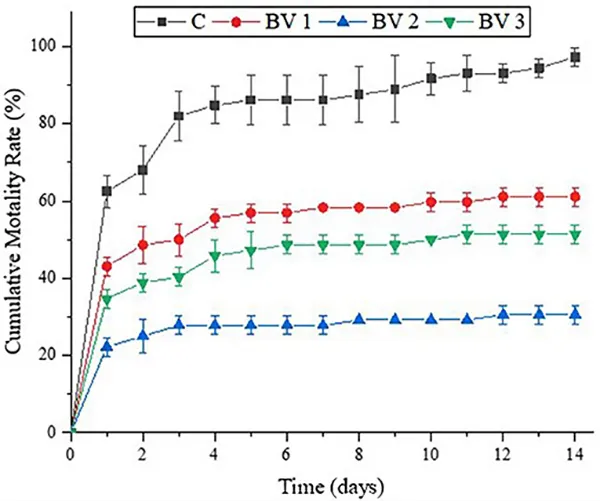 Figure 2: Effects of B. velezensis diet on the cumulative mortality rate of L. vannamei after V. parahaemolyticus infection.
 Overall, the results showed that dietary supplementation with B. velezensis can promote growth performance, enhance immune responses, and modulate the gut microbiota of L. vannamei shrimp, significantly increasing the abundance of beneficial Bacillus and reducing the abundance of potentially pathogenic Vibrio in the shrimp gut. The recommended dosage as a feed additive is 107 CFU/g of feed to enhance the growth rate and health status of whiteleg shrimp.
This article is compiled based on research by Chen L., et al., 2021.