Currently, many people from Ninh Hoa Town, Cam Ranh City (Khanh Hoa) travel to Xuan Dai Bay, Song Cau Town (Phu Yen) by boat to dive and catch Láng clams (Lụa clams) in the middle of the bay. During the diving process, digging up mud to find and catch clams causes water turbidity, affecting shrimp respiration.
Many weak juvenile shrimp in cages are dying, while larger shrimp have red eyes and stop eating.
Digging mud at night
Mr. Nguyen Van Tien, who farms lobster in Xuan Dai Bay, Xuan Thanh ward, said: For nearly a month now, many people from Cam Ranh have come by boat to dive and dig up mud to find and catch Láng clams. They dive from 5 PM until dawn. Láng clams live buried deep in the mud, so to catch them, one must dive 5-7m deep and dig up the mud. They line up horizontally to dig for mud, making the water in this area very turbid. Muddy water flows into the shrimp cages, causing small shrimp to suffocate and die, while larger shrimp experience eye irritation and stop eating.
Mr. Dinh Van Tan from Vung Dong (Xuan Phuong commune) complained: "The Láng clam catchers from Khanh Hoa dive year-round, except when it's too cold. To catch Láng clams, they have to dig up mud and then sift through it to find the clams, which makes the muddy water turn completely black. In the morning, I dive down to my cages to check how much feed the shrimp have eaten, but the water is too dark, I can't see anything."
According to many people living around Xuan Dai Bay, Láng clams live in a natural environment, have firm and delicious meat, and are therefore very popular. Other seafood like rock mussels, crabs, and ghẹ sometimes drop in price and are difficult to sell, but all Láng clams caught are sold.
Currently, Láng clams are bought by traders at a price of 100,000 - 120,000 VND/kg; each day, divers can catch 10 - 12 kg, earning about 1,000,000 VND, so not only people from outside the province but also locals are competing to dive and catch them. They dive outside the shrimp cages, making it difficult for shrimp farmers to confront them. Late at night, they sometimes secretly dig up mud close to the shrimp cages to catch clams.
"I have 10 cages for juvenile lobsters, with an average of 200 juveniles per cage, and the price for each juvenile lobster is 17,000 VND/individual. However, due to the clam divers stirring up the water, weak juvenile lobsters are dying, and now only 50 individuals remain per cage. It's very difficult for me to find and buy fingerlings because the lobster juveniles are imported from abroad. Therefore, I request that authorities patrol and prevent this activity, otherwise, this area will become polluted, and all the lobsters will die," complained Mr. Bui Tan, a lobster farmer.
Polluted Water Source
The lobster farming area currently has over a thousand people from various places engaged in lobster farming, with over 50,000 cages. Daily, tons of fresh feed for lobsters, consisting of ground fish (various types of fish mixed together), are dumped into the lagoon. If the lobsters don't consume all of it, the excess feed sinks to the bottom of the lagoon. To avoid bottom layer pollution, lobsters must be farmed using a "floating" method (using plastic containers to keep the cages suspended mid-water, rather than submerged).
However, when clam catchers dig up mud, it's as if they are mixing the polluted bottom water with the middle and upper layers, so even with the floating farming method, pollution still occurs. Due to the polluted water source, farmed lobsters have been dying from disease for several months, with losses of about 10-15%.
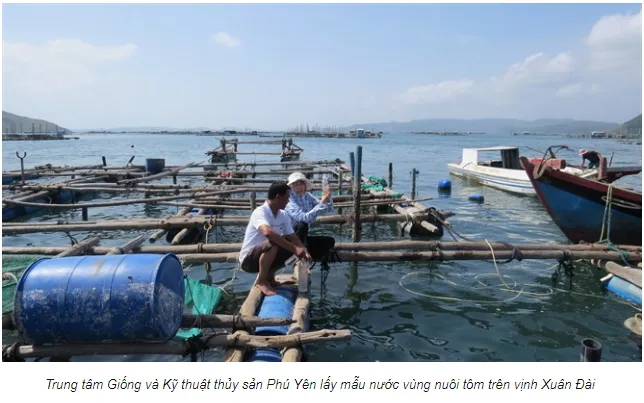
According to the water environment monitoring results from mid-July in the Xuan Dai Bay lobster farming area by the Phu Yen Fisheries Seed and Technical Center, the NH3 parameter exceeded the permissible limit in the Dan Phuoc farming area (Xuan Thanh ward); bottom water samples ranged from 0.01 - 0.04 mg/L. Compared to the monitoring period in early July 2018, the NH3 parameter increased by 2 points, exceeding the threshold. Dissolved oxygen levels in the water were also below the permissible limit.
The Phu Yen Fisheries Seed and Technical Center recommends, based on the monitoring results, that lobster farmers need to enhance cage hygiene, preventing oysters and barnacles from attaching to the cages, which would reduce water circulation between the outside and inside of the cages.
Manage feed quantity, avoid excess feed, regularly check for water stratification to promptly adjust the cages, and if necessary, hang sacks of lime in the corners of the cages to limit algal blooms caused by thunderstorms.
Mr. Do Van Chinh, Head of the Economic Department of Song Cau Town, stated that from now until the end of the year, the Economic Department will coordinate with Border Guard Posts and the People's Committees of communes and wards in Song Cau Town to inspect and handle, according to regulations, fishing vessels operating in the lagoon and coastal areas engaged in clam raking, trawling, "Thai balls", electric fishing, etc., thereby preventing prohibited fishing activities within the town's jurisdiction.
Source: Manh Hoai Nam, Nông Nghiệp Newspaper