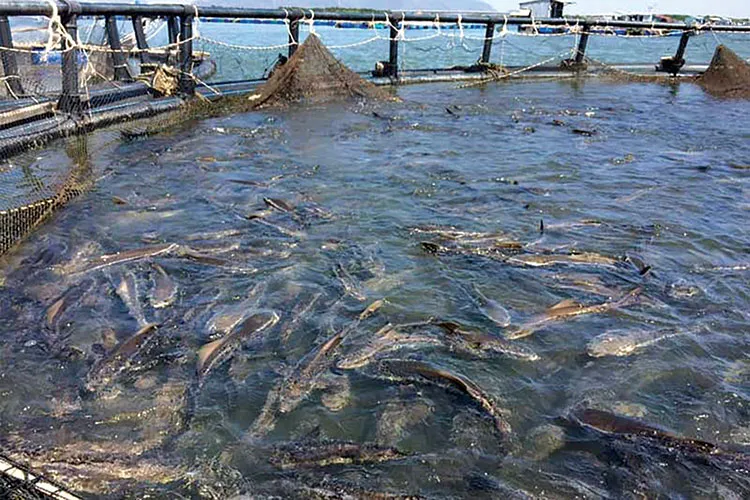
In addition to the advantage of rapid growth, cobia also has high adaptability and good disease resistance, making it quite popular for farming in many coastal provinces of our country. Among these, HDPE cage farming is particularly effective.
Fingerling Selection
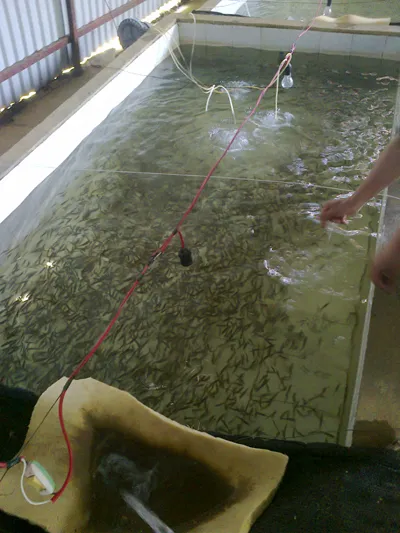
Fingerlings should have a bright brown color, with two distinct silvery-white stripes along the body length (fish that are pale white or dark black all over, with the two silvery-white stripes faded or invisible, are weak or diseased). Fingerlings for stocking should be uniform in size, with a length difference of no more than 3 cm among fingerlings stocked in the same cage. Fish should be healthy, swim actively, without deformities, abnormalities, or abrasions. Sizes are 10 – 12 cm for small fingerlings, and ≥ 18 cm for large fingerlings.
Fingerling size must be larger than the cage mesh opening and mesh size to ensure fish do not escape.
Transportation and Stocking
Transport fish using air-filled bags with water and oxygen, maintaining an average temperature of 20 – 220C.
Acclimate the temperature of the air-filled bags and seawater by submerging the fingerling bags in seawater for about 10 - 15 minutes before releasing the fish into the cage area. Then, open the bag slowly to allow water to flow in, and tilt the bag for the fish to gradually swim out.
Before stocking, acclimate the fish for 5 – 10 minutes combined with aeration to eliminate parasitic pathogens on the fish, or bathe them in potassium permanganate at a concentration of 5 ppm for 15 – 20 minutes. It is best to stock fish early in the morning or late in the afternoon.
Feed
Trash fish: Fish must be fresh, sorted to remove impurities, and parasites eliminated by soaking in freshwater before feeding to prevent diseases in farmed fish. Initially, trash fish should be chopped into 1 – 3 cm pieces depending on the size of the farmed fish; when fish are over 2 kg/individual, trash fish of 10 – 15 cm (whole) can be fed.
Homemade feed: Contains 42% protein. Use an extruder to produce moist pellet strands, with different strand diameters depending on the size of the farmed fish. Feed once a day in the morning. Distribute feed slowly to allow fish to easily catch it. Feed the fish gradually until they stop eating, then cease feeding to prevent feed from falling to the bottom of the cage.
Commercial feed: Farmers can also use commercial feed specifically for cobia, feeding fish twice a day, morning and afternoon, with a feed amount of about 1.5 – 2% of the fish's body weight per day.
Technical Department, THAN VUONG Company