Previously, shrimp were traditionally farmed in coastal or estuarine areas with salinities ranging from 15 to 40 ppt. However, the farming of black tiger shrimp and Pacific whiteleg shrimp has been successfully implemented in many places using seawater with varying salinities (0-10 ppt), and thus the ionic composition of the water differs. Such low-salinity water needs to be supplemented with essential minerals to achieve desired yields.
Importance of Minerals
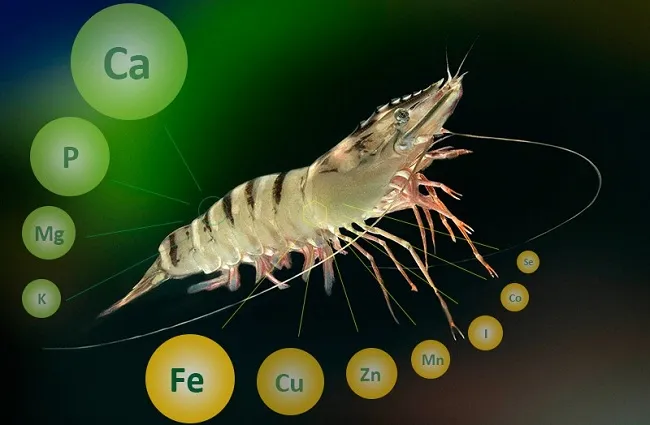
Minerals are involved in maintaining acid-base balance and are crucial for osmoregulation. Among macronutrients, calcium (Ca) and magnesium (Mg) play major roles in molting and new shell formation in shrimp.
Mineral Requirements in Shrimp Ponds
In addition to basic water quality parameters, minerals are also essential components for whiteleg shrimp (P.vannamei). The actual mineral requirements are difficult to quantify due to the varying ionic composition of the water. The bioavailability of minerals will be a function of their concentration in the water.
Ionic Ratios
Ionic ratios differ significantly between seawater and other water sources. The ratios of Na (Sodium) to K (Potassium) and Mg (Magnesium) to Ca (Calcium) in the water appear to be more critical than the pond water's salinity. Inappropriate ratios of these minerals in the water affect osmoregulation, impacting shrimp growth and survival rates. Optimal Na:K and Mg:Ca ratios are 28:1 and 3.4:1, respectively. It should be noted that high Ca content and a Ca:K ratio of approximately 1:1 in seawater are also essential. In waters with high Ca:K and Na:K ratios, supplementing K to reduce these ratios in low-salinity water enhances shrimp growth.
Mineral Supplementation in Water
To maintain optimal mineral concentrations and ionic balance, mineral supplementation can be adjusted in both water and feed. Water-based mineral supplementation methods are more effective than feed-based supplementation, although the cost of ion enhancement can be relatively high for large farming areas. Ion levels in low-salinity ponds must be raised to match their concentrations in seawater diluted to the same salinity. To achieve desired mineral levels at different salinities, the water salinity (ppt) is multiplied by certain factors for each mineral. Seawater with a salinity of 35 ppt is considered the standard.
Application of Mineral Supplement Products for Shrimp Ponds
Several commercial products are available on the market (Potassium chloride, Magnesium chloride, complex minerals, etc.) to correct ionic ratio imbalances in pond water. Many commercial products do not specify their mineral composition. Extreme caution is advised when using such commercial products, as studies have shown a lack of standardization and efficacy. The dosage (g/m3) of a product required for pond application for a specific mineral can be calculated using the following formula:
Dosage (g/m3) = Desired concentration of specific mineral (mg/L) x Percentage of that mineral in the salt/100. Generally, whether in high or low salinity water, if optimal mineral concentrations and appropriate ionic ratios are present, no mineral supplementation is needed. However, throughout the culture period, minerals are primarily lost due to soil absorption, shrimp harvesting, and water drainage during harvest, which alters their concentrations.
Therefore, it is necessary to regularly assess mineral concentrations in pond water and supplement them in case of deficiency. Farmers should consider the concentrations of ions at the desired water salinity and the products used for ion supplementation. Particular caution should be exercised when using commercial products for pond supplementation to achieve maximum effectiveness.
Source: National Innovations in Climate Resilient Agriculture (NICRA), National Surveillance Programme for Aquatic Animal Diseases (NSPAAD)
Translated by: Trần Thị Thúy Quyên