Almost every marine aquarium hobbyist or marine fish farmer has, at least once, faced white spot disease in their aquarium or fish tank. This is a common disease, the most difficult to completely cure, and causes the most stress to marine fish.
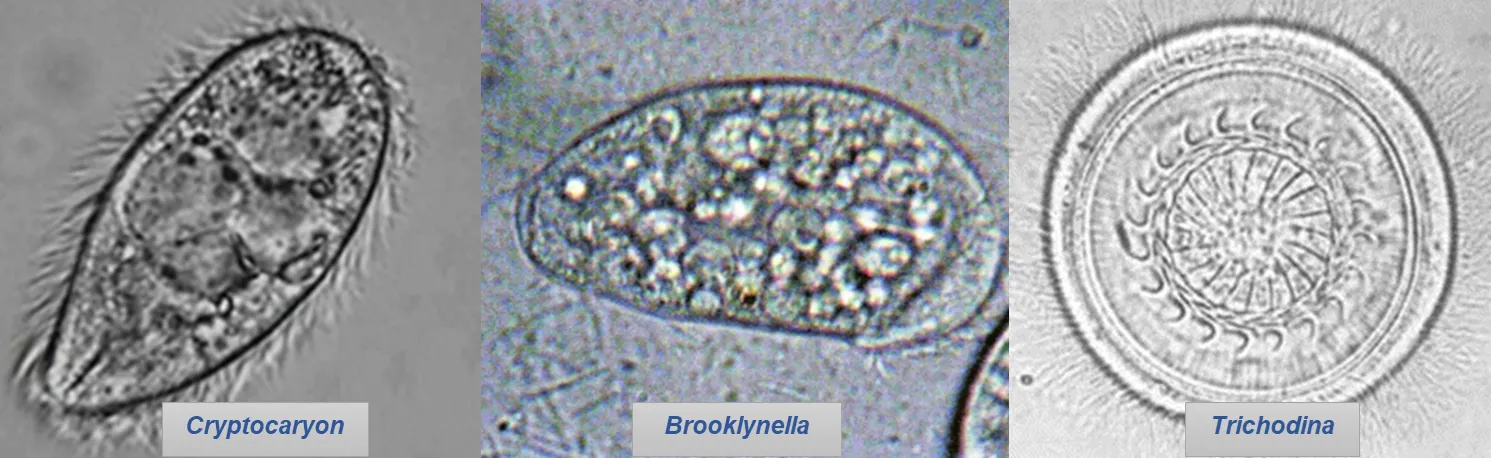
Pathogens include:
- Ciliated protozoan (marine ich) - Cryptocaryon irritans
- Mouth fluke – Brooklynella
- Wheel parasite - Trichodina jadranica
I. Symptoms of the disease
- Affected fish often gather in groups and float near the water surface, showing signs of itching and frequently rubbing themselves.
- Pale white patches are often observed on the fish's skin, and tiny white spots appear on the gills. Severely affected fish turn a moldy silver color, separate from the school, and die. The disease causes scattered to mass mortality within 3-7 days.
- White spots resembling grains of sand appear (these are Cryptocaryon beginning to attach to the fish).
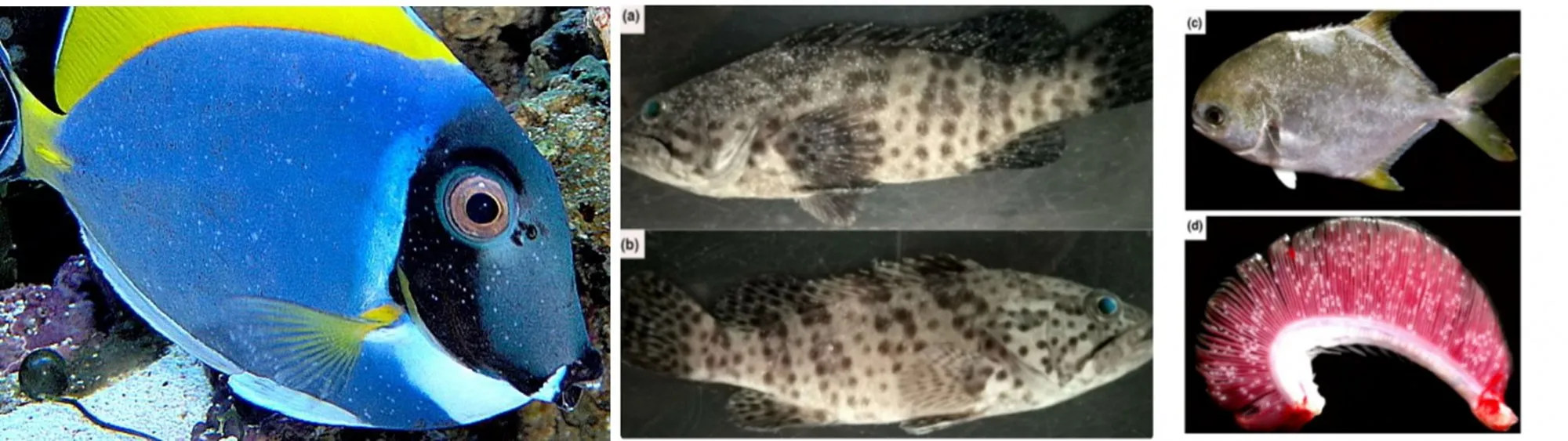
- Fish exhibit rubbing themselves against rocks, sand, etc. (fish are uncomfortable when Cryptocaryon is present).
- Fish breathe rapidly (Cryptocaryon attacks the gills). Increased mucus layer (the fish's immune system secretes it to resist Cryptocaryon).
- Fish lose color and patterns on their skin (Cryptocaryon attaches to and attacks the fish).
- Fish fins are frayed (tattered, eroded) (Cryptocaryon attacks the fins).
- Cloudy eyes (Cryptocaryon attacks the eyes).
Each symptom appears at a different stage. The more symptoms that appear simultaneously, the more severe the disease and the greater the number of Cryptocaryon proliferating in the aquarium or tank.
II. Disease development process – Cryptocaryon life cycle
The Cryptocaryon life cycle consists of 4 stages as shown in the figure below:
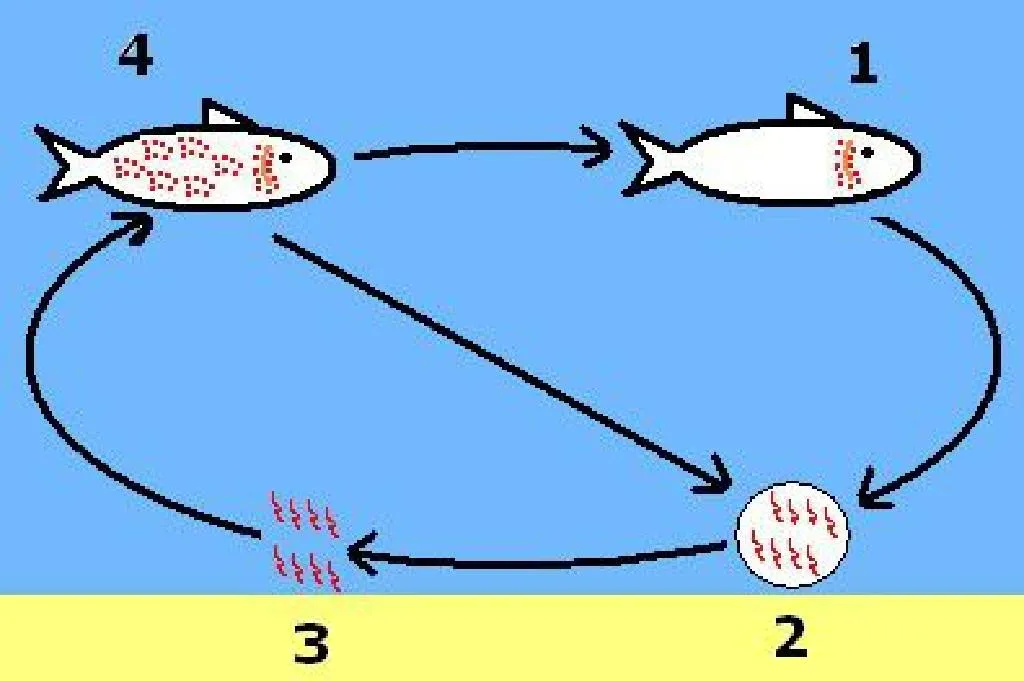
Stage 1 – parasitic: In this stage, the parasite attaches to the fish's gills and is called a Trophont. In other words, the fish is being attacked by parasites on its gills. Trophonts will live and feed on the fish for 3-9 days. After that, the Trophont will detach from the fish and be called a Protomont.
Stage 2 – detachment: In this stage, the Trophont detaches from the fish and is called a Protomont. The Protomont will move to the bottom surface and begin to crawl around for approximately 2-18 hours. Once the Protomont attaches to a suitable surface, it begins to break down its protective membrane and is called a Tomont.
Stage 3 – reproduction: In this stage, after the Protomont breaks its membrane and becomes a Tomont. Inside the Tomont, reproduction occurs, multiplying into hundreds of daughter parasites called Tomites. Tomites remain encased and await an opportunity. This stage lasts from 3 to 72 days. After this process, Tomites hatch into Theronts and begin swimming to find the next host. This is the stage where many people mistakenly believe they have completely eliminated white spot disease from their aquarium.
Stage 4 – infection: This is the stage when Tomites hatch into Theronts, and at this stage, Theronts must find the next host within 48 hours, or they will die. Theronts concentrate on attaching to the fish's skin and gills, then transform into Trophonts, and the process restarts from Stage 1.
III. Causes of the disease
1 – Fish experience high stress during farming.
2 – Parasites are not treated periodically during farming.
3 – Pond water environment is dirty, allowing Cryptocaryon and other parasites to proliferate.
4 – Internal parasites are not regularly dewormed in fish.
IV. Treatment methods
1 – Hyposalinity: a method of reducing salinity (only applicable in aquariums, tanks; difficult to apply in cage farming).
2 – Copper treatment: medications containing copper. Can be used as a bath, by hanging bags around cages, or diluted and evenly distributed throughout the pond, tank, or cage.
3 – Transfer method: fish are moved to another farming environment (new environment) that has been rehabilitated and safely treated, which will yield higher treatment effectiveness (this is the most feasible method).
Immune system:
In cases where it's not possible to change the fish's living environment, the only remaining option, and merely a 50-50 chance, is to allow the fish to develop resistance to Marine Ich naturally. For weak or compromised individuals, the chance of survival is very slim, but if they can fully recover, the surviving fish will have developed immunity to Marine Ich. However, achieving this requires significant sacrifice and demands meticulous observation and water quality management. Always maintain the best water quality – the most effective way is frequent water changes, keeping water stable to prevent fish stress, feeding less but with high-quality feed (by introducing probiotics, supplementing nutrients, minerals, etc.) and efficiently. Typically, if fish have good resistance and a good water environment, they have a fairly good ability to combat the disease; as long as the fish continue to eat, the chances of survival and recovery are quite high.
Maintain this for at least 8 weeks from the last appearance of Marine Ich signs to consider it a success. This is very difficult because the Marine Ich cycle constantly revolves; as long as there are infected fish, even if they don't die, Marine Ich will continue its cycle until it can no longer do so. After each cycle, with the support of good water quality, fish will gradually become immune, and once Marine Ich can no longer attack any fish in the aquarium or tank, it will automatically die after 48 hours.
V. Prevention
Preventing white spot disease is the best cure. Prevention methods primarily revolve around 3 main objectives:
1 – Good water quality management, minimizing the development of Cryptocaryon and other parasites.
2 – Minimize fish stress during farming (by introducing probiotics, supplementing nutrients, minerals for fish, etc.).
3 – Periodically deworm internal parasites and treat external parasites during farming (ideally during stages 2 and 3 of the parasite's life cycle).
VI. Conclusion
Marine Ich can appear anytime, anywhere, potentially causing mass mortality or continuously coming and going without causing any damage. It's not just a disease issue, but rather a warning about water quality and the living conditions of fish that farmers need to re-evaluate. Therefore, this disease is considered endless, with no definitive cure. Even if fish are healthy, if the old living environment is not good, they will easily get reinfected.
Therefore, instead of seeking a cure, learn scientific prevention methods (applying a flexible balance between chemical and biological approaches) – as well as appropriate fish selection, stocking, and conditioning./.
Technical Department, THAN VUONG Company