A study on the effects of water pH on the blood physiology and coloration of the bumblebee catfish (Pseudomystus siamensis) with weights ranging from 4 - 6 g/individual was conducted under experimental conditions. The experiment was carried out for 8 weeks with different pH values (3, 4, 5, 6, 7, 8, 9, 10, 11).
Bumblebee catfish (Pseudomystus siamensis) were purchased from fish hatcheries in Ho Chi Minh City and Tay Ninh areas. Fish used for the experimental setup were of uniform size, healthy, and had an average weight of 5 – 6 g/individual.
Effect of water pH on the cumulative mortality rate of bumblebee catfish
The experiment was set up in glass tanks, with 8 fish/tank, each having an average weight of 4 – 6 g/individual.
Fish activities were monitored, and the number of dead fish was recorded at 3, 6, 9, 12, 15, 18, 21, and 24 hours after setup. Dead fish were removed to prevent affecting other living individuals. This allowed for the determination of the low and high pH thresholds causing 50% mortality after 24 hours.
Effect of water pH on the blood physiology and coloration of bumblebee catfish
The experiment was conducted for 8 weeks with 8 treatments at different pH values (3; 4; 5; ..; 10). Each treatment involved 50 fish with an average weight of approximately 4 – 6 g/individual placed in glass tanks.

Experimental setup diagram
Results
Effect of water pH on the cumulative mortality rate of bumblebee catfish
Throughout the experiment, water environmental factors remained relatively stable and showed little fluctuation due to the tightly controlled experimental system.
Overall, environmental parameters throughout the experiment were relatively stable and within suitable limits for the normal growth and development of the fish.
pH tolerance of bumblebee catfish
When the pH in the tank increased to 11, fish exhibited symptoms such as rapid swimming, continuously surfacing; loss of balance; skin, gills, and entire body covered in a large amount of mucus; cloudy eyes; inverted body, and death within 3 hours of exposure. This phenomenon could be due to the sudden change in pH value increasing mucus secretion. The mucus adhering to the gill surface obstructs gas exchange between blood and water, leading to respiratory difficulties and death in fish.
At pH = 10, fish initially swam rapidly, then reduced swimming activity, became sluggish, had cloudy eyes, lay motionless near the bottom, some fish drifted with the water current created by aeration, and fish began to die, reaching 50% mortality after 21 hours of setup and 70.8% after 24 hours.
At pH values of 4, 5, 6, 7, 8, and 9, no fish mortality was observed after 24 hours of the experiment. However, at pH values of 8 and 9, fish swam rapidly at the beginning of the experiment, then their movement decreased, they lay motionless near the bottom, and their skin became pale.
At pH = 3, fish secreted mucus (less than at pH = 11), initially swam rapidly, then gradually reduced activity and lay motionless near the bottom, their eyes gradually became cloudy, signs of ulceration appeared on the skin, and mortality gradually reached 54% after 21 hours and 62.5% after 24 hours.
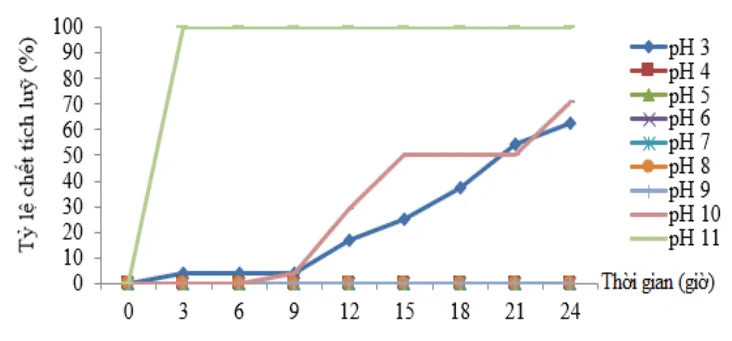
Cumulative mortality rate of bumblebee catfish in 24 hours
From the mortality rates of bumblebee catfish at different pH values over 24 hours, the low and high pH thresholds causing 50% mortality in bumblebee catfish were determined. Experimental results showed that bumblebee catfish can tolerate a wide range of pH fluctuations, leaning towards acidic environments.
Effect of water pH on some blood physiological parameters of bumblebee catfish
Fluctuation in red blood cell count
After 6 hours, the red blood cell count peaked at pH = 8. At pH = 5, 9, and 10, the red blood cell count decreased compared to the pre-experiment setup. One day after the experiment, red blood cell density rapidly increased at pH = 3, 9, and 10 treatments. The increase in red blood cell count in fish may be due to respiratory difficulties leading to oxygen deficiency, so fish respond by increasing red blood cell count to maintain respiratory activity and supply oxygen to the body. After the third sampling, the red blood cell count in most treatments decreased, with the lowest at pH = 10.
Red blood cell count fluctuates according to the physiological state of the fish, sex, age, as well as environmental factor variations.
Fluctuation in white blood cell count
The total white blood cell count in all treatments gradually increased over the sampling periods, peaking at week 4 and week 6 after the experiment.
At pH = 9 and 10, the total white blood cell count rapidly increased 1 day after the experimental setup, then sharply decreased 3 days later. White blood cells are involved in regulating immune function; when organisms live in an environment affected by pathogens or stress factors, the body responds by increasing the number of white blood cells to cope with stress. The increase in white blood cell count may correlate with increased antigen production, helping fish survive and recover from intoxication. However, if unable to adapt to new living conditions, prolonged stress factors will lead to immune system suppression and a decrease in white blood cell count. The presence of various types of white blood cells is extremely important in the body's immune response.
Effect of water pH on the coloration of bumblebee catfish
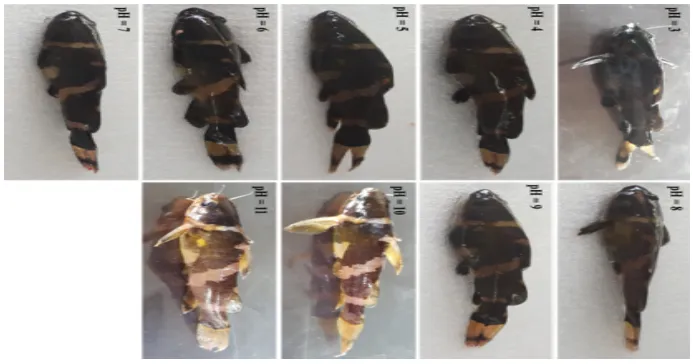
Visual assessment by the naked eye only revealed differences in treatments at the two extreme pH ranges (low and high) where fish could not survive. Furthermore, at low pH values, the entire body of the fish typically had only one color, black or dark brown, and the stripes on the fish's body were often not visible or very faint. At high pH values, the stripes on the fish's body were quite distinct, with yellow stripes observed on the body and most clearly on the fins. However, at pH values of 10 and 11, fish could not adapt to the environment and died completely before the end of the experiment.
Conclusion
The lowest and highest pH values causing 50% mortality in bumblebee catfish within 24 hours were 3.04 and 9.95. After 24 hours of the experiment, red blood cell and white blood cell densities rapidly increased at pH = 3, 9, and 10 treatments, reaching the highest at pH = 3. After 8 weeks of rearing, the total red blood cell and white blood cell counts were highest at pH = 8. The survival rate of fish at pH = 6 treatment was highest at the end of the experiment. In higher pH environments, the fish's coloration became brighter and shifted towards the yellow spectrum.
Source: Ho Chi Minh City University of Agriculture and Forestry